
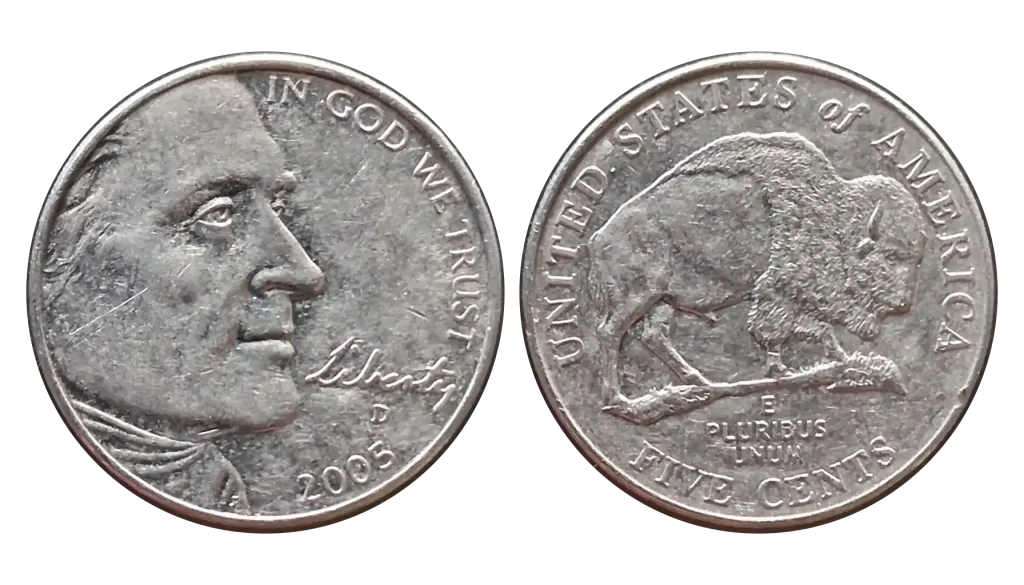
Somewhere in a jar of loose change sitting on your dresser, a five-cent coin might be worth more than you ever expected. That sounds hard to believe for a coin you could pull out of a vending machine, but certain 2005 buffalo nickels have sold for hundreds — and in one famous case, $2,650 — at auction. The gap between face value and collector value is enormous, and the difference comes down to a handful of factors that most people never think to check.
The coin in question is officially called the “American Bison” nickel. It was released by the U.S. Mint in early 2005 as part of the Westward Journey Nickel Series, a four-coin commemorative program honoring the 200th anniversary of the Lewis and Clark Expedition. With Thomas Jefferson’s portrait on the front and a bold American bison on the back, this nickel captured public attention the moment it hit circulation. Collectors immediately noticed the design’s resemblance to the beloved 1913–1938 Buffalo Nickel, and the coin earned the informal name that stuck — the 2005 buffalo nickel.
Before you start digging through your pocket change, it helps to understand what makes some of these coins ordinary and others genuinely valuable. This article breaks down everything you need to know: the coin’s history, its current market value across different grades and mint marks, the famous minting errors that drive prices into four figures, and how to tell whether the nickel in your hand is worth five cents or five hundred dollars. Whether you are a seasoned numismatist or someone who just found an interesting coin in a parking lot, this guide covers it all.
The Story Behind the Buffalo Design’s Return
The American bison had not appeared on a U.S. nickel since 1938. For sixty-seven years, the Jefferson nickel carried the same basic look — a left-facing profile of Thomas Jefferson on the obverse and his Monticello estate on the reverse. That changed in 2004 when Congress authorized the Westward Journey Nickel Series, a commemorative program tied to the bicentennial of the Louisiana Purchase and the Lewis and Clark Expedition of 1804–1806.
The Mint released four unique designs across two years. In 2004, collectors saw the Peace Medal reverse and the Keelboat reverse. In 2005, two more designs followed: the American Bison and the Ocean in View. The bison design launched first, appearing in circulation during early spring of 2005. It lasted only a few months before the Ocean in View design replaced it. By 2006, the Mint returned to the traditional Monticello reverse, and the buffalo was gone for good.
That brief production window is part of what makes the coin appealing to collectors. It exists as a standalone type coin — a one-time design that will never be repeated in the Jefferson nickel series.
The Obverse — A New Look at Jefferson: Joe Fitzgerald sculpted the obverse portrait, basing it on Houdon’s famous marble bust of Jefferson. For the first time in Jefferson nickel history, the president faces right instead of left, shown in a close-up that fills most of the coin’s surface. The word “Liberty” appears near Jefferson’s chin, written in cursive script traced directly from Jefferson’s own handwriting in his draft of the Declaration of Independence. The inscription “IN GOD WE TRUST,” the date 2005, and the mint mark complete the front design.
The Reverse — The Bison Returns: Jamie N. Franki designed the reverse, depicting a lone American bison standing on flat ground and facing right. The inscriptions “UNITED STATES OF AMERICA” and “E PLURIBUS UNUM” arc around the animal, with “FIVE CENTS” along the bottom rim. While the design clearly pays homage to James Earle Fraser’s original 1913 Buffalo Nickel, it is not a direct copy. Franki’s bison has a different stance, and the overall composition reflects a modern artistic sensibility.
The coin itself is struck on the same planchet used for all Jefferson nickels since 1946: 75% copper and 25% nickel, weighing 5 grams, with a diameter of 21.2 millimeters and a plain edge.
How Much Is a 2005 Buffalo Nickel Worth?
This is the question most people ask when they find one of these coins, and the honest answer depends entirely on condition, mint mark, and whether any minting errors are present. Let us walk through each category.
Circulated Coins — The Majority: Close to 936 million 2005 buffalo nickel coins were struck across three mints. That is a massive number, and it means the overwhelming majority of circulated examples are worth exactly five cents. A lightly worn coin with decent eye appeal might bring ten to fifty cents from a dealer who buys in bulk, but that is the ceiling for a typical circulated piece. If your coin shows heavy wear, scratches, nicks, or discoloration, it carries no collector premium whatsoever. The sheer volume of coins produced ensures that common examples will remain affordable for the foreseeable future.
Uncirculated and Mint State Coins: This is where the math starts to change. Coins graded MS60 through MS62 on the Sheldon scale trade for roughly twenty-five cents to a dollar. Move into the MS63–MS64 range and you are looking at one to five dollars. The real separation happens at MS65 and above. A Philadelphia-minted coin in MS66 can sell for thirty to fifty dollars, while MS67 examples have reached over a hundred dollars at auction. The record for a standard, non-error Denver coin in MS67 stands at an impressive $6,250. These prices reflect condition rarity — despite nearly a billion coins being struck, very few survived the minting and distribution process without acquiring bag marks, nicks, or handling damage. Finding a truly pristine example is harder than the mintage numbers suggest.
Proof and Satin Finish Coins: San Francisco struck 3,344,679 proof versions for collector sets, each bearing an “S” mint mark. Standard proofs in PR67–PR68 sell for a dollar or two. Perfect PR70 coins with deep cameo contrast command a bigger premium, though most proofs remain affordable. Satin Finish versions were included in special mint sets from both Philadelphia and Denver. They display a distinctive soft, matte-like luster that differs from business strikes. SP69 satin coins are relatively common and inexpensive; SP70 examples are genuinely rare and carry significantly higher price tags.
Mint Marks and How They Affect the 2005 Buffalo Nickel Value
Three facilities produced this coin, and the mint mark on your nickel plays a meaningful role in determining its worth.
Philadelphia (P) — 448,320,000 Struck: Look for a small “P” on the obverse near Jefferson’s shoulder. Philadelphia coins are known among collectors for inconsistent quality. Weak strikes, surface scratches, and general roughness were common problems during production. This means that while the mintage is enormous, genuinely clean high-grade examples are scarcer than you might expect. A Philadelphia coin in MS66 or above carries a real premium precisely because so few made it through the minting process in top condition.
Denver (D) — 487,680,000 Struck: Denver produced the highest volume of any mint that year, and its coins carry a “D” mint mark in the same location. Most circulated D-mint pieces are worth a dime at best. However, Denver is also the birthplace of the most famous modern nickel error in existence — the Speared Bison. That single variety has made the Denver mint mark the one collectors examine most closely when sorting through rolls.
San Francisco (S) — 3,344,679 Struck (Proofs Only): Every San Francisco coin was produced as a proof for collector sets. None entered general circulation. These coins feature mirror-like fields and frosted raised devices. Graded examples in PR69 and PR70 sell for five to thirty dollars depending on the level of cameo contrast. While they are beautiful coins, the relatively large proof mintage keeps prices moderate.
Rare Errors That Turn a Five-Cent Coin Into a Collector Prize
Minting errors are where the real money hides in the 2005 buffalo nickel series. The U.S. Mint produced these coins at extraordinary speed to meet demand, and that pace led to several documented mistakes that collectors now chase aggressively.
The Speared Bison — The Most Famous Modern Nickel Error: This is the one everybody in the hobby knows about. On a single die at the Denver Mint, a deep gouge developed during production. That gouge created a raised line on the finished coins that looks exactly like a spear piercing through the bison’s back and exiting through its midsection. It only appears on 2005-D coins, and the severity varies from piece to piece depending on when during the die’s life the coin was struck. Speared Bison nickels were discovered shortly after the coins entered circulation, mostly found in rolls purchased directly from the Denver Mint. A relatively small number exist compared to the total mintage. In circulated condition, a Speared Bison can sell for thirty to three hundred dollars depending on how well-preserved it is. Move into mint state territory and prices jump sharply. MS65 examples sell for five hundred to seven hundred dollars. The auction record, set in 2021, stands at $2,650 for a 2005-D MS66 Speared Bison graded by NGC. When identifying this error, look for a clear, raised diagonal line running through the bison’s body. It should be consistent, sharp, and feel raised to the touch — not a random post-mint scratch.
The 2005 P Buffalo Nickel Error — Feeder Finger Marks: Philadelphia produced its own headline-grabbing error variety. During the striking process, mechanical “fingers” feed blank planchets into position on the press. Normally, these fingers retract before the die strikes. When they malfunction and get caught between the die and the planchet, they leave distinct parallel horizontal lines impressed into the coin’s surface. On affected 2005-P nickels, you can see these lines running across the bison’s body or through the word “LIBERTY.” The visual effect is striking and unmistakable. In 2022, a collector on eBay paid $1,010 for a 2005-P MS65 nickel with a prominent feeder finger error. Clean, high-grade examples with deep, clearly visible marks consistently sell for over a thousand dollars. Subtler examples — where the lines are faint or partially visible — still bring a hundred to three hundred dollars.
The Detached Leg Error: On some coins, the bison’s rear leg appears disconnected from its body. A visible gap of flat, unstruck space separates the leg from the torso. This happens when grease or debris on the die blocks part of the design from striking properly. Collectors sometimes confuse this with the legendary 1937-D 3-Legged Buffalo, but the two are entirely different errors on different coins separated by nearly seventy years. Detached leg nickels sell for thirty to sixty dollars in circulated grades. In MS64 and higher, prices can reach a hundred to four hundred dollars depending on how dramatic the separation looks.
Doubled Die Varieties: When a die strikes the planchet at slightly different angles on successive impressions, the result is overlapping or shadowed letters and design elements. The more intense the doubling, the more valuable the coin. A 2005-D MS66 doubled die nickel sold for $995 at Heritage Auctions in 2023, confirming that well-preserved doubled die examples carry serious premiums.
Die Adjustment Errors (Weak Strikes): Mint workers regularly adjust dies to maintain proper striking pressure. When an adjustment goes wrong, the die does not press hard enough, and the resulting coin shows a faded or incomplete design. One side may appear sharp while the other looks ghostly. A 2005-D MS65 die adjustment error coin sold for $845 in 2023.
Other Documented Errors: The 2005 series also includes struck-through errors (where foreign objects like cloth, hair, or metal fragments get caught between the die and planchet), clipped planchets (a crescent-shaped chunk missing from the edge), and improperly annealed planchets (darkened, discolored surfaces caused by incorrect heat treatment during blank preparation). Each of these carries a collector premium that varies based on visual impact and grade.
Buffalo Nickel 2005 Upside Down — Separating Fact From Fiction
A surprisingly common question among coin finders is whether their 2005 buffalo nickel has the buffalo stamped “upside down.” This claim circulates widely on forums and social media, and it deserves a careful explanation.
All United States coins are struck in what numismatists call “coin turn” orientation. This means the obverse and reverse are rotated 180 degrees from each other. If you hold a coin with Jefferson’s head upright and flip it top-to-bottom (not left-to-right), the bison on the reverse should also appear upright. Many people who believe they have found an upside-down coin are simply flipping it the wrong way. Rotating the coin left-to-right naturally makes the reverse appear inverted, but that is normal for every U.S. coin ever made.
That said, genuine rotated die errors do exist. These occur when one of the two dies shifts out of proper alignment during production, causing the obverse and reverse to be offset by a measurable number of degrees. A slight rotation of five to ten degrees is relatively common and adds minimal value. A major rotation of ninety degrees or more is genuinely scarce and can be worth a hundred to several hundred dollars depending on the severity, the coin’s grade, and collector demand at the time of sale.
If you believe you have a rotated die error, compare your coin side by side with several other nickels from the same year. If the alignment is clearly different, you may have something worth pursuing. However, authentication through a professional grading service like PCGS or NGC is essential before drawing any conclusions or listing the coin for sale.
Grading, Authentication, and Protecting Your Coin’s Value
Understanding how coins are graded is critical for anyone trying to determine what their nickel might be worth. The industry standard is the Sheldon scale, which runs from 1 (a coin that is barely identifiable) to 70 (a coin with absolutely no imperfections under magnification).
Professional grading services evaluate three primary factors: strike quality (how sharply the design was impressed), remaining luster (the original mint shine on the surface), and surface preservation (the absence of bag marks, scratches, fingerprints, and other damage). On a 2005 buffalo nickel specifically, graders pay close attention to the sharpness of Jefferson’s portrait details on the obverse and the definition of the bison’s fur, legs, and surrounding lettering on the reverse.
For any coin you believe may be worth fifty dollars or more, professional grading is a smart investment. Submitting to PCGS or NGC costs a modest fee, but the certified grade and tamper-evident holder you receive in return add significant buyer confidence and typically increase the selling price well beyond the cost of grading. Third-party authentication also protects against counterfeits — an important consideration given that popular errors like the Speared Bison have attracted forgers who create post-mint scratches to mimic die gouges.
A few basic handling and storage practices will protect your coin’s condition over time. Always hold coins by the edges, never touching the flat surfaces. Store pieces in acid-free holders, flips, or capsules. Keep them in a cool, dry location away from direct sunlight and humidity. And perhaps the most important rule of all: never clean your coins. Cleaning strips away original luster, leaves visible hairline scratches, and can cut a coin’s market value by half or more. Dealers and grading services can spot a cleaned coin instantly.
Smart Tips for Buying and Selling
Whether you are looking to add a 2005 buffalo nickel to your collection or sell one you have found, a few practical strategies will help you get the best outcome.
For buyers, always compare prices across multiple platforms before committing. Auction houses like Heritage Auctions and GreatCollections provide transparent price histories that show what similar coins have actually sold for — not just what sellers are asking. Online marketplaces can offer good deals, but the risk of misrepresented or counterfeit coins is higher. Insist on professionally graded and encapsulated coins for any purchase above fifty dollars.
For sellers, presentation matters. Take clear, well-lit photographs of both sides of your coin against a neutral background. Describe any errors, special finishes, or notable features honestly and specifically. Reference recent auction results for comparable coins to justify your asking price. If your coin is in strong condition or carries a notable error, the modest cost of professional grading before selling will almost certainly pay for itself through a higher sale price.
One affordable and rewarding collecting strategy is building a complete Westward Journey Nickel Series set. The four designs — Peace Medal, Keelboat, American Bison, and Ocean in View — tell the story of the Lewis and Clark Expedition through coinage. A full set in uncirculated condition can be assembled for well under fifty dollars and makes an excellent entry point for new collectors.
Frequently Asked Questions
FAQ 1: How much is a 2005 buffalo nickel worth?
Most circulated 2005 buffalo nickels are worth face value, which is five cents. Uncirculated examples in MS65 or higher grades can sell for thirty to over a hundred dollars. Error coins like the Speared Bison have reached as high as $2,650 at auction depending on condition and grade.
FAQ 2: Is a 2005 buffalo nickel made of silver?
No, the 2005 buffalo nickel is not made of silver. It is composed of 75% copper and 25% nickel, the same alloy used for all Jefferson nickels since 1946. Its value comes from condition, mint mark, and errors — not from precious metal content.
FAQ 3: What is the Speared Bison error on a 2005 nickel?
The Speared Bison is a die gouge error found only on 2005-D nickels where a raised diagonal line runs through the bison’s body, resembling a spear. It was caused by damage to a single die at the Denver Mint and is the most famous modern nickel error in existence. Well-graded examples have sold for $500 to $2,650 at auction.
FAQ 4: How do I tell if my 2005 buffalo nickel has the Speared Bison error?
Look at the reverse side under good lighting for a raised line running from the bison’s upper back down through its midsection. The line must be raised, not incised — a sunken scratch is post-mint damage, not a die error. Only coins with a “D” mint mark can carry this variety, and professional grading is recommended for confirmation.
FAQ 5: Where is the mint mark on a 2005 buffalo nickel?
The mint mark is located on the obverse (front) side of the coin, near the lower right area close to Jefferson’s shoulder and just below the date. A “P” indicates Philadelphia, a “D” indicates Denver, and an “S” indicates a San Francisco proof coin.
FAQ 6: Is a 2005 buffalo nickel with the reverse upside down worth anything?
It depends on the degree of rotation. All U.S. coins use “coin turn” orientation, meaning the reverse appears upright only when you flip the coin top-to-bottom. If the alignment is genuinely off by 90 degrees or more, it could be a rotated die error worth $100 to several hundred dollars. Minor rotations of a few degrees add very little value.
FAQ 7: How many 2005 buffalo nickels were made?
Approximately 939 million were produced across all three mints. Philadelphia struck about 448.3 million, Denver produced roughly 487.7 million, and San Francisco minted about 3.3 million proof-only coins. The massive total mintage is why most circulated examples are worth only face value.
FAQ 8: What is the most valuable 2005 buffalo nickel ever sold?
The highest recorded auction price for any standard 2005 buffalo nickel is $6,250, paid for a Denver-minted coin in SP70 Special Strike grade. Among error coins, the record belongs to a 2005-D MS66 Speared Bison nickel that sold for $2,650 at auction in 2021.
FAQ 9: Is the 2005 buffalo nickel the same as the original Buffalo Nickel from 1913?
No, they are different coins from different eras. The original Buffalo Nickel, designed by James Earle Fraser, was minted from 1913 to 1938 and features a Native American on the obverse. The 2005 version is a modern Jefferson nickel with a new bison reverse designed by Jamie N. Franki as part of the Westward Journey Nickel Series. They share the buffalo theme but have entirely different designs and compositions.
FAQ 10: What errors should I look for on a 2005 buffalo nickel?
The most valuable errors include the Speared Bison (Denver only), feeder finger marks (parallel lines, mostly Philadelphia), detached or missing leg, doubled die varieties, die adjustment weak strikes, clipped planchets, and improperly annealed planchets with unusual dark or copper-toned surfaces. Each error carries a different premium depending on visibility and grade.
FAQ 11: What is the 2005 P buffalo nickel feeder finger error?
This error occurs when the mechanical fingers that position blank coins into the press fail to retract in time and get struck by the die. The result is a set of parallel horizontal lines impressed into the coin’s surface, often visible across the bison or the word “LIBERTY.” A 2005-P nickel with a prominent feeder finger error sold for $1,010 on eBay in 2022.
FAQ 12: Should I clean my 2005 buffalo nickel before selling it?
Never clean a coin before selling. Cleaning removes the original mint luster, leaves visible hairline scratches, and can reduce a coin’s market value by 50% or more. Professional coin dealers and grading services can immediately identify a cleaned coin, and it will always sell for less than an uncleaned example in the same grade.
FAQ 13: What is a Satin Finish 2005 buffalo nickel?
Satin Finish versions were special strike coins included in the U.S. Mint’s annual uncirculated coin sets for 2005. They have a distinctive soft, matte-like surface that differs from the shiny luster of standard business strikes. Both Philadelphia and Denver produced satin finish versions. SP69 coins are relatively affordable, but perfect SP70 examples are quite rare and carry significant premiums.
FAQ 14: Is the cursive “Liberty” on the 2005 buffalo nickel an error?
No, the cursive script is an intentional part of the design. The word “Liberty” was traced from Thomas Jefferson’s own handwriting, specifically from his draft of the Declaration of Independence. Many new collectors mistake this stylistic choice for a minting error, but it is a deliberate design feature unique to the 2005 Westward Journey nickels.
FAQ 15: How do I get my 2005 buffalo nickel professionally graded?
You can submit your coin to either PCGS (Professional Coin Grading Service) or NGC (Numismatic Guaranty Company), the two most widely trusted grading services in the industry. Both accept submissions by mail and through authorized dealer networks. The coin is evaluated, assigned a grade on the 1–70 Sheldon scale, and sealed in a tamper-evident holder that protects it and certifies its authenticity.
FAQ 16: Why is my 2005 buffalo nickel a different color?
If your coin appears dark gray, copper-red, or almost black, it may have an improperly annealed planchet — a minting error caused by incorrect heat treatment of the blank before striking. This is a genuine and collectible error that can be worth $200 to $750 depending on condition and how dramatic the discoloration is. However, coins that turned colors from environmental exposure or chemical damage carry no premium.
FAQ 17: Are there counterfeit 2005 buffalo nickel errors?
Yes, counterfeits exist, particularly for the Speared Bison error. Some sellers add post-mint scratches or gouges to normal coins to mimic the famous die gouge. A genuine Speared Bison features a raised line that is part of the struck design, while a fake will show an incised or scratched line that is cut into the surface. Professional grading is the safest way to verify authenticity.
FAQ 18: Can I still find a 2005 buffalo nickel in pocket change?
It is possible but increasingly uncommon. These coins were released into general circulation in 2005, and some remain in active use. Your best chances are searching through coin rolls purchased from banks, checking accumulated jars of loose change, or visiting estate sales where older coin collections may include unsorted nickels from that era.
FAQ 19: What is the detached leg error on a 2005 buffalo nickel?
This error makes the bison’s rear leg appear disconnected from its body, with a visible gap of flat space between the leg and the torso. It is caused by grease or debris on the die that prevented part of the design from striking properly. In circulated condition, detached leg nickels sell for $30 to $60, while higher-grade examples can bring $100 to $400.
FAQ 20: What is the difference between a 2005-D and 2005-P buffalo nickel?
The “D” indicates the coin was struck at the Denver Mint, while “P” means it came from the Philadelphia Mint. Denver produced more coins (487.7 million vs. 448.3 million) and is the sole source of the Speared Bison error. Philadelphia is known for feeder finger errors and die crack varieties. In standard circulated condition, neither carries a meaningful premium over the other.
FAQ 21: Is a 2005 buffalo nickel a good investment?
For standard circulated coins, no — they are worth face value and will not appreciate. However, high-grade uncirculated examples (MS66 and above) and documented error varieties like the Speared Bison are considered solid collectible investments with strong liquidity. The key is buying certified coins in the best condition your budget allows and storing them properly.
FAQ 22: What was the Westward Journey Nickel Series?
The Westward Journey Nickel Series was a commemorative coin program authorized by Congress to mark the 200th anniversary of the Lewis and Clark Expedition and the Louisiana Purchase. It produced four unique Jefferson nickel designs across 2004 and 2005: the Peace Medal, the Keelboat, the American Bison (the 2005 buffalo nickel), and the Ocean in View. By 2006, the Mint returned to the traditional Monticello reverse design.
Final Thoughts
The 2005 buffalo nickel sits in an unusual spot in American numismatics. It is one of the most common modern coins by mintage, yet it harbors some of the most valuable error varieties produced in the last two decades. A standard circulated example will never be worth more than five cents. But a Speared Bison in mint state can fetch thousands, a feeder finger error from Philadelphia can top a thousand dollars, and even lesser-known varieties like the detached leg and doubled die command real premiums from knowledgeable collectors.
What makes the 2005 buffalo nickel particularly interesting for everyday people is accessibility. You do not need a rare coin dealer or an expensive hobby budget to start looking. These nickels passed through cash registers, tip jars, and parking meters for years after their release. Some are still out there, sitting unnoticed in rolls and change jars, waiting for someone observant enough to flip the coin over and take a closer look. A basic magnifying glass and a few minutes of patience are the only tools required. The odds are long, but the payoff for finding the right coin is remarkably high for something that started life as pocket change.