
Somewhere between your first heartbreak and your most recent one, you’ve probably lain awake asking the same question the rest of us ask. Why did that relationship happen at all?
There’s a popular idea that offers an answer. It suggests most of us experience 3 loves in life: an idealistic first love, a difficult second love, and a lasting third love that arrives when we least expect it. Each one shows up at a different stage. Each one teaches something the others couldn’t.
I first heard about the 3 loves in life theory after a breakup that made no sense to me. Reading about it felt like someone had handed me a map of my own history. The relationships that ended suddenly looked less like failures and more like chapters.
In this article, we’ll walk through what each love looks like, where the idea comes from, what psychology actually says about it, and how to work out which chapter you might be living right now.
What Are the 3 Loves in Life? Understanding the Theory
The 3 loves in life theory says that most people fall deeply in love three times, and that each love serves a different purpose. The first love teaches us what love is. The second love teaches us who we are. The third love shows us what love was supposed to feel like all along.
It’s a simple framework. That’s exactly why it has spread so far. Heartbreak feels chaotic while you’re inside it, and this idea gives the chaos a shape.
Where the Theory Comes From
The roots trace back to the work of Helen Fisher, a biological anthropologist who spent decades studying romantic love. Fisher’s research identified three core systems that drive human relationships: lust, attraction, and attachment. Each system runs on different brain chemistry, and each pulls us toward a different kind of bond.
The popular version of the theory grew out of that foundation. Writers and creators reshaped Fisher’s science into a life story: three distinct loves, arriving in three distinct seasons. A wave of viral essays in the mid-2010s carried the idea into the mainstream, and social media storytimes have kept it there ever since.
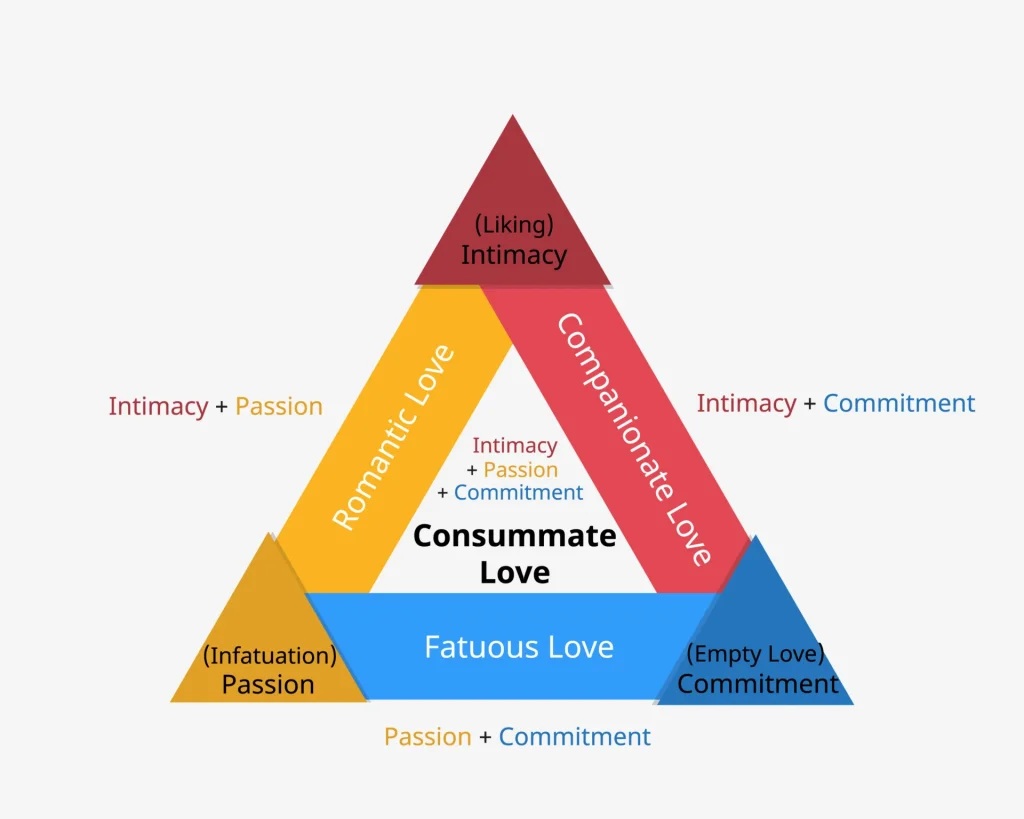
The framework also overlaps with the triangular theory of love proposed by psychologist Robert Sternberg. He argued that love is built from three components: passion, intimacy, and commitment. Look closely at the three loves and you’ll notice each one tends to be dominated by a single corner of that triangle.
What Psychology Actually Says
Here’s the honest part. The three loves framework is not a validated clinical model. No study has confirmed that humans fall in love exactly three times, in a fixed order, with predictable lessons attached.
Psychologists who have commented on the trend tend to describe it the same way. It’s an anecdotal structure that loosely reflects real principles from developmental psychology and attachment theory. In other words, it captures patterns many people genuinely live through, without being a scientific law.
That distinction matters. Treat the idea as a mirror, not a prophecy. It’s a useful way to reflect on where you’ve been. It’s a poor way to predict where you’re going.
So why does it resonate so widely? Psychologists who study narrative identity have shown that people make sense of their lives by turning them into stories, complete with chapters, turning points, and lessons. The three loves framework hands us a ready-made plot for the most emotionally confusing parts of our history. That’s a powerful thing, even when the science behind it is soft.
The First Love: The Idealistic One
Most people meet their first love young. High school hallways, first jobs, university dorms. It arrives while we’re still forming, which is exactly why it hits so hard. Within the 3 loves in life framework, this is the love that teaches us love exists at all.
What It Feels Like
The first love feels like a fairy tale because we want it to be one. We’ve spent years absorbing songs, films, and stories about what love should look like, and this relationship becomes the stage where we finally act it out.
There’s a performance quality to it. We care how the relationship looks to friends, to family, to the version of ourselves we’re trying to become. Every milestone feels enormous. First date. First “I love you.” First slow dance to a song that will ambush you in supermarkets for the rest of your life.
And we’re certain it will last forever. That certainty isn’t foolishness. It’s inexperience. We have no earlier heartbreak to measure against, so the intensity reads as permanence.
What It Teaches You
When it ends, and it usually does, the first love leaves behind lessons that outlast the pain.
It proves you’re capable of loving someone. That sounds small, but for many people it’s the foundation everything else gets built on.
It also delivers the first hard truth of adult relationships: intensity is not the same thing as compatibility. Two people can feel everything for each other and still want completely different lives.
Finally, it sets a baseline. Every relationship that follows gets measured against this one, consciously or not. Part of growing up is noticing when that baseline is helping you and when it’s quietly holding you back.
The Second Love: The Hard One
If the first love is the fairy tale, the second is the storm. This is the relationship people describe as the one that changed them, and rarely because it was gentle. Of the 3 loves in life, this one tends to leave the deepest marks.
Why This Love Hurts the Most
The second love is consuming. Dramatic highs. Crushing lows. Jealousy you didn’t know you were capable of. A constant push and pull that somehow feels like passion and punishment at the same time.
This is usually the relationship where our unresolved patterns surface. The attachment wounds we picked up early in life. The insecurities we’ve never said out loud. The fear of being left, or the fear of being trapped. The second love acts like a mirror, and we don’t always like what we see in it.
We often respond by trying to fix things through force. We try to change the other person into the partner we need. Or we contort ourselves into someone we think they’ll finally choose. Neither works, and the trying is exhausting.
One important note before going further. A hard love and a harmful one are not the same thing. Difficulty can mean growth. Control, cruelty, or fear never do. If a relationship leaves you feeling unsafe rather than just unsettled, that isn’t a chapter to push through. It’s a situation to get support for, from people you trust or a professional who can help.
The Lessons Hidden in the Pain
Ask people about the relationship that taught them the most, and a striking number will describe their second love.
This is where boundaries stop being an abstract idea and become survival skills. It’s where you learn the difference between what you need and what you’ve merely been willing to tolerate. It’s where self-worth gets tested, sometimes broken, and eventually rebuilt on firmer ground.
The second love also does something quieter. It burns away the fantasy. After it, you stop searching for a love that completes you and start searching for one that fits you. That shift is the bridge to everything that comes next.
One more lesson deserves mention. The second love is often what finally pushes people toward real healing, whether that means therapy, honest conversations with family, or simply a long season of being single on purpose. The pain becomes a doorway. Walking through it is what separates repeating the pattern from retiring it.
The Third Love: The One That Feels Like Home
The third love has a reputation for bad timing, in the best possible way. It tends to show up once you’ve stopped auditioning for it. In the story of the 3 loves in life, this is the ending that doesn’t feel like an ending at all.
Why It Arrives When You Least Expect It
There’s a practical reason this love feels unexpected. By the time it arrives, you’ve usually done the work the first two demanded.
You know your patterns, because the second love dragged them into the light. You know intensity isn’t everything, because the first love proved it. So you’re no longer choosing a partner to fill a hole. You’re choosing from something closer to wholeness, and that changes who you’re drawn to.
It also tends to defy the checklist. This person often looks nothing like what your younger self ordered. Different type, different timing, different everything. And somehow it works, with an ease that almost feels suspicious after everything that came before.
How It Differs From the First Two
The clearest difference is the absence of performance. You’re not acting out a story for an audience, and you’re not fighting to be chosen. You’re simply known, flaws included, and loved anyway.
Calm replaces chaos. That can be disorienting at first. People who grew up equating love with drama sometimes mistake peace for boredom. Give it time. Peace is what love feels like when nothing is wrong.
A word of balance here, because “easy” gets misunderstood. Easy doesn’t mean effortless. The lasting love still requires communication, repair after arguments, and daily choosing. The difference is that the effort builds something instead of just patching leaks. You’re working on the relationship, not fighting for basic safety inside it.
In Sternberg’s terms, this is the love where passion, intimacy, and commitment finally show up together instead of taking turns. The triangle is complete, and the relationship holds its shape even under pressure.
One nuance worth holding onto: “third” describes maturity, not arithmetic. For some people this love is their fifth relationship. For others, remarkably, it’s their first. The number matters far less than the growth behind it.
How to Recognize the 3 Loves of Your Life
Reading about the theory is one thing. Seeing your own story inside it is another. If you want to identify the 3 loves of your life, or figure out which one you might be living now, sit with a few honest questions.
A few prompts worth journaling on:
- Which relationship taught you the most about yourself, and what exactly did it teach?
- Where have you shrunk, performed, or edited yourself in order to be loved?
- What did “love” mean to you at eighteen, and what does it mean now?
- In your current or most recent relationship, do you feel at peace or on trial?
Your answers will tell you more than any label ever could.
If you’d like a faster gut-check, here are the telltale signs of each stage:
- The idealistic love feels like proving something. You’re focused on how the relationship looks and on reaching milestones, and the thought of it ending feels impossible rather than survivable.
- The hard love feels like a fight you can’t stop signing up for. The highs are euphoric, the lows are devastating, and you keep believing one more change will fix everything.
- The lasting love feels like exhaling. You’re not managing an image or bracing for impact. Disagreements still happen, but they get repaired instead of weaponized.
Two cautions as you reflect. First, don’t force your history into the mold. The framework should illuminate your story, not rewrite it. If your relationships don’t line up neatly, your relationships are not wrong. The theory is simply incomplete, because every theory about human beings is.
Second, use the lens forward, not just backward. The real value in mapping your past against the 3 loves in life framework is spotting your repeating patterns before you carry them into the next relationship. That’s where reflection turns into actual change.
The Three Loves Idea in Pop Culture
Once you know this framework, you start seeing it everywhere. That’s no accident. Storytellers love it for the same reason heartbroken people do: it gives messy romance a clean arc.
Television has leaned into it directly. HBO’s anthology series Love Life built each season around one person’s journey from their first love to their last, which is essentially the theory in episode form. The show was cancelled after two seasons, yet people still search for Love Life season 3 years later, and the series found a whole new audience when it landed on Netflix. The appetite for that story structure clearly hasn’t gone anywhere.
Interactive stories play with the same beats. It’s part of why players of romance games grow so attached to early relationship choices, and why searches for My Candy Love University Life episode 3 still circulate in fan communities. When you’re the one making the romantic decisions, every stage of love becomes personal.
Add in the breakup albums, the film trilogies, and the endless TikTok storytimes tagged with three-loves confessions, and the pattern is hard to miss. The 3 loves in life idea has quietly become modern folklore.
Does Everyone Experience 3 Loves in Life?
Short answer: no. The number three is symbolic, not a quota, and treating it as a rule misses the point entirely.
Plenty of people marry their first love and grow through every lesson inside that single relationship. The early idealism, the hard years, the settled peace. Some couples genuinely live all 3 loves in life with one person, and their story is no less complete for it.
Others count five or six formative loves before anything sticks. Some people’s most transformative loves were never romantic at all. A friendship that remade them. A child. A long, difficult reconciliation with themselves.
Culture shapes the map too. In communities where arranged marriage is common, love often grows after commitment rather than before it, which scrambles the theory’s tidy order. Aromantic people may not relate to the framework at all. Late bloomers might meet their first love at forty and their lasting one at forty-three.
None of these stories are exceptions to some rule, because the rule was never real. What is real are the stages of growth the theory describes: idealism, reckoning, and acceptance. Those show up in almost every life. How many people it takes to walk you through them is entirely your own.
FAQs About the 3 Loves in Life
1. What are the 3 loves in life? The 3 loves in life are the three romantic stages many people pass through: an idealistic first love, a difficult second love, and a lasting third love. Each one arrives at a different point of emotional maturity and teaches a lesson the previous one couldn’t.
2. What is the three loves theory in psychology? It’s a popular framework loosely built on anthropologist Helen Fisher’s research into lust, attraction, and attachment, along with Robert Sternberg’s triangular theory of love. Psychologists treat it as a reflective model of relationship patterns rather than a proven scientific law.
3. Who came up with the three loves theory? The scientific roots come from Helen Fisher’s decades of research on romantic love. The popular “we only fall in love with three people” version was largely spread by writer Kate Rose, whose viral essay carried the idea across social media.
4. Is it true that you only fall in love three times? Not literally. There’s no fixed number of times a person can fall in love. The “three” represents stages of emotional growth, which some people experience with three partners, others with more, and some within a single lifelong relationship.
5. Is the 3 loves in life theory scientifically proven? No. No study confirms that people fall in love exactly three times in a set order. Experts describe it as an anecdotal framework that echoes attachment theory and developmental psychology, making it useful for reflection but not for prediction.
Understanding Each Stage
6. What is the first love in the three loves theory? The first love is the idealistic love, usually experienced young. It mirrors the fairy-tale version of romance we absorb from stories, and it often prioritizes how the relationship looks over how it truly feels. Its core lesson is that intensity isn’t the same as compatibility.
7. What is the second love called? The second love is known as the hard love, and sometimes the karmic love. It’s the intense, turbulent relationship where old wounds and insecurities rise to the surface. Its purpose, according to the theory, is to teach you who you are and what you genuinely need.
8. What is the third love in the three loves theory? The third love is the unexpected, lasting love, often nicknamed the soulmate love. It arrives without warning, usually after real personal growth, and it feels calm rather than chaotic. This is the love built on acceptance, mutual respect, and feeling completely at home.
9. What does each of the three loves teach you? In the popular framing, the first love teaches you about your expectations, the second teaches you about yourself, and the third teaches you what love is actually supposed to feel like. Together they trace a path from idealism to self-knowledge to acceptance.
10. Why is the second love the hardest? Because it entangles love with identity. The second love drags out insecurities, attachment wounds, and repeating patterns, then wraps them in extreme highs and lows. Losing it can feel like losing part of yourself, which is why most people call it the hardest to recover from.
Order, Timing, and Age
11. At what age do you experience the three loves? There’s no fixed timetable. The first love commonly happens in the teens or early twenties, the hard love in the twenties or thirties, and the lasting love whenever enough growth has occurred. Plenty of people meet these stages far earlier or later, and that’s normal.
12. In what order do the 3 loves in life happen? The classic order is idealistic love, then hard love, then lasting love. Real life is messier. People can repeat the second stage several times, skip a stage entirely, or move through all three phases inside one long relationship.
13. Can you skip the second love? Yes, some people do. The hard lessons about boundaries and self-worth can also come through friendships, family, therapy, or difficult seasons within one committed relationship. The stage is about growth through struggle, not about a mandatory painful partner.
Soulmates and Deeper Questions
14. Is your third love your soulmate? Not automatically. The third love is often called the soulmate love because of its depth and ease, but relationship experts note that a soulmate is defined by the quality of the connection, not by where the person falls in your romantic sequence.
15. What is the difference between karmic love and soulmate love? Karmic love describes the intense, lesson-heavy second relationship that forces growth through friction. Soulmate love describes the calm, accepting bond of the third stage. One teaches through pain, the other through peace, and both shape who you become.
16. Which of the three loves is the strongest? It depends on how you define strength. The second love is usually the most intense, but intensity fades. The third love is widely considered the strongest overall because it balances passion, intimacy, and commitment, which is what allows it to last.
17. Can your second love become your last love? Yes. If both partners recognize their patterns and genuinely grow, a hard love can mature into a lasting one. The stages describe emotional development, and two people are fully capable of developing together instead of apart.
Edge Cases and Personal Reflection
18. Can one person be all 3 loves in life? Yes. Many long-term couples move through idealism, hard years, and settled acceptance with the same partner. In those cases, one relationship holds every stage the theory describes, which is why the number three is symbolic rather than literal.
19. What if you’ve fallen in love more than three times? That’s completely normal, and it doesn’t break the theory. Many people cycle through the second stage several times before its lesson lands. The framework counts phases of growth, not partners, so a longer romantic history simply means more chapters.
20. Can your first love be your true love? Yes. Some couples meet young and do all their growing side by side, experiencing the fairy tale, the struggles, and the deep acceptance within one bond. The theory allows for this, since it describes common patterns rather than requirements.
21. Do the three loves have to be romantic? No. The lessons of idealism, struggle, and acceptance can also come through deep friendships, family bonds, or the relationship you build with yourself. Romance is the most common lens for the theory, but it isn’t the only one.
22. How do you know which of the three loves you’re in? Check how the relationship feels day to day. If you’re performing for approval, it resembles the first love. If you’re stuck in exhausting highs and lows, it mirrors the second. If you feel known, safe, and at peace, that points to the third.
Final Thoughts
Every framework about love eventually runs into the same wall: people are not formulas. Still, there’s a reason this one endures.
The 3 loves in life idea takes our most confusing endings and turns them into education. The fairy tale that collapsed taught you that love is real. The storm that nearly broke you taught you who you are. And whatever comes after, or already came, gets to feel like home instead of homework.
So wherever you are right now, whether it’s the first, the second, the third, or somewhere gloriously unnumbered, you’re not behind schedule. You’re mid-story.
Which of the three loves shaped you the most? If this framework put words to something you’ve lived, share your chapter in the comments. Someone reading it is probably standing exactly where you once stood.