
You have probably never heard its formal name, but you have almost certainly experienced what it does. That banana-like sweetness in your favorite candy, the fruity note drifting from a glass of aged whiskey, the subtle solvent behind a pharmaceutical tablet — all of these trace back to a single five-carbon alcohol that quietly powers dozens of industries around the world. That compound is 3-methyl-1-butanol, also known as isoamyl alcohol or isopentanol, and it carries the CAS registry number 123-51-3.
Classified as a branched-chain primary alcohol with the molecular formula C₅H₁₂O, this colorless liquid has been a workhorse in chemistry for well over a century. Yet it is far from a relic of the past. A growing body of research now positions it as a serious candidate in renewable biofuel development, and its global market — valued above 90 million dollars in 2022 — is projected to climb past 290 million dollars by the end of this decade. Whether you are a student trying to read an infrared spectrum, an engineer evaluating solvent options, or a researcher exploring green fuel alternatives, this guide will walk you through everything you need to know about this remarkably versatile compound.
What Is 3-Methyl-1-Butanol and Why Does It Matter?
At its core, this compound is a pentanol isomer — one of several alcohols sharing the same molecular formula but differing in structure. Its IUPAC name describes exactly where its branches sit: a methyl group hangs off the third carbon of a four-carbon backbone tipped with a hydroxyl group (-OH). The structural formula reads (CH₃)₂CHCH₂CH₂OH, and that simple branching gives the molecule a set of physical behaviors that set it apart from its straight-chain cousins.
The compound goes by many names in everyday lab and industrial shorthand, including isoamyl alcohol, isopentanol, isobutyl carbinol, and fermentation amyl alcohol. This last name hints at where most people first encounter it — as the dominant ingredient in fusel oil, the oily layer that separates during alcoholic fermentation of grains and potatoes. In fact, fusel oil typically contains about 85 percent of this alcohol by weight.
Nature produces it in other places, too. It shows up in ester form across a surprising range of biological sources: strawberries, peppermint oil, lemongrass, eucalyptus, hops, and rum. It has also been identified as a microbial volatile organic compound, or MVOC, which researchers have detected in moisture-damaged buildings and composting facilities. Its presence in indoor air, even at low levels, can serve as an indicator of hidden mold growth — a detail that makes it relevant well beyond the chemistry lab.
Physical and Chemical Properties Worth Knowing
Understanding what a chemical can and cannot do starts with its physical constants. Here is a snapshot of the numbers that define how this alcohol behaves under typical conditions.
Boiling point: 130 °C. This places it well above ethanol (78 °C) and gives it a lower evaporation rate, which is useful when you need a solvent that does not vanish too quickly from a surface or a reaction mixture.
Melting point: −117 °C. The compound remains liquid across a very wide temperature range, making it practical for cold-climate applications and low-temperature chemical processes.
Density: 0.809 g/mL at 25 °C. Because it is less dense than water, it floats on the surface when the two liquids are mixed — a property exploited during extraction procedures in analytical chemistry.
Flash point: 43 °C, placing it in the GHS Flammable Liquid Category 3 bracket. This means it does ignite under moderate heat and must be stored away from open flames, but it is not as volatile or dangerous as lighter solvents like diethyl ether or acetone.
Vapor pressure: 2 mmHg at 20 °C, with a vapor density of roughly 3 compared to air. The heavier-than-air vapors can collect in low-lying areas of poorly ventilated spaces, which is an important safety detail for warehouse and production floor design.
Water solubility: About 25 grams per liter at 20 °C. It mixes freely with ethanol and diethyl ether but only partially dissolves in water, which is precisely why it works so well in liquid-liquid extraction setups.
From a reactivity standpoint, the compound is considered stable under normal storage conditions. However, it is incompatible with strong oxidizers, acid chlorides, and acid anhydrides. One lesser-known hazard is that it can slowly accumulate organic peroxides when left exposed to air and light for extended periods. Those peroxides can become dangerous if the liquid is distilled or concentrated without proper testing, so containers should be kept tightly sealed and regularly inspected.
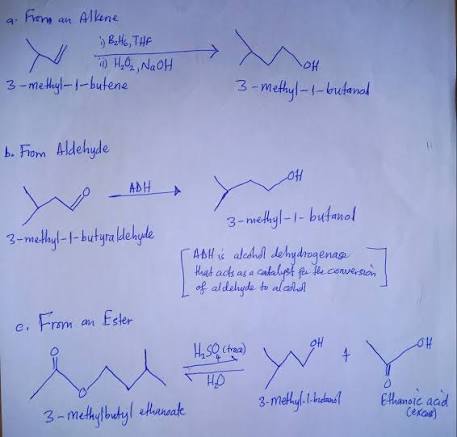
On the synthetic side, the hydroxyl group opens up straightforward esterification reactions. Combine it with acetic acid and you get isoamyl acetate — the ester responsible for artificial banana flavoring. React it with sodium nitrite and you produce isoamyl nitrite, one of the fastest-acting vasodilators in the nitrous ester family.
Reading the 3-Methyl-1-Butanol IR Spectrum
Infrared spectroscopy remains one of the most accessible tools for confirming the identity of an organic compound, and students in organic chemistry courses encounter this particular spectrum frequently. Knowing which peaks to look for can save hours of guesswork in both academic and quality-control settings.
The O–H stretch (3200–3600 cm⁻¹): This is usually the first feature that catches your eye. A broad, strong absorption band centered near 3325 cm⁻¹ signals the hydroxyl group. The broadness comes from hydrogen bonding between neighboring alcohol molecules, and it is a reliable indicator that you are looking at an alcohol rather than an ether, aldehyde, or ketone.
The C–H stretches (2960–2873 cm⁻¹): Several sharp peaks in this region correspond to the symmetric and asymmetric stretching of the methyl (CH₃) and methylene (CH₂) groups along the branched carbon chain. Because the molecule has two methyl groups and two methylene units, this region tends to be strong and well-defined.
The C–O stretch (1050–1150 cm⁻¹): A medium-to-strong band in this lower region confirms the carbon-oxygen bond of the primary alcohol functional group. Its position helps distinguish primary alcohols from secondary and tertiary ones, which absorb at slightly different wavenumbers.
The fingerprint region (below 1500 cm⁻¹): This is where the spectrum becomes unique to the molecule itself, much like a human fingerprint. The pattern of smaller peaks here can be matched against reference spectra — such as the one archived in the NIST WebBook — to verify compound identity with high confidence.
One important negative observation is also worth noting. The absence of a sharp, strong peak near 1700 cm⁻¹ rules out any carbonyl contamination. If you see a peak there, you are likely dealing with an aldehyde or ketone impurity rather than a pure sample of the alcohol.
Industrial and Commercial Applications
Few organic chemicals touch as many industries as this one. Its versatility stems from a combination of moderate polarity, good solvency, a manageable boiling point, and a structure that lends itself to easy chemical derivatization.
Flavor and fragrance work represents one of its oldest and most widespread uses. As a starting material for isoamyl acetate — commonly called banana oil — it anchors the production of one of the world’s most popular fruit-flavor esters. Food-grade regulations in multiple countries, including China’s GB 2760 standard, specifically list it as an approved flavoring agent for apple and banana notes. The compound also occurs naturally as esters in strawberries, peppermint, and citrus oils, so using it to recreate those profiles in processed foods is really just mimicking what nature already does.
Pharmaceutical and biomedical applications give it a second life entirely. Isoamyl nitrite, synthesized directly from this alcohol, acts as a rapid vasodilator used in emergency cardiac care. The compound also serves as a building block for sedatives and hypnotics, including the barbiturate derivative amytal. More recent research has revealed that it demonstrates antifungal activity against Candida albicans by inhibiting hyphal growth and reducing biofilm formation — a finding with potential implications for hospital-acquired infection control. In molecular biology labs, it plays a quieter but equally essential role as an antifoaming agent in the chloroform-isoamyl alcohol mixture used for DNA and RNA extraction.
Solvent and chemical intermediate roles account for a large share of industrial consumption. It dissolves oils, fats, resins, waxes, and alkaloids with ease, making it a standard ingredient in paint strippers, coating formulations, and adhesive systems. Analytical chemists rely on it for fat determination in milk, for complexation extraction of iron, cobalt, and copper salts, and for separating lithium chloride from other alkali metal chlorides. On top of that, it feeds into the manufacture of plasticizers, photographic chemicals, corrosion inhibitors, and herbicide intermediates.
Biofuel research is arguably the most exciting frontier for this compound right now. Compared to ethanol — the current workhorse of renewable fuel — it offers higher energy density, lower water absorption, and better compatibility with existing gasoline infrastructure. A 2026 study published in Advanced Science reported that an engineered strain of Escherichia coli achieved a record titer of 6.24 grams per liter through a combination of enzyme engineering, pathway optimization, and adaptive laboratory evolution. Meanwhile, a comprehensive review published in Frontiers in Microbiology in early 2026 catalogued ongoing efforts to boost microbial production using both yeast and bacterial hosts, noting that the global push toward carbon neutrality is accelerating investment in these pathways. The challenges — low titers, product toxicity to host cells, and cofactor imbalance — remain real, but progress over the past two years has been substantial.
How 3-Methoxy-3-Methyl-1-Butanol Compares
Because their names are so similar, people frequently confuse 3-methyl-1-butanol with its methoxy derivative, 3-methoxy-3-methyl-1-butanol (CAS 56539-66-3). The two compounds are chemically related but serve quite different purposes, and understanding the distinction matters if you are sourcing materials for a specific application.
The methoxy variant — sold commercially under the trade name Solfit or the abbreviation MMB — carries both an ether group (–OCH₃) and a hydroxyl group, giving it dual hydrophilic and lipophilic character. This makes it an exceptional solvent with a balanced polarity profile that dissolves a wide array of organic and inorganic substances.
Where the parent alcohol leans toward food, pharmaceutical, and fermentation applications, the methoxy derivative finds its strongest footing in paints, inks, coatings, adhesive systems, and industrial cleaning products. It compares favorably with ethylene glycol monobutyl ether — a common industrial solvent — but with a notably lower toxicity profile, which is driving adoption in formulations where worker safety and environmental compliance are priorities. It also shows up in personal care products as a stabilizer and emulsifier, and in the fragrance industry as both a building block and a carrier solvent.
The takeaway is straightforward: if your application involves food contact, pharmaceutical synthesis, or biofuel research, you are working with 3-methyl-1-butanol. If your application centers on coatings, cleaning agents, or material science, the methoxy version is likely the better fit.
Safety, Handling, and Regulatory Profile
No discussion of a chemical’s usefulness is complete without a sober look at its hazards. This compound demands respect, particularly in enclosed or poorly ventilated environments.
Under the Globally Harmonized System of classification, it carries several hazard statements: H226 (flammable liquid and vapor), H315 (causes skin irritation), H318 (causes serious eye damage), H332 (harmful if inhaled), and H335 (may cause respiratory irritation). The OSHA permissible exposure limit is set at a time-weighted average of 100 parts per million, while NIOSH identifies 500 ppm as immediately dangerous to life or health. Human volunteer studies have documented mild throat irritation at concentrations as low as 100 ppm after just three to five minutes of exposure. Repeated or prolonged skin contact can cause dryness and cracking.
On the reassuring side, the compound is not listed as a carcinogen by ACGIH, IARC, the National Toxicology Program, or California Proposition 65. Its acute toxicity is moderate rather than severe, but prudent handling remains essential.
Storage should always be in a cool, dry, well-ventilated area, away from heat sources, sparks, and open flame. Containers must be kept tightly sealed — not just to prevent evaporation, but to guard against the slow formation of organic peroxides. Chemical splash goggles, nitrile or butyl rubber gloves, and adequate local exhaust ventilation are the minimum personal protection measures for routine handling.
Spill response calls for containing the liquid with non-combustible absorbent material such as sand or vermiculite, and preventing it from reaching drains or waterways. The compound is highly mobile in soil and can leach into groundwater, though it volatilizes into the atmosphere where it breaks down through reactions with photochemically generated hydroxyl radicals. It is not expected to bioconcentrate in aquatic organisms, and disposal is typically carried out via incineration in a facility equipped with an afterburner and scrubber.
Production Methods Old and New
The oldest and most straightforward route for obtaining this alcohol is the fractional distillation of fusel oil, the oily by-product that separates during the fermentation of starchy raw materials like potatoes, corn, or grains. Because fusel oil contains such a high percentage of the target compound — roughly 85 percent — the purification process is relatively simple, involving chemical treatment followed by careful distillation.
Synthetic chemistry offers a second pathway. Acid-catalyzed reactions and the hydroformylation of C₄ alkenes can both yield the compound at industrial scale, though these routes depend on petrochemical feedstocks and carry a higher carbon footprint.
The third and increasingly attractive option is biotechnological production. Researchers have engineered both Escherichia coli and Saccharomyces cerevisiae (brewer’s yeast) to overproduce the compound by hijacking the leucine amino acid biosynthesis pathway. In the engineered pathway, glucose is converted through a series of keto-acid intermediates and then reduced to the final alcohol. The most advanced bacterial strain reported to date — profiled in a 2026 paper in Advanced Science — achieved 6.24 grams per liter in a scaled-up bioreactor, the highest titer ever recorded for an engineered microbial system. While this is still well below the concentrations needed for cost-competitive fuel production, the pace of improvement has been rapid, and ongoing work on cofactor balancing, product efflux engineering, and adaptive evolution continues to push yields upward.
Environmental and Sustainability Outlook
The growing interest in bio-based production of this compound is not purely academic. Global sustainability targets are creating real market pull for renewable solvents and fuels, and 3-methyl-1-butanol fits neatly into that conversation.
Its higher energy density compared to ethanol means vehicles could travel farther per gallon of blended fuel. Its low hygroscopicity — meaning it absorbs very little water from the atmosphere — solves one of ethanol’s most persistent logistics headaches: pipeline corrosion and phase separation during transport. And because it can be blended with gasoline at virtually any ratio without engine modification, it sidesteps the “blend wall” problem that limits ethanol adoption beyond E15 in many markets.
On the solvent side, formulators seeking safer alternatives to traditional glycol ethers are turning to both this compound and its methoxy cousin for use in paints, coatings, and cleaning products. Regulatory agencies in Europe and North America have been tightening restrictions on volatile organic compound emissions, and products with lower vapor pressures and better environmental degradation profiles are gaining ground.
The compound’s natural origin — it is, after all, something that yeast has been producing for millennia — adds a certain narrative appeal to sustainability branding efforts. But the real test will be whether microbial production can reach costs competitive with petrochemical routes. If the titer and yield improvements of the past two years are any indication, that crossover point may arrive sooner than many in the industry expected.
Frequently Asked Questions
1. What is 3-methyl-1-butanol and what is it commonly called? 3-Methyl-1-butanol is a branched-chain primary alcohol with the molecular formula C₅H₁₂O and a CAS number of 123-51-3. It is most commonly known as isoamyl alcohol or isopentanol. Other names include isobutyl carbinol and fermentation amyl alcohol. It appears as a clear, colorless liquid with a pungent alcoholic odor and is widely used across food, pharmaceutical, solvent, and biofuel industries.
2. What does 3-methyl-1-butanol smell like? The compound has a characteristic pungent, slightly sweet alcoholic odor that many describe as harsh or choking at higher concentrations. Its air odor threshold is remarkably low at just 0.042 ppm, meaning even trace amounts can be detected by the human nose. In its ester forms, however, it contributes pleasant fruity aromas — its acetate ester is responsible for the well-known banana scent in candies and processed foods.
3. Is 3-methyl-1-butanol the same as isoamyl alcohol? Yes, the two names refer to the exact same compound. Isoamyl alcohol is the traditional trade name, while 3-methyl-1-butanol is the systematic name based on IUPAC nomenclature rules. The IUPAC-recommended name is 3-methylbutan-1-ol. All three names describe a five-carbon alcohol with a methyl branch on the third carbon and a hydroxyl group on the terminal carbon.
4. What is the boiling point and melting point of 3-methyl-1-butanol? The boiling point is 130–132 °C and the melting point is −117 °C. This wide liquid range makes it practical for both high-temperature applications like coatings and low-temperature chemical processes. Its boiling point is significantly higher than ethanol (78 °C), which gives it a slower evaporation rate — a desirable trait for solvents used in paints and extraction work.
5. Is 3-methyl-1-butanol soluble in water? It is only partially soluble in water, dissolving at approximately 25 grams per liter at 20 °C. Because its density is 0.809 g/mL — lower than water — it floats on the surface when the two liquids are combined. However, it mixes freely with ethanol, diethyl ether, benzene, chloroform, and acetone. This partial water miscibility makes it especially useful in liquid-liquid extraction procedures.
6. What are the main uses of 3-methyl-1-butanol in industry? Its industrial uses are remarkably diverse. In the flavor and fragrance sector, it serves as the starting material for isoamyl acetate (banana oil) and other fruit-flavor esters. In pharmaceuticals, it is a precursor for vasodilators like isoamyl nitrite and sedatives like amytal. As a solvent, it dissolves oils, fats, resins, and alkaloids, earning it a place in paint strippers, coatings, and analytical chemistry labs. It also functions as the antifoaming agent in the chloroform-isoamyl alcohol mixture used during DNA extraction.
7. Why is isoamyl alcohol used in DNA extraction? During phenol-chloroform DNA extraction, isoamyl alcohol is added in a 24:1 ratio with chloroform to serve two critical purposes. First, it acts as an antifoaming agent, preventing the formation of a cloudy emulsion at the interface between the aqueous phase (containing DNA) and the organic phase (containing denatured proteins and lipids). Second, it helps stabilize that interface, resulting in cleaner phase separation and higher-purity DNA. It also inhibits RNase activity, protecting RNA molecules during the extraction process.
8. What does the IR spectrum of 3-methyl-1-butanol look like? The infrared spectrum shows three primary absorption regions. A broad O–H stretching band appears near 3200–3600 cm⁻¹ (centered around 3325 cm⁻¹), indicating the hydroxyl group with hydrogen bonding. Sharp C–H stretching peaks appear between 2960 and 2873 cm⁻¹, corresponding to the methyl and methylene groups. A medium-to-strong C–O stretching band shows between 1050 and 1150 cm⁻¹, confirming the primary alcohol linkage. The absence of any peak near 1700 cm⁻¹ rules out carbonyl-containing impurities.
9. How is 3-methyl-1-butanol produced? There are three main production routes. The traditional method involves fractional distillation of fusel oil — a by-product of yeast fermentation of starchy raw materials like potatoes and grains — which typically contains about 85% of this alcohol. Synthetic routes include acid-catalyzed methods and hydroformylation of C₄ alkenes using petrochemical feedstocks. The third and increasingly important route is biotechnological production using engineered strains of Escherichia coli or Saccharomyces cerevisiae that convert glucose into the alcohol through modified amino acid biosynthesis pathways.
10. What is fusel oil and how is 3-methyl-1-butanol related to it? Fusel oil is a mixture of higher alcohols, fatty acid esters, and other volatile compounds produced as a by-product during alcoholic fermentation by yeast. It literally means “bad liquor” in German. 3-Methyl-1-butanol is the dominant component of fusel oil, making up roughly 65–85% of its composition. Fusel oils occur naturally in beer, wine, and spirits, where at low concentrations they contribute complexity to the flavor, but at higher levels they produce an unpleasant, harsh taste and are associated with hangover symptoms.
11. Is 3-methyl-1-butanol toxic or dangerous? It is classified as moderately toxic and carries several GHS hazard statements: flammable liquid and vapor (H226), causes skin irritation (H315), causes serious eye damage (H318), harmful if inhaled (H332), and may cause respiratory irritation (H335). The oral LD50 in rats is approximately 1,300 mg/kg. However, it is not listed as a carcinogen by ACGIH, IARC, NTP, or California Proposition 65. Safe handling requires chemical goggles, gloves, and adequate ventilation, especially in enclosed spaces where heavier-than-air vapors can accumulate.
12. What is the difference between 3-methyl-1-butanol and 3-methoxy-3-methyl-1-butanol? Although their names look similar, these are different compounds with distinct applications. 3-Methyl-1-butanol (CAS 123-51-3) is a simple branched alcohol used in food, pharma, and biofuel applications. 3-Methoxy-3-methyl-1-butanol (CAS 56539-66-3), sold commercially as Solfit or MMB, carries an additional methoxy (–OCH₃) group that gives it both ether and alcohol functionality. This dual character makes it a preferred low-toxicity solvent in paints, inks, coatings, cleaning products, and personal care formulations — areas where the parent alcohol is rarely used.
13. Can 3-methyl-1-butanol be used as a biofuel? Yes, and this is one of the most active research areas for the compound. It offers several advantages over ethanol as a fuel: higher energy density, lower water absorption (meaning fewer pipeline corrosion issues), and the ability to blend with gasoline at virtually any ratio without engine modifications. A 2026 study published in Advanced Science reported a record titer of 6.24 grams per liter from an engineered E. coli strain. The global market for this compound is projected to exceed 290 million dollars by 2031, with biofuel applications being a significant growth driver.
14. What is the molecular weight and density of 3-methyl-1-butanol? The molecular weight is 88.15 g/mol, calculated from its molecular formula C₅H₁₂O. Its density is 0.809 g/mL at 25 °C, which means it is lighter than water. This density difference is practically important — during extraction and purification procedures, the compound floats on top of the water layer, making phase separation straightforward. Its refractive index is n²⁰/D 1.406, which is commonly used alongside density for purity verification in quality-control labs.
15. What is the flash point of 3-methyl-1-butanol and is it flammable? Yes, it is classified as a flammable liquid under GHS Category 3. Its flash point is approximately 43 °C (109.4 °F), and its explosive limits in air range from 1.2% to 9% by volume. This means it requires moderate heat before ignition can occur — it is not as volatile as acetone or diethyl ether, but it must still be stored away from open flames, sparks, and strong oxidizers. Containers should be kept tightly sealed in cool, well-ventilated areas.
16. What is the role of 3-methyl-1-butanol in Kovac’s reagent? Kovac’s reagent is a diagnostic solution used in microbiology to perform the indole test, which helps identify bacterial species such as E. coli that can break down the amino acid tryptophan into indole. The reagent is made by dissolving p-dimethylaminobenzaldehyde in this alcohol and then adding hydrochloric acid. The alcohol serves as both the solvent for the aldehyde and the extraction medium that pulls indole out of the bacterial culture, producing a cherry-red color at the surface when the test is positive.
17. Does 3-methyl-1-butanol occur naturally in food and beverages? Absolutely. It occurs naturally as a fermentation by-product in beer (typically 35–52 mg/L), wine, brandy, and whiskey, where concentrations in spirits can reach up to 2,108 mg/L. In its ester forms, it is found in over 230 natural sources including strawberries, raspberries, apples, bananas, peppermint, lemongrass, eucalyptus oil, and rum. It is also one of the compounds responsible for the distinctive aroma of black truffles and has been identified as a component of hornet pheromones.
18. What is the OSHA exposure limit for 3-methyl-1-butanol? The OSHA Permissible Exposure Limit (PEL) is set at a time-weighted average of 100 ppm (360 mg/m³) over an 8-hour workday. The NIOSH Recommended Exposure Limit matches this at 100 ppm TWA, with an Immediately Dangerous to Life or Health (IDLH) concentration of 500 ppm. The ACGIH Threshold Limit Value is 100 ppm TWA with a short-term exposure limit (STEL) of 125 ppm. Human volunteer studies have documented mild throat irritation at 100 ppm after exposures as short as three to five minutes.
19. Is 3-methyl-1-butanol biodegradable and what is its environmental impact? The compound is readily biodegradable, with studies showing greater than 70% degradation under standard test conditions. It is highly mobile in soil and can leach into groundwater, but it volatilizes readily into the atmosphere where it breaks down through reactions with photochemically produced hydroxyl radicals. It is not expected to bioconcentrate in aquatic organisms. However, it can be acutely toxic to freshwater fish at elevated concentrations. Disposal must follow local environmental regulations, typically via incineration with afterburner and scrubber equipment.
20. What is the difference between 3-methyl-1-butanol and 2-methyl-1-butanol? Both are pentanol isomers with the molecular formula C₅H₁₂O, but they differ in the position of the methyl branch. In 3-methyl-1-butanol, the methyl group sits on the third carbon, while in 2-methyl-1-butanol (also called active amyl alcohol), it sits on the second carbon. Both compounds occur together in fusel oil and share a boiling point of 130 °C, making them inseparable by conventional distillation — azeotropic distillation with agents like toluene is required. They have similar but not identical flavor profiles and are used in somewhat overlapping applications.
21. What is the structural formula of 3-methyl-1-butanol? The structural formula is (CH₃)₂CHCH₂CH₂OH. The molecule consists of a four-carbon backbone with a methyl group branching off the third carbon and a hydroxyl group attached to the first (terminal) carbon. This branched-chain structure classifies it as a primary alcohol and a pentanol isomer.
22. Is 3-methyl-1-butanol a primary, secondary, or tertiary alcohol? It is a primary alcohol. The hydroxyl group (–OH) is attached to the terminal carbon of the chain, which is bonded to only one other carbon atom. This primary classification influences its chemical reactivity — it oxidizes more readily than secondary or tertiary alcohols and undergoes esterification reactions with relative ease.
23. Can 3-methyl-1-butanol be used in cosmetics? Yes. It is found in formulations for shampoos, toilet soaps, perfumes, and other personal care products. A derivative of isoamyl alcohol — the p-methoxycinnamate — is used as a UV absorber in some sunscreen formulations. Its role in cosmetics is primarily as a fragrance component, solvent, or processing aid rather than as an active ingredient.
24. Why does 3-methyl-1-butanol float on water? It floats because its density (0.809 g/mL) is lower than that of water (1.00 g/mL). Despite containing a polar hydroxyl group that allows partial mixing with water, the nonpolar hydrocarbon portion of the molecule is large enough to keep the overall density below water. This property is practically exploited in liquid-liquid extraction, where the compound naturally separates as the upper layer above an aqueous phase.
Conclusion
Few compounds manage to straddle so many worlds at once. From the banana-scented ester in a child’s candy to the engineered bioreactor churning out renewable fuel, 3-methyl-1-butanol occupies a unique position at the intersection of tradition and innovation. Its physical properties make it a dependable solvent. Its chemical reactivity opens doors to pharmaceuticals, flavors, and fragrances. Its spectroscopic fingerprint — that broad O–H stretch, those sharp C–H peaks — gives students and analysts a clear, learnable example of how structure dictates spectrum.
And then there is the future. With engineered microbial strains now pushing past six grams per liter in bioreactor fermentations, and with sustainability pressures reshaping the energy and chemical sectors worldwide, this century-old compound is stepping into a role that its early discoverers could never have imagined. Whether you encounter it in a lab, a factory, or a research paper, understanding what it is and what it can do puts you ahead of the curve in a rapidly changing chemical landscape.