

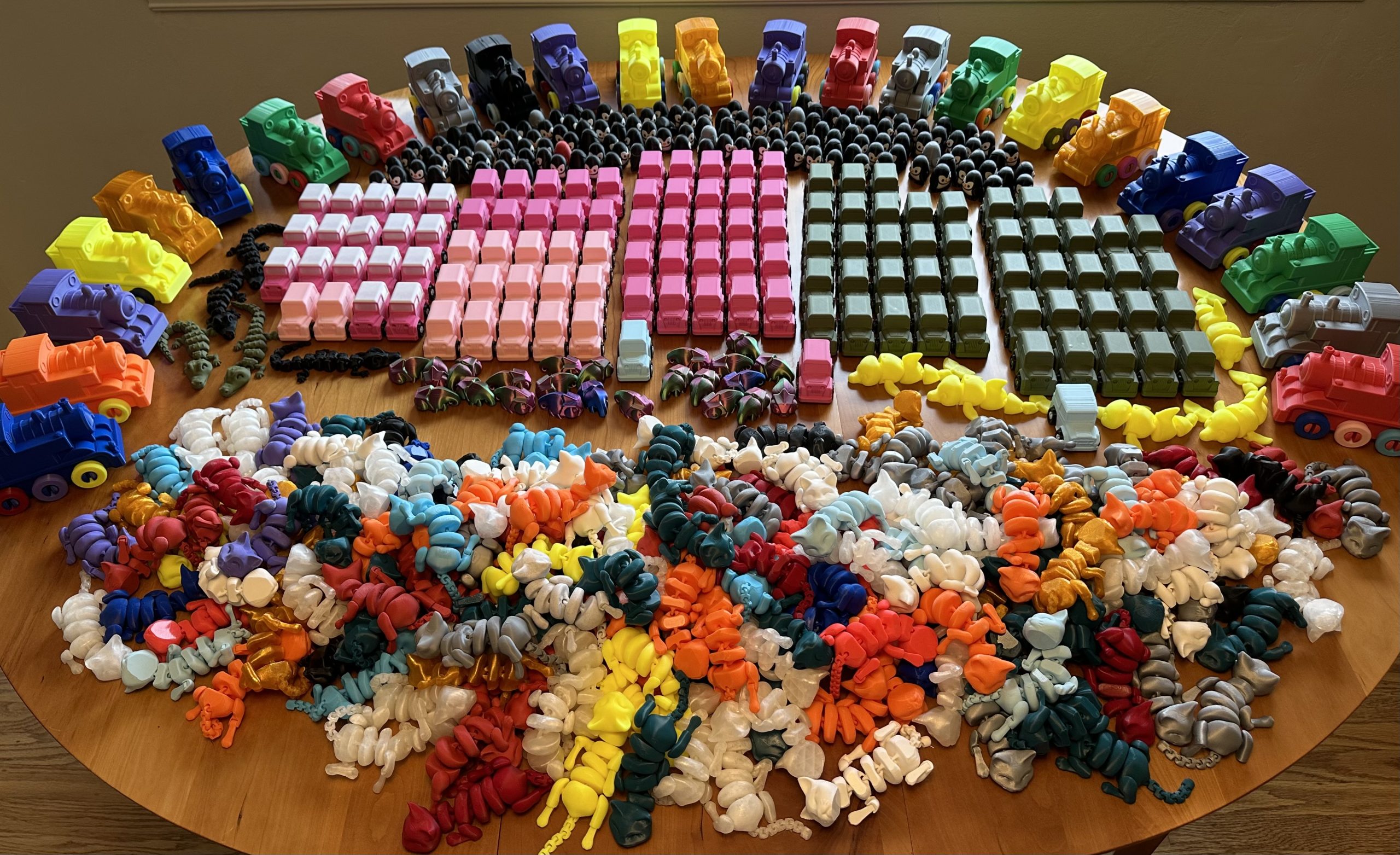
Imagine it’s the night before your child’s birthday. The one toy they wanted is completely sold out everywhere. Instead of stressing, you sit down at your desk, download a free design file, and by morning a fully formed, colorful dinosaur is sitting on the kitchen table — one you built yourself, layer by layer.
That is the quiet revolution happening in living rooms and garages across the world right now.
3D printed toys have moved far beyond the hobbyist fringe. They are now a real, practical option for parents, teachers, makers, and collectors who want something more personal than what sits on a store shelf. With home printers becoming more affordable every year and free design libraries growing by the thousands, the barrier to entry has never been lower.
This guide walks you through everything you need to know. From how the printing process works and which types of toys people are actually making, to printer recommendations, safety advice for parents, and how to get your first design off the ground — it is all here, organized clearly and written to be genuinely useful.
What Are 3D Printed Toys and Why Are They Changing Playtime?
The concept behind 3D printed toys is simple once you understand it. A 3D printer constructs objects layer by layer from a digital file, using melted plastic — or in some cases UV-cured resin — as the raw material. What started as an expensive industrial tool in the 1980s has steadily found its way into homes, schools, and libraries over the last decade. Toy making became one of the most popular personal applications almost immediately.
The reason is not hard to understand. Toys are physically simple enough to print without industrial equipment but interesting enough to justify the effort. More importantly, customization actually matters with toys in a way it rarely does with, say, a replacement bracket or a cable holder.
A child does not just want a dinosaur — they want a purple one with a cracked horn, designed to match the character from their favorite book. That is something a factory cannot offer. A home printer can.
A Brief History Worth Knowing
The open-source maker community accelerated this movement faster than any single company could have. Platforms like Thingiverse, launched in 2008 by MakerBot, gave designers a place to share free STL files with the world. What started as engineers swapping functional parts quickly filled up with dragons, articulated robots, puzzle boxes, and castle playsets.
Today, millions of toy designs are freely available. Dedicated design communities build around specific categories — articulated creatures, educational tools, tabletop miniatures, sensory toys — and the output is remarkable in both quantity and quality.
How the Printing Process Actually Works
Two main technologies dominate the consumer market. FDM (Fused Deposition Modeling) printers melt a spool of plastic filament and deposit it in precise layers to build up a shape from the bottom up. Resin printers use ultraviolet light to cure liquid resin into solid shapes, producing far finer surface detail but requiring more careful handling due to the chemicals involved.
For most toy applications, FDM is the right choice for beginners and families. It is cheaper, the materials are safer and easier to store, and it handles the sizes most toys require without issue. Resin printing is better reserved for highly detailed miniatures where surface quality matters above everything else.
The three most commonly used materials for 3D printed toys are:
- PLA — the beginner’s default; derived from cornstarch or sugarcane, non-toxic, easy to print, available in every color imaginable
- PETG — tougher and slightly more flexible than PLA, excellent for toys that take rough daily handling
- TPU — a soft, rubber-like filament ideal for fidget toys and any design where flex and tactile feel matter
According to a 2024 industry report by MarketsandMarkets, the global 3D printing market is projected to exceed $44 billion by 2028, with consumer, educational, and hobbyist applications driving a growing share of that figure.
Top Types of 3D Printed Toys People Are Actually Making
This is where things get genuinely exciting. The range of what the maker community is producing goes far beyond simple plastic shapes. Here is a clear breakdown of the main categories.
Articulated Animals and Print-in-Place Figures
Print-in-place designs are among the most satisfying creations in the entire hobby. These are objects that print as a single piece — fully articulated, with moving joints — and require no assembly once they come off the printer bed. You remove the print, flex it a few times to free the layers, and it moves.
Flexi-dragons, segmented fish, articulated foxes, and mechanical scorpions are perennial favorites. They feel almost magical when you pick them up for the first time. For anyone just starting out, these are an ideal first project because the result is immediately impressive and the designs are widely available and well-tested.
3D Printed Fidget Toys — The Stress-Relief Category That Took Over
Few categories in the maker space have grown as fast or attracted as much mainstream attention as 3D printed fidget toys. What began as a niche corner of design forums has become one of the most searched and downloaded design types across every major file-sharing platform.
The appeal is straightforward and practical. Fidget tools — infinity cubes, gear spinners, pop-it style grids, clicker buttons, ratcheting rings — give restless hands something to do. They are compact, satisfying to use, and endlessly customizable in ways that mass-produced versions simply cannot match.
The therapeutic value is real and well-documented. A 2021 study published in the American Journal of Occupational Therapy found that hand-held fidget tools improved attention and on-task behavior in children during structured activities. For children with ADHD, anxiety, or sensory processing differences, having the right fidget tool — in the right size, the right material, the right weight — makes a measurable difference. Being able to print those tools at home, dialed exactly to what works for a specific child, is a meaningful advantage.
TPU filament is the material of choice for most 3D printed fidget toys. Its natural softness creates a more satisfying tactile experience than rigid PLA, and it handles repeated flex without cracking.
Educational and STEM-Focused Designs
Teachers and homeschool parents have quietly become one of the most active groups using 3D printing for toy-adjacent educational tools. Working gear trains that demonstrate mechanical advantage, mathematical manipulatives for fractions and geometry, anatomical models, architectural scale replicas — all of these get printed and used in classrooms regularly.
The educational value is layered. Students don’t just use the finished objects. Many schools now teach basic CAD design as part of their curriculum, giving children the direct experience of going from an idea on a screen to a physical object in their hands within a single session. That is a powerful thing for a young mind to experience.
Miniatures, Board Game Accessories, and Tabletop Props
This category has one of the most passionate and organized communities in the entire hobby. Losing a board game piece is no longer a problem — you print five replacements in an evening. But the depth goes much further than that.
The tabletop roleplaying game community has embraced 3D printing with remarkable enthusiasm. Custom character miniatures, dungeon terrain tiles, fantasy props, and campaign-specific accessories are printed by the thousands every week. The detail achievable with resin printing in particular has made professionally designed miniature sets — sold as digital files — a genuine business category in their own right.
How to 3D Print Fidget Toys at Home — A Step-by-Step Breakdown
If you want to start making your own 3D print fidget toys, the process is far more approachable than most people expect. Here is a practical walkthrough.
Step 1 — Find a Good Design File
The best starting point for beginners is a free file repository. Printables (run by Prusa Research) and Thingiverse both have extensive fidget-specific categories. Search “infinity cube,” “gear fidget,” or “pop-it” and filter results by “no supports required.” Designs that print without support structures are faster, cleaner, and waste far less filament.
Look for files with high download counts and genuine user reviews. A design with 40,000 downloads and a 4.7-star rating has been tested across dozens of different printers — you can trust that it works.
Step 2 — Configure Your Slicer Settings
Slicer software translates the design file into printer instructions. For fidget toy designs, these settings work well as a starting point:
- Layer height: 0.2mm for standard prints; 0.15mm for better joint articulation
- Infill: 15–25% is sufficient — these toys don’t need to be solid
- Supports: avoid where possible; well-designed fidget files are engineered to not need them
- Print speed: 40–50mm/s keeps moving part tolerances tight, which matters for mechanism feel
Step 3 — Choose the Right Filament
TPU (95A Shore hardness) gives the most satisfying result for tactile fidget designs — it bends without snapping and has a natural grip texture that feels good in the hand. PETG offers a middle ground between PLA’s stiffness and TPU’s flexibility and prints more easily for beginners. PLA works fine for clicker-type mechanisms where flex isn’t required.
Step 4 — Post-Processing and Testing
Once printed, work moving parts gently at first. The layers need to separate slightly from each other. A small drop of silicone lubricant on joints transforms a stiff print into something that glides and clicks the way it should.
Run your fingers along every edge before giving the toy to a child. Sand any rough spots with 400-grit sandpaper. Test each mechanism several times to confirm it moves freely and consistently.
Picking the Right Toy Box 3D Printer for Your Needs
The printer you choose determines print quality, material options, ease of use, and ultimately what you can realistically make. The 2025 market is genuinely strong at every budget level — but the right choice depends entirely on your situation.
Kid-Friendly Printers Versus Enthusiast Machines
The Toybox Printer is the most heavily marketed option for families with young children. It connects through a dedicated app, comes with a built-in library of pre-approved toy designs, and is intentionally simplified so that children can start a print themselves with minimal adult involvement. That simplicity has genuine value for the right audience.
The trade-off is real, though. The Toybox locks users into its ecosystem, limits material choices, and does not produce print quality that matches other machines in the same price range. If you are serious about making a wide variety of 3D printed toys, it will feel limiting within a few months.
The Bambu Lab A1 Mini has become the community favorite for families who want both ease of use and real capability. It handles multiple materials, prints quickly, and its software is polished enough for beginners while being powerful enough for experienced makers.
What to Look for When Buying
When evaluating a printer specifically for toy making, these specifications matter most:
- Build volume: most single toys don’t need a huge print area, but play sets and large figures benefit from at least 220mm × 220mm
- Enclosed print chamber: important if you plan to use PETG or ABS, which need stable ambient temperatures to print reliably
- Filament compatibility: check whether the machine supports TPU before buying if you plan to make fidget-style toys
- Noise level: if the printer lives in a shared space or apartment, check community reviews for real-world noise figures — spec sheets rarely reflect this honestly
Budget Breakdown for 2025
- Under $250: Creality Ender 3 V3 SE — excellent reliability for beginners, large online community, minor setup required
- $250–$500: Bambu Lab A1 Mini — genuinely plug-and-play, fast, highly reliable from first use
- $500 and above: Bambu Lab P1S or Prusa MK4 — for makers who want near-professional results at home
Safety First — What Every Parent Needs to Know About 3D Printed Toys
Safety is the question every thoughtful parent asks when they first come across this hobby, and it deserves a direct and honest answer rather than vague reassurance.
Are 3D Printed Toys Safe for Children?
PLA, the most common filament, is derived from renewable plant materials and is broadly considered non-toxic. It does not off-gas dangerously at normal printing temperatures, and finished PLA objects are safe for children to handle. For most 3D printed toys intended for children over three years old, PLA is entirely appropriate.
ABS is a different story. It releases fumes during printing that are better kept away from enclosed spaces without proper ventilation, and away from children entirely. PETG does not carry this concern and is a good alternative when extra toughness is needed.
One issue that trips up new makers is porosity. 3D prints have microscopic gaps between layers that can trap bacteria and moisture over time. Toys that will be put in mouths regularly — or shared between multiple children — need either a sealant finish or careful material selection. For toddler toys, this is worth taking seriously.
Small Parts and Choking Hazard Considerations
Any design for a child under three should be evaluated against the same standard applied to commercial toys. No component should be small enough to pass through a standard small-parts testing cylinder (roughly 1.25 inches in diameter). Many articulated figures and mechanical designs have small connectors and joint pins — know your audience and design accordingly.
Practical Safety Habits for Home Toy Printing
- Use food-safe or body-safe filament labels where they exist, particularly for any item that will contact a child’s mouth
- Sand every edge and surface artifact before the toy reaches a child’s hands
- Apply a non-toxic clear sealant on toys that will be handled frequently in wet conditions
- Run the printer in a ventilated area away from children’s sleeping and play spaces
The ASTM F963 standard governs commercially sold toys in the United States, not homemade items — but it remains a useful checklist for thinking through potential hazard categories before a toy leaves your hands.
Adult Applications — Beyond the Playroom
Not every 3D printing project is aimed at children, and the adult maker market is substantial.
Collectibles, Desk Toys, and Cosplay Props
Adults are actually the largest demographic using home printers for toy-adjacent projects. Custom cosplay props, replica accessories from video games and films, scale models of fictional vehicles, desk-sized kinetic sculptures, marble run tracks, and mechanical puzzle boxes are all printed regularly by people who simply love the craft.
The desk toy category has developed its own enthusiastic following. Intricate mechanical clocks, tabletop zen gardens with moving sand rakes, and modular building systems that snap together in new configurations every time — these are genuinely creative objects that happen to live on a work surface.
A Note on Adult Novelty Products
It is worth briefly acknowledging that 3D printed adult novelty items exist as a distinct and separate niche. For anyone exploring this area, material safety is the only consideration that matters. Standard PLA and PETG are not suitable for intimate use due to their porous layer structure. Non-porous options — medical-grade resins with appropriate coatings, or professionally finished nylon — are the appropriate materials for this application. This is a one-paragraph note, not a chapter, and the core advice is simple: know your material and its safety properties before use.
Where to Find Free Designs for 3D Printed Toys — and How to Create Your Own
The design ecosystem surrounding 3D printed toys is one of the hobby’s greatest strengths. You do not need to design anything yourself to produce excellent results — but if you want to, the tools are accessible and genuinely beginner-friendly.
The Best Free File Repositories
Printables, operated by Prusa Research, has become the community’s preferred platform over the last two years. It rewards designers when their files are downloaded, which incentivizes quality and detailed documentation. Search tools are clean and filter options are excellent.
Thingiverse remains the largest archive by pure volume. Its interface is dated and quality varies widely, but for specific well-known designs — articulated dragons, fidget cubes, puzzle boxes, TTRPG terrain — it is still a reliable first search.
Cults3D and MyMiniFactory lean toward higher-quality designs, with many offering free lite versions of their premium files. These platforms tend to include more thorough printing instructions and better photography, which helps newer makers know what they are getting.
Designing Your Own Toy From Scratch
TinkerCAD is the most accessible starting point for complete beginners. It runs entirely in a web browser, is free, and uses a block-based design method that most people can get comfortable with in an afternoon. Simple toys, custom storage containers, and name-tag accessories are all achievable from day one.
For more control and professional-grade tools, Fusion 360 offers a free personal hobby license. The learning curve is steeper, but the ceiling is much higher — mechanical assemblies, parametric designs, and complex interlocking systems are all possible.
AI-assisted tools like Meshy have added a genuinely new dimension to this space. Users can now generate rough 3D model shapes from text prompts or photograph uploads. The output is rarely print-ready without cleanup, but it dramatically reduces the time between having an idea and having a workable file — particularly for organic forms that are slow and tedious to model by hand.
Can You Sell 3D Printed Toys?
Yes, under the right conditions. If you are printing downloaded designs, always check the license first. Most free files are licensed for personal use only, not commercial sale. Creative Commons licenses vary — some explicitly permit commercial use, some do not.
Designing original toys and selling them through platforms like Etsy is a viable side business. The market for personalized and custom-designed toys is active, and customization — a name stamped into a piece, a specific character designed to order, a color combination chosen by the buyer — is exactly what mass manufacturing cannot offer. Many makers have built consistent income streams around this distinction.
Conclusion — Your Next Print Is Waiting
There has never been a better moment to explore 3D printed toys, regardless of where you are starting from. Whether you are a parent looking for a weekend project with your child, a teacher searching for hands-on classroom tools, an adult maker who wants to combine creativity with craft, or simply someone curious about what this technology can actually do — the entry point is lower than you probably think.
The machines are affordable and genuinely good. The design libraries are vast and largely free. The community is active, welcoming, and endlessly helpful on forums and social platforms. And the results — a flexi-dragon that moves like a real creature, a fidget cube tuned exactly to what your child needs, a chess set designed from nothing — are satisfying in a way that buying something off a shelf simply cannot replicate.
Start with one beginner-friendly file. Print it. Hold it. Figure out what you would change next time. That is exactly how every skilled maker in this community started.
Q1 Are 3D printed toys safe for children?
Yes, when the right materials are used. PLA is the most recommended filament for children’s toys because it is biodegradable, non-toxic after solidifying, and emits very low VOC levels during printing. PETG is another safe option for toys that need extra durability. Resin-printed toys should be avoided for direct child play as uncured resin retains toxicity. Always print in a well-ventilated space and sand sharp edges before handing any print to a child.
Q2 Is PLA or ABS safer for kids’ toys?
PLA is significantly safer than ABS for children’s toys. PLA is derived from cornstarch or sugarcane, is biodegradable, and emits far lower levels of volatile organic compounds (VOCs) during printing. ABS releases fumes during printing that irritate the respiratory system and should never be printed in enclosed spaces around children. For toy applications, PLA or PETG are the go-to choices — ABS should be reserved for functional parts in ventilated workshops.
Q3 Can 3D printed toys be given to toddlers?
Only with strict precautions. Toddler toys must pass the small-parts test — no component should fit inside a cylinder roughly 1.25 inches in diameter. Any print intended for a child under three must be made in PLA, thoroughly sanded smooth, and sealed with a non-toxic coating if the child tends to mouth objects. Prusa Research recommends cleaning the surface thoroughly to prevent ingestion of plastic microparticles and applying a food-safe coating for toddlers who explore with their mouths.
Q4 Are resin 3D printed toys safe for kids?
No — standard resin is not safe for children’s direct play. Photopolymer resins contain monomers, diluents, and photoinitiators that cause skin sensitization and respiratory irritation, and retain residual toxicity even after UV curing. Studies have found that resin printing releases VOCs such as acrylates, formaldehyde, and naphthalene indoors. If resin is used for a toy, it must be fully post-cured, sealed with a certified non-toxic finish, and kept away from children who put things in their mouths.
Q5 Do 3D printed toys meet toy safety standards like ASTM F963 or EN71?
Homemade 3D printed toys are not subject to mandatory ASTM F963 (US) or EN71 (EU) certification requirements — those standards apply to commercially manufactured and sold toys. However, some filament brands, such as Flashforge PLA, have voluntarily passed the EN71-3 migratable elements test. If you plan to sell 3D printed toys commercially, you should research the specific safety certification requirements for your region and product category.
Q6 What is the best filament material for 3D printed toys?
PLA is the best choice for most children’s toys due to its safety profile, ease of printing, and wide color range. PETG is preferred for toys requiring impact resistance, outdoor use, or repeated flexing. TPU is the top choice for fidget toys and tactile designs because its rubber-like texture creates a satisfying feel and it bends without breaking. ABS and standard resin should be avoided for children’s toys. For adult collectibles and detailed miniatures, properly post-processed resin can produce superior surface quality.
Q7 FDM or resin — which is better for making 3D printed toys?
FDM (filament-based) printing is the better starting point for most toy applications. It is cheaper, safer, easier to maintain, and handles the sizes most toys require. Resin printing produces far finer surface detail and is better for miniatures and intricate figurines, but requires chemical handling, more post-processing, and poses greater health risks — making it unsuitable for toys children will handle regularly. Use FDM for functional everyday play toys; use resin only for display-quality collectibles handled by adults.
Q8 What are print-in-place 3D printed toys and how do they work?
Print-in-place toys are designs engineered to print fully assembled in a single pass — with moving joints already connected — requiring no assembly once removed from the printer. The key is designing tiny gaps between moving parts (typically 0.2–0.4mm) that fuse enough to print but break free with gentle flexing. Articulated dragons, flexi-fish, and kinetic snakes are the most popular examples. They are ideal for beginners because they produce an immediately impressive result with a single print job and no hardware.
Q9 What slicer settings work best for 3D printed toys?
For most toy prints: 0.2mm layer height balances speed and quality; 15–25% infill is sufficient for non-structural toys; 2–3 perimeter walls add durability without excessive material use. For fidget toys and moving parts, drop print speed to 40–50mm/s to keep moving part tolerances tight. Avoid supports wherever possible by orienting the model correctly — support-free prints have cleaner surfaces and are faster to post-process. Most slicers display estimated filament use and print time before you start.
Q10 How do I post-process a 3D printed toy for a better finish?
Start by removing any support structures carefully with pliers or flush cutters. Sand the surface progressively — begin with 120–220 grit to remove layer lines and rough spots, then finish with 400–600 grit for smoothness. Apply a spray primer before painting to help paint adhere evenly. Acrylic paints work well on PLA and PETG. Seal the finished toy with a non-toxic clear coat to protect the paint, reduce surface porosity, and make it easier to wipe clean.
Q11 How long does it take to 3D print a toy?
Print time depends on size, complexity, and printer speed. A small fidget toy or articulated figure (roughly 10cm) typically takes 1 to 4 hours on a standard FDM printer at 60mm/s. A larger toy or detailed miniature can take 8 to 24 hours. Faster printers like the Bambu Lab A1 can cut these times significantly. Resin printers process entire layers at once, making them faster for small detailed parts but slower per-layer for tall prints.
Q12 Where can I find free designs for 3D printed toys?
The four most reliable free repositories are Printables (run by Prusa Research, incentivizes quality with a rewards system), Thingiverse (the largest archive by volume), Cults3D (higher average quality), and MyMiniFactory (often includes detailed printing guides). Filter searches by ‘no supports’ or ‘print-in-place’ to find beginner-friendly designs. Always check the license before downloading — most free files on Thingiverse prohibit commercial sale.
Q13 Can beginners make 3D printed toys without design experience?
Absolutely. Thousands of ready-made toy files are available to download and print with no design knowledge needed. The entire process — download a file, open it in free slicer software, press print — can be completed within an hour by a complete beginner. When you are ready to design your own toys, TinkerCAD is the most accessible starting point: it runs in a browser, is free, and most beginners can produce a simple original design within a single afternoon session.
Q14 Can kids use a 3D printer to make their own toys?
Yes, with appropriate supervision and the right equipment. Children aged 8 and above can operate simple FDM printers under adult supervision, and platforms like the Toybox Printer are specifically designed for children to use independently via a smartphone app. TinkerCAD is used in primary school curricula worldwide. Research shows that children who design and print their own toys score higher in spatial reasoning and analytical thinking. The printer should be kept in an adult-supervised area as nozzles reach 200°C+.
Q15 Can you 3D print replacement parts for broken toys?
Yes — this is one of the most practical everyday uses of home 3D printing. If a board game loses a token, a figure breaks a limb, or a toy mechanism snaps, a replacement part can often be designed in TinkerCAD and printed within a few hours. Some toy manufacturers are beginning to offer official replacement part files as a sustainability measure. For discontinued toys or games, the maker community on Printables and Thingiverse often has fan-made replacements already available.
Q16 How much does it cost to make a 3D printed toy at home?
Material cost per toy is typically very low — between $0.50 and $3.00 for most small to medium FDM prints using PLA at $15 to $25 per kg. Electricity adds roughly $0.01 to $0.05 per hour of printing. The main upfront expense is the printer itself, ranging from $200 for reliable beginner machines to $500+ for enthusiast models. A simple articulated toy costs under $1 in filament; a larger complex toy may use $8 to $12 of material.
Q17 Is 3D printing toys cheaper than buying them?
For small runs and custom designs, yes — the material cost per toy is a fraction of retail pricing. A fidget toy that costs $0.80 in filament sells for $10 to $15 on Etsy, reflecting a 70–80% profit margin on material. However, when you factor in printer depreciation, electricity, your time, and failed prints, the true cost is higher than filament alone. For a business, volume and efficiency define whether margins are sustainable.
Q18 What is the best 3D printer for making toys at home in 2025?
The Bambu Lab A1 Mini is widely considered the best all-round choice for home toy making in 2025 — fast, reliable, handles multiple materials including TPU, and its software is polished enough for beginners. The Creality Ender 3 V3 SE is the top budget option under $250 with a large online support community. The Toybox Printer suits families with young children who want a fully app-driven experience with minimal technical setup.
Q19 Can you legally sell 3D printed toys?
Yes, with conditions. Selling toys that you have designed yourself from scratch is fully legal. Selling prints of downloaded designs depends entirely on the file license — most free files on Thingiverse and Cults3D are for personal use only, not commercial sale. Designs featuring characters owned by Disney, Nintendo, Hasbro, or other IP holders cannot be legally sold regardless of who made the digital file. Always verify the license before listing anything for sale.
Q20 Can I 3D print and sell licensed characters like Disney or Pokemon?
No — not legally without explicit permission. Corporations like Disney, Nintendo, and Hasbro hold active intellectual property rights over their characters. Even if an independent designer created a fan-made version and shared it on Thingiverse, the underlying character copyright still belongs to the IP holder. Disney has previously had Star Wars models removed from file-sharing platforms. Selling prints of these characters commercially risks cease-and-desist letters, account bans, and potential legal action.
Q21 Do homemade 3D printed toys need to meet consumer product safety laws?
In most jurisdictions, homemade toys given away personally do not require formal safety certification. However, if you sell 3D printed toys to the public — even on Etsy or at a craft fair — consumer product safety regulations may apply. In the US, toys sold commercially for children under 12 are subject to CPSC regulations including ASTM F963. In the EU, the EN71 toy safety standard applies. Sellers should research regulations in their country and be transparent with buyers about the handmade nature of the product.
Q22 Are 3D printed fidget toys effective for ADHD and sensory needs?
Research supports the use of tactile fidget tools for children with ADHD, anxiety, and sensory processing differences. A 2021 study in the American Journal of Occupational Therapy found that hand-held fidget tools improved on-task behavior during structured activities. 3D printed fidget toys offer full customization of size, shape, stiffness, and mechanism type — advantages commercial products cannot match. TPU filament is the preferred material because its tactile flex and grip texture provide the most satisfying sensory response.
Q23 Can 3D printed toys be used as educational STEM tools?
Yes — teachers are among the most active communities using 3D printing for educational toy creation. Working gear trains, fraction tiles, anatomy models, and engineering challenge kits are printed and used in classrooms worldwide. Research shows children who design and interact with physical objects they helped create show stronger engagement and retention. TinkerCAD is used in school curricula across the US, UK, and Australia to teach design thinking alongside hands-on printing.
Q24 How long do 3D printed toys actually last?
Well-printed PLA toys held at room temperature and kept away from direct sunlight, heat, and moisture can last for years without degradation. PETG lasts longer in variable conditions and is preferred for outdoor or frequently handled toys. The weak points are always layer adhesion — joints and thin sections are more prone to cracking under repeated stress than injection-molded plastic. Printing with higher infill (25–30%), thicker walls (3 perimeters), and the right material for the use case significantly extends lifespan.