
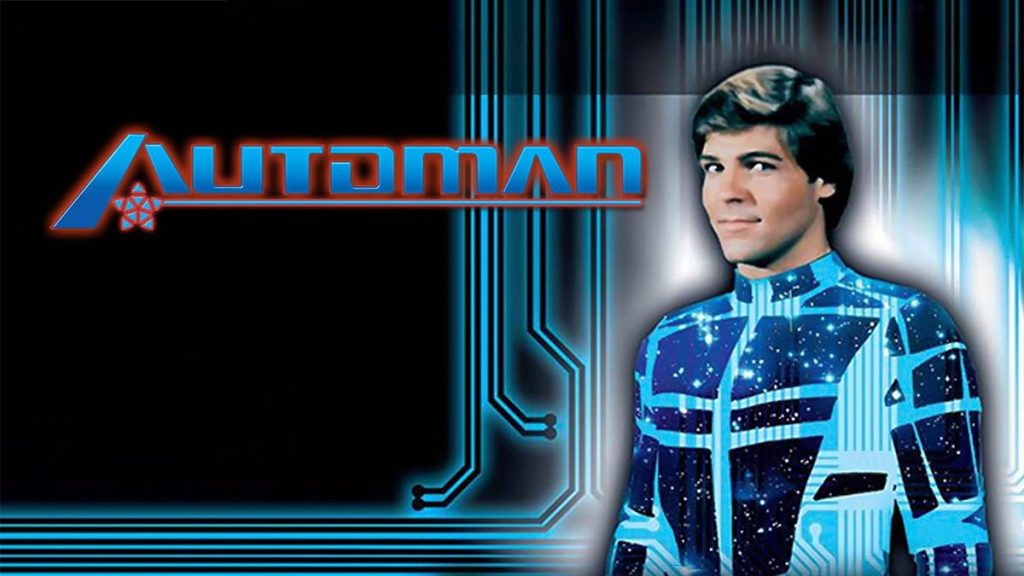
Picture this. It is late 1983, and you are parked on the living room carpet in front of a wood-paneled television set. The ABC logo fades, and suddenly your screen fills with streaks of neon blue light. A glowing humanoid figure steps forward from a wall of computer code while a pulsing synth theme kicks in. You have just experienced the 80’s Automan intro for the first time, and you will never forget it.
Automan was a science fiction series that premiered on ABC on December 15, 1983. Created by the legendary television producer Glen A. Larson, the show followed a police computer programmer who builds an artificially intelligent hologram capable of fighting crime in the real world. It was bold, flashy, and completely over the top. The kind of show that could only have existed in the Reagan-era landscape of network television, right alongside Knight Rider, Airwolf, and The A-Team.
The series lasted just one season. Only twelve of its thirteen produced episodes made it to air before ABC pulled the plug in April 1984. Poor ratings and expensive special effects sealed its fate. But here is the thing that nobody at the network predicted. Decades later, people still talk about this show. They share clips of it on social media. They hunt down DVD copies. And the single piece of Automan content that gets the most attention, the thing that draws newcomers in and sends longtime fans on a wave of warm nostalgia, is that opening sequence. The 80’s Automan intro packed an entire world of neon wonder into roughly sixty seconds of television, and it remains one of the most underrated openings of the decade.
This article is a deep dive into that intro. If you have ever searched for the 80’s Automan intro out of curiosity or pure nostalgia, you are in the right place. We are going to break down what it showed, how it was made, who was behind it, and why it still holds up after more than forty years.
What Was Automan? A Quick Rundown of the Show
The Premise Behind the Holographic Hero
Before we get into the 80’s Automan intro itself, it helps to understand what the show was actually about. Automan followed Walter Nebicher, played by Desi Arnaz Jr., a mild-mannered police officer who worked as a computer programmer for the LAPD. Walter was gifted, maybe even brilliant, but nobody at the precinct took him seriously. His superiors thought real police work happened on the streets, not behind a keyboard.
What they did not know was that Walter had used his programming skills to create something extraordinary. He built an artificially intelligent program that could generate a holographic human being, a crime-fighting digital superhero called Automan, short for Automatic Man. Played by Broadway performer Chuck Wagner, Automan could leave the computer world at night, walk among real people, and use his superhuman abilities to solve cases the regular police force could not crack. While out in the real world, he posed as a mysterious government agent named Otto J. Mann.
Automan did not work alone. He had a sidekick called Cursor, a small floating polyhedron that could draw the outlines of physical objects and then materialize them on the spot. Cursor’s most common creations included the Autocar, a sleek Lamborghini Countach covered in glowing neon lines, along with a helicopter, a motorcycle, and even a tank. These vehicles could bend the laws of physics, making impossible 90-degree turns at full speed, a visual gag that became one of the show’s most memorable trademarks.
The Creative Mind Behind the Series
The man responsible for bringing Automan to life was Glen A. Larson, one of the most prolific television producers in American history. Larson’s resume reads like a highlight reel of 70s and 80s pop culture. He created Battlestar Galactica, Knight Rider, Magnum P.I., The Fall Guy, and Buck Rogers in the 25th Century. The man had a gift for taking big cinematic concepts and translating them into weekly episodic television.
Automan was produced by 20th Century Fox Television in partnership with The Kushner-Locke Company. That last name is significant because Donald Kushner, one half of Kushner-Locke, had also served as producer on Disney’s groundbreaking 1982 film Tron. That connection would shape every visual choice Automan made, especially its opening sequence.
The show blended superhero action with buddy-cop comedy and wrapped it all in the early 1980s fascination with computers and digital technology. It was silly, charming, and visually ambitious in ways that network television had never really attempted before.
Breaking Down the 80’s Automan Intro Scene by Scene
Opening Moments and the Digital Stage
The intro wastes no time. From the very first frame, viewers are thrown into a world of wireframe computer graphics and electric blue light. The visual language is unmistakable. This show is about technology, about the future, about the digital frontier. The screen pulses with energy, and you can feel the production team reaching for something cinematic, something that belongs on a bigger screen than your family TV set.
We see Walter Nebicher at his oversized computer terminal inside the police precinct. He is typing, focused, completely in his element. The shot establishes him as the quiet genius behind everything that is about to happen. It is a smart storytelling choice because it grounds the sci-fi spectacle in something relatable. Walter is an underdog. He is the guy nobody listens to, and yet he has created something miraculous.
Automan Comes to Life
Then comes the moment that hooked a generation. Lines of glowing code begin to swirl and take shape on screen, forming the outline of a human figure. The light intensifies, and suddenly Chuck Wagner appears in the now-iconic Autosuit, a full-body costume covered in dozens of tiny light-reflecting panels. The suit gave Automan a shimmering, holographic appearance that looked unlike anything else on television at the time.
Behind the scenes, the Autosuit was a practical effects marvel. The reflective panels caught studio lighting and created a natural glow, which was then enhanced in post-production using chromakey compositing techniques. The result was a character who genuinely looked like he had stepped out of a computer screen and into reality. It was the kind of visual trick that made kids lean forward in their seats and made adults do a double take.
Cursor and the Iconic Vehicles
No discussion of this opening sequence is complete without mentioning Cursor. The little floating polyhedron appears in the intro doing what it does best, tracing glowing lines through the air that form into solid objects. The most famous of these is the Autocar, a black Lamborghini Countach decorated with neon reflective tape that glowed like a vehicle from another dimension.
The intro shows the Autocar tearing through city streets, making those signature 90-degree turns that defy all known laws of physics. This was a direct visual nod to the Light Cycles in Tron, and it gave the show an instant visual identity. You also catch glimpses of the Autocopter and other vehicles that Cursor conjures throughout the series. The message is clear from the intro alone. This show has cool cars, futuristic gadgets, and a hero who can materialize whatever he needs out of thin air.
The Theme Song That Tied It All Together
A great intro needs a great theme, and Automan delivered. The music was composed by Billy Hinsche and Stu Phillips. If those names sound familiar, it is because Phillips was the same composer behind the iconic themes for Knight Rider and Battlestar Galactica. He was Glen A. Larson’s go-to music man, and he brought that same sense of sweeping, synthesizer-driven energy to Automan.
The theme is upbeat, propulsive, and unmistakably 80s. It blends punchy synth melodies with orchestral undertones, creating a score that feels both futuristic and adventurous. Fans who watched the show during its original run often say the theme song is the first thing they remember, even before specific plot details or character names. It is one of those melodies that burrows into your memory and stays there for decades. If you hum it around someone who grew up watching Thursday night television in 1983, there is a good chance they will recognize it instantly.
The Tron Connection: How a Disney Film Shaped the 80’s Automan Intro
From the Big Screen to the Small Screen
You cannot talk about Automan without talking about Tron. Disney’s 1982 film was a landmark in cinema history. It was one of the first movies to use extensive computer-generated imagery, and even though it was only a modest hit at the box office, it captured the imagination of filmmakers, visual effects artists, and television producers everywhere. Its neon-soaked digital world, complete with glowing suits and impossible vehicle physics, became a visual vocabulary that others immediately wanted to borrow.
Glen A. Larson was among the first to act on that inspiration. Automan premiered barely a year after Tron hit theaters, and the visual similarities were impossible to miss. The glowing character outfits, the wireframe vehicles, the blue-on-black color palette, it all came from the same creative well. But this was not just surface-level imitation. Donald Kushner, who had produced Tron for Disney, came on board as a producer and special effects consultant for Automan. He brought direct expertise from the film set to the television production, giving the show a level of visual credibility that most network series could not match.
Visual Effects on a Television Budget
The special effects that made the opening sequence so striking came at a steep price. Each episode of Automan reportedly cost over one million dollars to produce, a figure that was enormous for network television in 1983. Most of that budget went toward the visual effects work.
The production team used a combination of traditional animation, miniature models lined with reflective tape, wireframe overlay graphics, and chromakey compositing to achieve the show’s signature look. The Autocar, for example, was a real Lamborghini Countach fitted with reflective strips, and its on-screen glow was enhanced through layers of post-production work. Portions of the intro and many scenes throughout the series were filmed at night because the reflective costumes and vehicle decorations simply did not look convincing in daylight. Special lighting setups were required to make the holographic effect read properly on camera, and all of that added time and money to every shoot day.
The irony is painful. The very effects that made the 80’s Automan intro so visually memorable were the same effects that ultimately killed the show. That tension between creative ambition and financial reality is a story that has played out many times in television, but rarely with such a striking example.
Why the 80’s Automan Intro Still Resonates With Fans Today
Pure 80s Nostalgia in Sixty Seconds
There is something about 80s television intros that modern shows have never been able to replicate. They were not just title cards or quick montages. They were miniature movies. They told you everything you needed to know about a show’s world, characters, and tone before a single line of dialogue was spoken. The Automan opening sequence does exactly this, and it does it with style. There is a reason the 80’s Automan intro keeps popping up in online discussions about the best television openings of the decade.
The intro captures everything people love about that era of television. Bold synthesizer music, neon-drenched visuals, a clear hero you can root for, and a general sense of optimistic futurism. Watching it today, you are transported back to a time when computers felt like portals to limitless possibility, when the future was something to be excited about rather than anxious over. It sits comfortably alongside the openings of Knight Rider, Airwolf, and The A-Team in the collective memory of anyone who grew up watching TV during that decade.
A Gateway to Rediscovery
For many people, the 80’s Automan intro is their first and sometimes only exposure to the show. Multiple uploads of the opening sequence exist on YouTube, and they have collectively racked up hundreds of thousands of views. Fan-remastered versions, including stereo audio enhancements of the original mono broadcast, have given the intro new life in the digital age.
In 2015, the independent home entertainment distributor Shout! Factory released the complete series on DVD for the first time. The box set included all thirteen episodes, both aired and unaired, along with a 42-minute retrospective documentary titled “Calling Automan.” The documentary featured new interviews with Chuck Wagner, Desi Arnaz Jr., Heather McNair, and Glen A. Larson himself, giving fans a behind-the-scenes look at how the show was made and why it holds such a special place in 80s pop culture. The series has also been made available through digital download platforms, allowing younger viewers who stumble across the intro online to easily watch the full show.
A Time Capsule of Early AI Imagination
Here is something that makes the Automan opening feel unexpectedly relevant today. The entire concept of the show, a computer program becoming a sentient, autonomous being capable of existing alongside humans, sounds a lot like the conversations we are having right now about artificial intelligence. Walter Nebicher created an AI that could think, learn, make decisions, and operate independently. Watching the intro in the context of modern AI development gives it an almost prophetic quality.
The visual storytelling of the 80’s Automan intro, code transforming into consciousness, lines of data becoming a living, breathing character, mirrors the way many people visualize AI today. It is a fascinating time capsule, not just of 1980s television aesthetics, but of how that era imagined the relationship between humans and machines.
The Cast and Characters Featured in the Opening Sequence
Desi Arnaz Jr. as Walter Nebicher
The son of legendary entertainers Lucille Ball and Desi Arnaz, Desi Jr. brought a grounded, everyman quality to the role of Walter. In the intro, you see him hunched over his computer, the quiet genius working behind the scenes while the flashier action plays out around him. He was the heart of the show, the guy you related to, even if Automan was the one getting all the glory.
Chuck Wagner as Automan
Chuck Wagner came from a background in musical theatre, and it showed in his performance. He had a physicality and stage presence that translated perfectly to the role of a larger-than-life holographic hero. In the intro, his glowing, confident entrance sells the character immediately. You believe that this is a being made of light and code, and yet he carries himself with the charisma of a leading man.
Wagner’s personality was a big part of what made the character work. Automan was programmed with the traits of various celebrities, including the cool of Paul Newman, the toughness of Clint Eastwood, and the charm of John Travolta. Wagner played all of these elements with a wink, never taking the role too seriously but never phoning it in either.
Supporting Cast
The opening montage also briefly features the show’s supporting players. Heather McNair appeared as Roxanne Caldwell, Walter’s close associate and one of the few people who knew Automan’s true identity. Gerald S. O’Loughlin played Captain E.G. Boyd, the gruff but good-hearted precinct boss. Robert Lansing rounded out the main cast as Lieutenant Jack Curtis. Each of these characters gets a quick moment in the intro, just enough to establish the ensemble dynamic that powered the show week to week.
Why Automan Was Canceled Despite Its Memorable Opening
The Budget Problem
The math never worked in Automan’s favor. Those stunning special effects that made the intro and the episodes so visually striking were bleeding ABC dry. At over one million dollars per episode, Automan was the most expensive series on network television at the time. For a show pulling middling ratings, that kind of spending was impossible to justify to network executives.
Tough Competition in the Thursday Night Lineup
Making matters worse, Automan aired on Thursday nights at 8:00 PM Eastern. That put it directly up against established ratings juggernauts. Viewers had to choose between Automan and other popular programming, and too often they chose the competition. The show earned a 13.6 Nielsen rating, a number that might have been acceptable for a cheaper production but was a death sentence for a show with Automan’s price tag.
A Short Run That Left a Long Legacy
ABC canceled the series after twelve aired episodes. A thirteenth episode had been produced but never made it to broadcast during the original run. It was a quick, quiet end for a show that had arrived with so much visual ambition.
But cancellation was not the end of the story. The show’s visual identity, especially the 80’s Automan intro that opened each episode, kept the series alive in the memories of fans who had watched it during its brief run. It became a frequent topic of nostalgic conversation, a “do you remember that show” favorite among people who grew up in the 80s. Over time, its reputation grew from forgotten curiosity to genuine cult classic.
Where to Watch the Opening Sequence and Full Series Today
If reading about this show has made you curious, or if you simply want to relive the 80’s Automan intro one more time, you have several options for tracking it down. The opening sequence is widely available on YouTube, where multiple uploads exist in varying quality. Some dedicated fans have even created remastered versions with enhanced stereo audio, breathing new life into Stu Phillips and Billy Hinsche’s memorable theme.
For the full series, the Shout! Factory DVD box set remains the definitive release. Available in both Region 1 and Region 2 formats, it includes all thirteen episodes along with the “Calling Automan” documentary. The set has become a collector’s item among fans of 80s television and cult sci-fi.
Digital download options also exist through various online platforms. For casual viewers who just want a taste, the intro alone is a satisfying standalone experience. It tells you everything you need to know about the show’s tone, style, and ambition in under a minute. And for those who fall in love with it, the full series is waiting.
Conclusion
Some television openings simply introduce a show. They play a theme, flash some character names, and get out of the way. The 80’s Automan intro did something different. It built an entire world in sixty seconds. Glowing heroes, sentient code, neon vehicles screaming through city streets, and a synth score that lodged itself permanently in your brain. It was a promise that the next fifty minutes of your Thursday evening were going to be unlike anything else on television.
The show behind that intro was canceled too soon. That much is certain. Expensive effects, tough competition, and modest ratings conspired to cut the story short before it had a real chance to find its footing. But the opening sequence outlived the series itself. It became the thing people remembered, the thing they shared, the thing that kept Automan from fading into total obscurity.
Today, in a television landscape dominated by reboots, revivals, and nostalgic callbacks, the enduring popularity of this intro proves something important. Sometimes the opening is the legacy. Sometimes sixty seconds of neon light and synthesizer music is all it takes to earn a permanent place in pop culture history. If you have never seen it, go find it. If you grew up watching it, go watch it again. It holds up better than you might expect.
Frequently Asked Questions
1. What is the 80’s Automan intro?
The 80’s Automan intro is the opening title sequence of the ABC science fiction series Automan, which premiered on December 15, 1983. It features neon-blue wireframe graphics, a glowing holographic hero, and a synth-driven theme song composed by Billy Hinsche and Stu Phillips. The intro quickly establishes the show’s Tron-inspired visual identity and introduces the main characters in under sixty seconds.
2. Who created the Automan TV series?
Automan was created and produced by Glen A. Larson, one of the most prolific television producers in American history. Larson was also the creator of Knight Rider, Battlestar Galactica, Magnum P.I., The Fall Guy, and Buck Rogers in the 25th Century. The series was produced by 20th Century Fox Television in partnership with The Kushner-Locke Company.
3. When did Automan first air on television?
Automan premiered on ABC on December 15, 1983, airing on Thursday evenings at 8:00 PM Eastern time. The show ran for a single season until April 2, 1984, and aired twelve out of its thirteen produced episodes before being canceled by the network.
4. Who composed the Automan theme song heard in the intro?
The theme music for the 80’s Automan intro was composed by Billy Hinsche and Stu Phillips. Phillips was Glen A. Larson’s go-to composer, already famous for scoring the themes for Knight Rider and Battlestar Galactica. The synth-heavy, upbeat score became one of the most fondly remembered TV themes of the decade.
5. How was the 1982 Tron movie connected to Automan?
Donald Kushner, who produced Disney’s 1982 film Tron, also served as a producer and special effects consultant on Automan. The show borrowed heavily from Tron’s neon-wireframe visual style, glowing character costumes, and digital vehicle designs. Both productions shared practical effects techniques and a similar color palette.
6. Who played the lead roles in Automan?
Desi Arnaz Jr., son of legendary entertainers Lucille Ball and Desi Arnaz, played Walter Nebicher, the police computer programmer. Chuck Wagner, a musical theatre performer, played the holographic superhero Automan. The supporting cast included Heather McNair as Roxanne Caldwell, Gerald S. O’Loughlin as Captain Boyd, and Robert Lansing as Lieutenant Jack Curtis.
7. What car was used as the Autocar in the show?
The Autocar was a 1974 Lamborghini Countach LP400 that belonged to producer Glen A. Larson personally. The car was painted black and outlined with 3M retroreflective tape to create its signature neon-blue glow. Its rear spoiler was removed, and it was primarily filmed at night to make the reflective tape effect look convincing on camera.
8. What was Cursor in Automan?
Cursor was Automan’s sidekick, a sentient floating polyhedron made of light that could draw the outlines of physical objects and then materialize them in the real world. Cursor created vehicles like the Autocar, Autocopter, motorcycles, and even clothing for Automan. The character was credited as playing “Self” in the show’s cast list and even received an “And Starring” billing in the credits.
9. Why was Automan canceled after only one season?
Automan was canceled due to a combination of high production costs and low ratings. Each episode cost over one million dollars to produce, making it the most expensive show on network television at the time. Coupled with a 13.6 Nielsen rating and stiff competition from established shows on Thursday nights, ABC could not justify the expense.
10. How many episodes of Automan were made?
Thirteen episodes of Automan were produced during its single season, but only twelve of those episodes aired during the show’s original run on ABC. The thirteenth unaired episode was later included in DVD and digital releases of the complete series, making the full collection available to fans for the first time.
11. What special effects techniques were used in the 80’s Automan intro?
The intro used a combination of traditional animation, miniature models covered in reflective tape, wireframe overlay graphics, and chromakey compositing. Chuck Wagner’s Autosuit was covered in dozens of tiny light-reflecting panels, which were enhanced in post-production to create the holographic glow. Many intro sequences were filmed at night because the reflective materials did not look convincing in daylight.
12. Was the Automan show inspired by Tron?
Yes, Automan openly drew visual inspiration from Disney’s 1982 film Tron. The show’s creator Glen A. Larson was impressed by Tron’s neon-soaked digital aesthetic and adapted that visual language for weekly television. The shared connection went beyond aesthetics, as Tron producer Donald Kushner also served as producer on Automan.
13. Is the 80’s Automan intro available to watch online?
Yes, the opening sequence is widely available on YouTube through multiple uploads, including fan-remastered versions with enhanced stereo audio. The original broadcast featured a mono audio track, but dedicated fans have created high-quality stereo remasters that have attracted hundreds of thousands of views across the platform.
14. Where can I buy or stream the complete Automan series?
The complete series was released on DVD by Shout! Factory in the United States on November 10, 2015, and by Fabulous Films in the United Kingdom in October 2012. The DVD box set includes all thirteen episodes across four discs plus bonus features. The show has also been available on the Roku Channel and through select digital download platforms.
15. What bonus features are included on the Automan DVD set?
The Shout! Factory DVD release includes a 42-minute retrospective documentary titled “Calling Automan” featuring interviews with Chuck Wagner, Desi Arnaz Jr., Heather McNair, and Glen A. Larson. The set also includes original press kit materials, a collectibles gallery showcasing Automan merchandise, a stills gallery, and cast and crew biographies.
16. Did Automan have any merchandise or toys?
Yes, although most Automan merchandise was released primarily in the United Kingdom. Products included an action figure and toy Autocar by Acamas Toys, a Halloween costume, a Commodore 64 video game, and a novelization of the pilot episode. In the United States, the Ja-Ru company released budget toys like binoculars, briefcases, and play money sets sold in supermarkets.
17. What was Automan’s personality based on?
Automan’s personality was programmed using the traits of several famous celebrities. He was given the cool composure of Paul Newman, the toughness of Clint Eastwood, and the charm of John Travolta. He also learned human behavior by watching movies through Walter’s portable video recorder, which occasionally led to humorous misunderstandings about real-world social situations.
18. How is Automan different from Knight Rider?
Both shows were created by Glen A. Larson and feature a hero with a high-tech vehicle fighting crime. However, Knight Rider centered on a human hero with a talking, self-aware car, while Automan featured a fully digital holographic being paired with a human programmer. Automan leaned more heavily into science fiction and visual effects, while Knight Rider had a more grounded action-adventure tone.
19. What were the 90-degree turns in Automan?
The 90-degree turns were a recurring visual gag and signature effect in the show. The Autocar would make sharp right-angle turns at full speed without slowing down, directly mimicking the Light Cycles from Tron. Human passengers inside the car would get thrown violently against the door during these turns, creating a running comedic bit throughout the series.
20. What happened to the cast of Automan after the show ended?
Chuck Wagner continued working in musical theatre and television after Automan ended. Desi Arnaz Jr. largely stepped away from acting to pursue business interests and a quieter personal life. Heather McNair continued acting in smaller television roles. Series creator Glen A. Larson went on to produce other shows but passed away from cancer in November 2014.
21. Was there ever a plan to reboot or revive Automan?
No official reboot or revival of Automan has been announced or produced as of 2026. However, the show’s growing cult following, its DVD release, and the broader trend of 80s television revivals have sparked fan discussions about the possibility. The concept of a holographic AI crime fighter feels especially relevant in the current era of artificial intelligence.
22. What day and time did Automan air during its original run?
Automan aired on Thursday nights at 8:00 PM Eastern on ABC in the United States. In the United Kingdom, the show was broadcast on Friday evenings. The Thursday time slot put it in direct competition with other popular network programming, which contributed to its relatively modest ratings performance.
23. Did Automan appear on the Sci-Fi Channel after its cancellation?
Yes, after its original ABC run ended in 1984, Automan was later rerun on the Sci-Fi Channel, which helped introduce the series to new audiences who had missed it during its brief original broadcast. These reruns played a role in building the cult following that the show enjoys today among fans of retro science fiction television.
24. How much did each episode of Automan cost to produce?
Each episode of Automan cost over one million dollars to produce, which was an enormous sum for network television in 1983. The bulk of that budget went toward the show’s ambitious special effects, which required traditional animation, miniature models, reflective wardrobe construction, and extensive post-production chromakey compositing work. That high cost per episode was the primary reason ABC ultimately canceled the series.