Most people don’t fail at managing money because they’re bad at math. They fail because nobody ever gave them a clear, step-by-step plan to follow.
That’s exactly the gap the ramsey baby steps were designed to fill.
If you’ve ever felt like you’re running in circles financially — paying off a credit card only to put something else on it, saving a little only to have an emergency wipe it out — you already understand why a structured approach matters.
Dave Ramsey didn’t develop his plan from a textbook. He went bankrupt in his late 20s after building a real estate empire on borrowed money. He rebuilt everything from the ground up, and the lessons he learned along the way became the foundation of what millions of people now call the baby steps.
The ramsey baby steps are not a shortcut or a trick. They’re a proven, sequential financial system that works because it’s built around how real human behavior actually functions — not how we wish it would.
In this guide, you’ll get a clear breakdown of every step, what it means, why the order matters, and how to start no matter where you are right now.
Who Is Dave Ramsey and Why Does His Plan Work?
The Man Behind the Baby Steps Plan
Dave Ramsey is a personal finance author, radio host, and entrepreneur based in Nashville, Tennessee. He hosts The Ramsey Show, which reaches over 18 million listeners every week. He’s also the author of The Total Money Makeover, one of the best-selling personal finance books of all time.
His credibility doesn’t come from a finance degree. It comes from hitting rock bottom. After building a real estate portfolio worth over one million dollars in his 20s, Ramsey watched it all collapse when his lenders called in his short-term loans. He filed for bankruptcy and had to rebuild everything with his wife Sharon while raising a young family.
That experience gave him something most financial advisors don’t have — a first-person understanding of what financial desperation feels like, and a genuine drive to help others avoid the same pain.
Why the Ramsey Baby Steps Are Different From Typical Financial Advice
Standard financial advice is logical. Pay off high-interest debt first. Maximize employer matching. Diversify your portfolio. All of that is mathematically sound.
But most people don’t follow it — not because they don’t understand it, but because logic alone isn’t enough to change long-term financial habits.
The ramsey baby steps are built around behavioral momentum. Each step is designed to create a win that motivates the next step. The system acknowledges that feelings, fear, and frustration play just as big a role in financial outcomes as interest rates and spreadsheets.
That’s why it works for people who’ve tried other plans and failed. It meets people where they are.
The 7 Ramsey Baby Steps Explained One by One
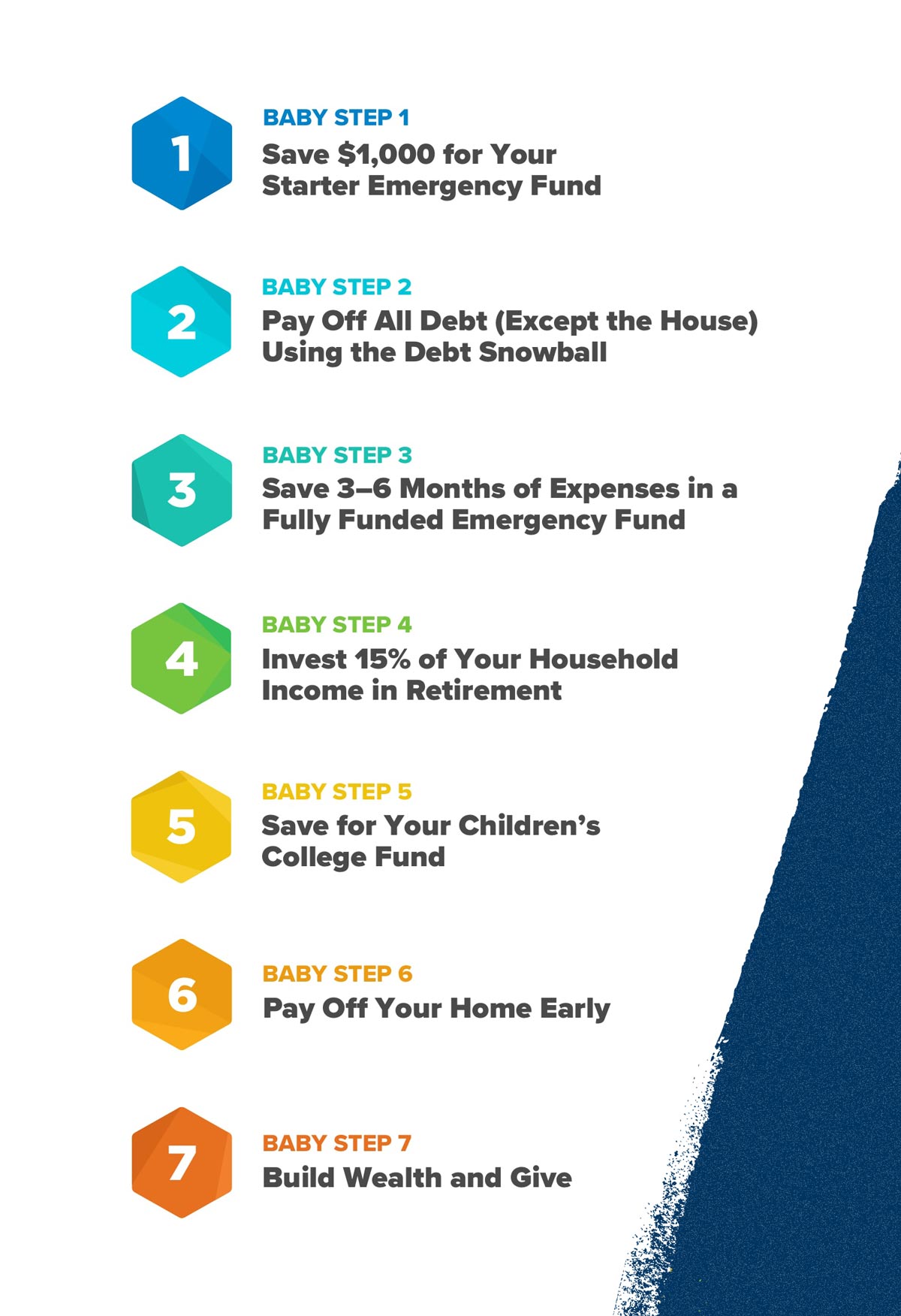
Each of the seven ramsey baby steps builds on the one before it. The order is intentional. You don’t jump ahead, and you don’t go back unless life forces you to. Here’s what each step actually means and how to approach it.
Baby Step 1 — Save $1,000 as Your Starter Emergency Fund
The first of the ramsey baby steps is to save $1,000 as fast as possible. That’s it.
It sounds almost too simple. But this initial amount serves a critical purpose. It creates a buffer between you and the next unexpected expense — a flat tire, a visit to urgent care, a broken appliance — so that you don’t immediately reach for a credit card.
The goal here isn’t to save a comfortable amount. It’s to save a functional amount quickly, so you build confidence and create a little breathing room while you attack your debt.
How do you get there fast? Sell unused items around your house. Cut one subscription you don’t use. Pick up extra shifts or freelance work for a few weeks. The speed matters because momentum matters.
Baby Step 2 — Pay Off All Debt Using the Debt Snowball
This is where the real transformation begins. Baby Step 2 is the heart of the plan, and for many people it’s the longest phase.
Here’s how the debt snowball works: list every debt you have — credit cards, car loans, student loans, medical bills, personal loans — from the smallest balance to the largest. Pay the minimum on everything, then throw every extra dollar you can find at the smallest balance first.
When that debt is gone, take everything you were paying on it and add it to the minimum payment on the next smallest debt. Your payment grows like a snowball rolling downhill. That’s where the name comes from.
You might wonder — why not pay the highest-interest debt first? That would save more money in theory. But the ramsey baby steps aren’t just about math. They’re about behavior.
Research from Northwestern University found that people using the debt snowball approach were more likely to pay off all their debts compared to those using interest-rate-based methods. The quick wins keep motivation high. And motivation is what keeps people going when the process feels slow.
Baby Step 3 — Build a Fully Funded Emergency Fund
Once you’re completely debt-free — except for your house — it’s time to build a real safety net. Baby Step 3 means saving three to six months of living expenses in a liquid savings account.
Calculate your actual monthly expenses: rent or mortgage, utilities, food, insurance, transportation, and essential bills. Multiply that number by three for a leaner fund, or by six if you have a less stable income, dependents, or a single-income household.
This money lives in a high-yield savings account. Not an investment account. Not a checking account. Somewhere accessible but not so accessible that you’ll dip into it casually.
With this step complete, you’ve eliminated all non-mortgage debt and built a financial cushion. From here, every dollar you earn starts working for your future rather than your past.
Baby Step 4 — Invest 15% of Your Household Income for Retirement
Now the ramsey baby steps shift from defense to offense. Baby Step 4 is where wealth-building begins in earnest.
Invest 15% of your gross household income into retirement accounts every month. Not 10%. Not whatever’s left over. A consistent 15%.
The recommended order for where to invest: start with your employer’s 401(k) up to the full employer match, because that’s free money. Then max out a Roth IRA. If you still have room after that, go back and increase your 401(k) contributions.
Ramsey recommends growth stock mutual funds with strong long-term track records. The goal is to let compound interest do the heavy lifting over decades.
This step runs simultaneously with Baby Steps 5 and 6. Once your debt is gone and your emergency fund is built, you work on Steps 4, 5, and 6 at the same time.
Baby Step 5 — Save for Your Children’s College Fund
If you have children, Baby Step 5 is about giving them a financial head start. Ramsey recommends using a 529 college savings plan or an Education Savings Account (ESA) to save for education expenses in a tax-advantaged way.
The goal isn’t necessarily to fund 100% of college. Even covering a significant portion means your children graduate with far less debt — or none at all. That changes their financial trajectory from day one of adult life.
This step runs at the same time as Steps 4 and 6. You balance the three based on your income and priorities.
Baby Step 6 — Pay Off Your Home Early
With retirement investing underway and college savings on track, every extra dollar now goes toward your mortgage. This is Baby Step 6, and for most people it’s the longest and most satisfying.
Make extra principal payments every month. Apply tax refunds and bonuses directly to the mortgage balance. Consider refinancing only if it lowers your interest rate without extending your timeline.
Eliminating your mortgage before retirement fundamentally changes what retirement can look like. Your monthly obligations drop dramatically. Your need for investment income decreases. The stress of owing money to anyone, for anything, simply disappears.
Dave Ramsey calls Baby Step 6 “the big dog.” Once your home is paid off, the final step becomes possible.
Baby Step 7 — Build Wealth and Give Generously
This is the finish line. And it’s also, in Ramsey’s view, the real beginning.
With zero debt, a paid-off home, and a growing investment portfolio, every dollar you earn is fully yours. Baby Step 7 is about continuing to build wealth, diversifying your investments, and living generously.
Ramsey’s famous phrase sums it up well: “Live and give like no one else.” The sacrifice you made during the earlier steps now allows you to help your family, your community, and causes you believe in — without financial strain.
This is what the ramsey baby steps are ultimately pointing toward. Not just financial security, but financial freedom that spills over into the lives of others.
What You Actually Gain When You Follow the Ramsey Baby Steps
A Clear, Stress-Reducing Financial Structure
One of the most underrated benefits of the baby steps plan is how much it reduces decision fatigue. Instead of wondering whether to pay off debt or invest or save, you always know exactly what to do next.
That clarity reduces financial anxiety in a measurable way. Money stops being a source of daily dread and becomes something you’re actively managing and improving. That mental shift alone is worth the effort for many families.
Behavior Change That Actually Sticks
Short-term financial fixes don’t work because they don’t change the underlying habits. The ramsey baby steps are a long-term behavioral system. Each step reinforces a new way of thinking about money — one where you live below your means, avoid debt, and invest consistently.
The sequential structure is key. Because you master each step before moving to the next, the habits compound just like the money does.
Proven Results Across Millions of Families
Ramsey Solutions has been tracking outcomes for over 30 years. The evidence across thousands of real families is consistent: people who follow the ramsey baby steps in order build significantly more wealth over time than those who don’t follow a structured plan.
The debt-free screams on The Ramsey Show aren’t just feel-good moments. They represent real families who paid off tens or even hundreds of thousands of dollars — often in just a few years — by following the plan with intensity and discipline.
Where the Ramsey Baby Steps May Not Be a Perfect Fit
No financial plan is one-size-fits-all. The ramsey baby steps work extraordinarily well for most people, but it’s worth understanding where the plan has real limitations.
The Credit Card Debate
Ramsey is adamant: cut up your credit cards. For people who have consistently misused credit, that’s probably the right advice.
But for disciplined spenders who pay in full every month, credit cards offer real benefits — rewards, travel points, fraud protection, and credit score improvements that affect mortgage rates and even rental applications. The blanket no-credit-card rule may be too extreme for people who use credit responsibly.
The 12% Return Assumption
Ramsey has historically cited 12% as an average annual return on growth stock mutual funds. Critics point out that this is based on long-term market averages and doesn’t account for sequence of returns risk, inflation-adjusted returns, or the more conservative expectations used by most financial planners.
A more balanced assumption of 7-8% real returns is what most independent advisors work with. This doesn’t invalidate the baby steps — it just means your retirement timeline needs to be based on realistic projections.
Mental Health and Life Balance
The intensity of Baby Step 2 — “gazelle intensity” in Ramsey’s words — is motivating for many. For others, the relentless sacrifice can lead to burnout, relationship strain, and a sense that life is entirely on hold.
No financial plan works if you abandon it. It’s okay to build in occasional breathing room, celebrate small wins, and pace the process in a way that’s sustainable for your specific household.
How to Get Started With the Ramsey Baby Steps Today
The best time to start the ramsey baby steps was years ago. The second best time is right now.
Step Zero — Write Out a Monthly Budget
The baby steps cannot work without a budget underneath them. Before anything else, track exactly where your money is going each month.
Ramsey recommends a zero-based budget, where every dollar of income is assigned a specific job before the month begins. The idea is that income minus all spending and saving equals zero — not because you have nothing left, but because every dollar has a purpose.
Tools like the EveryDollar app are built directly around this method. A simple spreadsheet works just as well if you’re willing to use it consistently.
Assess Where You Stand Right Now
Write down every debt you have with its balance, minimum payment, and interest rate. List your monthly income after taxes. List every monthly expense in honest detail.
Most people are genuinely surprised by what this exercise reveals. Subscriptions, dining out, impulse purchases — the numbers add up faster than expected. This moment of clarity is uncomfortable, but it’s also the starting point of everything.
Decide Which Baby Step You’re On — And Commit
Once you have your full financial picture, identify which step in the ramsey baby steps you’re currently on. Don’t try to work multiple steps at once in the early phases. Focused intensity wins over scattered effort every single time.
Find Your ‘Why’ and Build Accountability
Motivation based on feelings comes and goes. Purpose is more durable. Whether your why is your children’s future, the ability to retire without stress, or simply never receiving another collections call — anchor your efforts to something real.
Community also matters. Consider joining a Financial Peace University class, an online forum, or simply finding an accountability partner who knows your goals. Progress accelerates when someone else is watching.
The Ramsey Baby Steps Still Work — If You Work Them
The ramsey baby steps aren’t magic. They don’t promise an easy road or a quick fix. What they promise is a clear path, built on real-world behavior, that has led millions of ordinary people to an extraordinary financial life.
From the starter emergency fund all the way to paying off your home and building generational wealth, each step exists for a reason. The sequence is not arbitrary. The psychology behind it is as intentional as the math.
Is the plan perfect? No. Some elements deserve scrutiny — particularly around credit cards, investment assumptions, and the emotional toll of prolonged sacrifice. A smart financial life incorporates the best of the baby steps while adapting where needed.
But the core of the plan is as sound today as when it was first developed. Spend less than you earn. Eliminate debt with urgency. Invest consistently for the long term. Protect your family with a real emergency fund. Give generously when you can.
Those aren’t radical ideas. They’re just ideas that take discipline to execute — and a clear plan to follow.
If you’re ready to change your financial life, you already have everything you need to begin. Pick the step you’re on, make a budget, and take one action today.
FAQ 1: What are the ramsey baby steps?
The ramsey baby steps are a seven-step personal finance plan created by Dave Ramsey to help people eliminate debt, build savings, and create lasting wealth. The steps must be followed in order: save $1,000 as a starter emergency fund, pay off all non-mortgage debt using the debt snowball, build a full emergency fund of 3–6 months of expenses, invest 15% of household income for retirement, save for children’s college, pay off your home early, and finally build wealth and give generously. The plan was designed to help families ditch debt and build lasting wealth, and it has been used by millions of people over the past 30 years.
FAQ 2: Why does the order of the ramsey baby steps matter so much?
The sequence is intentional and behavioral, not just logical. The steps are sequential — each one has a defined trigger before you move to the next, with no room for creative interpretation or skipping around. Debt.org Starting with a small emergency fund prevents new debt from forming during the payoff phase. Paying off debt before investing focuses your intensity on one goal at a time. Each completed step builds the psychological momentum needed to tackle the next one. Jumping ahead consistently leads to scattered effort and slower results.
FAQ 3: What is the debt snowball, and why do the ramsey baby steps use it instead of the debt avalanche?
With the debt snowball method, you pay off your debt in order from smallest to largest balance, regardless of the interest rate — attacking the smallest debt with everything you have while making minimum payments on the others. Ramsey Solutions The debt avalanche pays highest-interest debts first, which saves more money mathematically. The debt snowball is a brilliant psychological hack — paying off your smallest debt first gives you a quick, powerful win, and that momentum is the fuel that keeps you going. Ramsey Solutions Research from Northwestern University confirms that people using the snowball method are more likely to eliminate all their debts compared to those who use mathematically superior approaches.
FAQ 4: Should I stop investing completely during Baby Step 2 of the ramsey baby steps?
Ramsey recommends pausing all retirement contributions during Baby Step 2 so you can concentrate all energy and resources on getting out of debt — including the money you’ve been setting aside for retirement. Dad is FIRE However, many financial advisors suggest a nuanced exception: if your debt-free journey is going to take more than two years, you should at minimum contribute enough to capture your full employer 401(k) match — because leaving that free money on the table for years is hard to justify. Ramsey Solutions If you can realistically be debt-free in 18–24 months, pausing entirely makes more sense.
FAQ 5: How much should I save in Baby Step 3 of the ramsey baby steps?
Your fully funded emergency fund should cover essential monthly expenses only — housing, utilities, groceries, insurance, and transportation — multiplied by three to six months. AF Morgan Law If your monthly essentials total $4,000, your target range is $12,000 to $24,000. Single-income households or those with variable income should aim for the six-month end of the range, while stable two-income households can target three months. Moneywise This money belongs in a high-yield savings account — accessible but separate from your checking account.
FAQ 6: Why do the ramsey baby steps put retirement savings (Step 4) before college savings (Step 5)?
The reason is straightforward: your kids may or may not go to college, but you will definitely retire. Putting retirement first is not selfish — it’s wise, because sending your children to an expensive university while leaving yourself unable to retire only creates a different financial crisis down the road. AF Morgan Law Additionally, students can take on scholarships, work-study, or community college options. Parents cannot borrow for retirement. Securing your financial future first is the only sustainable order.
FAQ 7: Can I work on multiple ramsey baby steps at the same time?
Yes — but only at the right stage. Baby Steps 4, 5, and 6 are designed to be worked simultaneously — start with saving 15% for retirement, then pour into college savings, and while doing both, also put extra money toward the mortgage. Lionhood Financial In the earlier steps, however, focusing on one at a time is critical. Splitting your attention during Baby Steps 1 through 3 dilutes your intensity and slows progress significantly. Focused effort in the right sequence is what makes the plan work.
FAQ 8: How long does it typically take to complete the ramsey baby steps?
There is no universal answer — it depends entirely on your income, total debt, and household size. Baby Step 2 alone can take anywhere from a few months to several years, especially for those carrying student loans alongside credit card and car debt. Debt-Free Doctor Most families complete Baby Steps 1 through 3 within two to five years. Baby Steps 4 through 6 — which run simultaneously — can take a decade or more, particularly the mortgage payoff in Step 6. The full journey to Baby Step 7 is a long-term commitment, not a sprint.
FAQ 9: What is “gazelle intensity” in the context of the ramsey baby steps?
Gazelle intensity is Dave Ramsey’s term for the level of urgency he encourages during Baby Step 2. The phrase comes from the image of a gazelle sprinting with full effort to escape a cheetah — running as if its life depends on it. In financial terms, it means cutting every non-essential expense, picking up additional income sources, selling unused possessions, and directing every available dollar at debt elimination. It is not meant to last forever, only long enough to clear all non-mortgage debt and build real financial momentum.
FAQ 10: Do the ramsey baby steps work for people with a low income?
The ramsey baby steps provide a structured plan that simplifies personal finance into manageable goals — and this clarity is valuable at any income level. Debt-Free Doctor The timeline will be longer on a lower income, and that’s okay. The foundational principles — spending less than you earn, eliminating debt systematically, and investing consistently — apply regardless of what you make. Research from the Association for Financial Counseling and Planning Education consistently shows that financial knowledge alone does not drive behavior change — execution is the barrier, not income. Debt.org The plan works when the behavior changes, not when the paycheck increases.
FAQ 11: What does Baby Step 7 of the ramsey baby steps actually look like in practice?
In Baby Step 7, you invest in growth stock mutual funds balanced across four types — growth, growth and income, aggressive growth, and international — while continuing to max out tax-advantaged accounts like Roth IRAs and 401(k)s. Amazon Real estate investments paid for in cash are also common at this stage. Equally important is generosity — many people at this step begin tithing or increasing charitable giving substantially. There’s no set percentage for giving, but many people start with a tithe of 10% and increase it over time as their wealth grows.
FAQ 12: What is the difference between the debt snowball and the debt avalanche?
The debt avalanche focuses on paying off debts from highest to lowest interest rate, with the goal of saving the most money in interest over the long run. The debt snowball pays from smallest balance to largest, regardless of interest rate, with the goal of building psychological momentum through quick wins. Ramsey Solutions The choice depends on your personality — if you’re highly disciplined and motivated by mathematical optimization, the avalanche may suit you, but if you need emotional wins to stay motivated, the snowball method works better in practice. Debt-Free Doctor The ramsey baby steps use the snowball exclusively.
FAQ 13: Should I pause the ramsey baby steps debt snowball if I have a financial emergency?
Yes — if you have to use your emergency fund, temporarily pause the debt snowball, make minimum payments on all debts, and rebuild your $1,000 starter emergency fund as fast as possible. Once it’s back to $1,000, restart the snowball. Lionhood Financial The key is not to use the emergency as an excuse to abandon the plan entirely. It’s also worth asking whether the expense truly qualifies as an emergency — planned expenses like birthdays, holidays, routine car maintenance, and vacations do not qualify and should not come out of your emergency fund.
FAQ 14: Where should I keep my emergency fund during the ramsey baby steps?
Both Baby Step 1 and Baby Step 3 funds should be kept in a savings account that is liquid, safe, and separate from your daily checking account. A high-interest savings or money market account with check-writing privileges is the recommended vehicle, so you can access the funds quickly when a true emergency strikes. Moneywise The money should not be invested in the stock market, because its purpose is stability and availability — not growth. A high-yield savings account is the perfect vehicle for this step — your emergency fund needs to be liquid and safe, not subject to market volatility.
FAQ 15: Is it a good idea to buy a house while working through the ramsey baby steps?
Ramsey recommends paying off all your debt and building a fully funded emergency fund before taking on a mortgage — buying a home while still in debt is a recipe for financial stress. Debt.org When you are ready to buy, he recommends a 15-year fixed-rate mortgage with a down payment of at least 10–20%, and your monthly payment should not exceed 25% of your take-home pay. Your emergency fund should remain intact during the home purchase process — keeping your fully funded emergency fund in place is a non-negotiable safety net during a major financial transition like buying a home.
FAQ 16: What is the biggest criticism of the ramsey baby steps?
The most consistent criticism is that the ramsey baby steps don’t account for how long it might take to pay off all non-mortgage debt — for people with large debt loads, delaying retirement investing for five or more years can cost significant compounding growth that is nearly impossible to fully recover. Ramsey Solutions Other common criticisms include the assumption of a 12% investment return, the blanket rejection of all credit cards, and the lack of guidance for households with extremely tight budgets. The most common overall criticism is that the steps are too rigid and one-size-fits-all — they rely on best-case scenarios that don’t reflect the real financial pressure many families face.
FAQ 17: What is a zero-based budget and how does it relate to the ramsey baby steps?
A zero-based budget is a monthly budgeting method where you assign every single dollar of income a specific purpose before the month begins — so that your income minus all spending, saving, and debt payments equals zero. Not because you have nothing left, but because nothing is unaccounted for. A budget creates goals and is the only way to achieve them — and the ramsey baby steps cannot work without one, because budgeting is what reveals where your money is actually going and frees up margin to attack debt and savings aggressively. Moneywise Ramsey’s EveryDollar app is built specifically around this method.
FAQ 18: How do the ramsey baby steps handle student loan debt?
Student loans are treated like any other non-mortgage debt in the ramsey baby steps — they go in the debt snowball in Baby Step 2, listed from smallest balance to largest. Tax debt takes the highest priority in the snowball regardless of balance size, since the government has the power to take money before asking questions — but after tax debt is addressed, student loans follow the standard snowball order alongside credit cards and car loans. Dad is FIRE Ramsey does not recommend income-driven repayment plans as a long-term strategy, instead advocating for aggressive payoff with increased income.
FAQ 19: Why do the ramsey baby steps include paying off your mortgage early (Step 6) instead of investing that money?
Paying off your mortgage is a guaranteed, risk-free return equal to your mortgage interest rate — and in a volatile market, that guarantee provides invaluable peace of mind. Ramsey Solutions Critics argue that mortgage interest rates are often low enough that investing the extra money would yield greater long-term returns. Ramsey’s counterpoint is behavioral and emotional: paying off your home early means no mortgage payment, total financial freedom, and the ability to enter retirement with dramatically lower monthly obligations — and that freedom changes what your financial life can look like in every stage that follows.
FAQ 20: What is Financial Peace University and how does it connect to the ramsey baby steps?
Financial Peace University (FPU) is a nine-week personal finance course developed by Dave Ramsey that walks participants through the ramsey baby steps in a structured group setting, with video lessons, workbooks, and community accountability. It is available both in-person through local churches and organizations and online through Ramsey Solutions. Ramsey’s approach recognizes that personal finance is 80% behavior and only 20% head knowledge — and FPU is designed to address that behavioral gap through community, repetition, and guided implementation of each step. Check City Many people who have struggled to follow the baby steps alone find the group accountability format significantly increases their success rate.