There is a moment in season four of Yellowstone when a character turns to a young cowboy named Jimmy and says something that made millions of viewers pause their screens and reach for Google.
“There are three Gods in Texas: the Almighty himself, Buster Welch, and George Strait.”
For horse people, ranchers, and anyone who had spent time in the American West, that line needed no explanation. They already knew. But for the rest of the world — the tens of millions of viewers who had never set foot inside a cutting pen — it raised a single burning question: who exactly is this man?
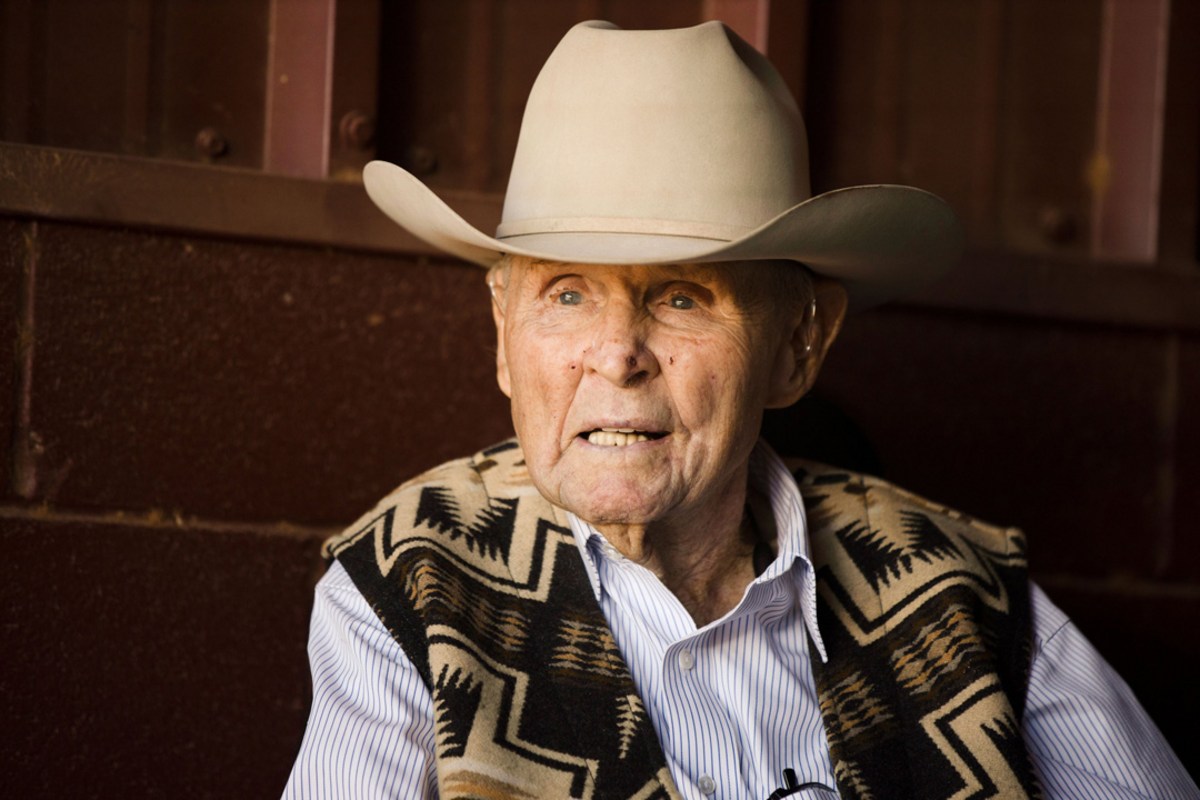
The answer is one of the most remarkable stories in American Western history. Buster Welch was not a fictional character, not a folklore invention, and not a television creation. He was a real man. A genuine Texas cowboy who ran away from home at thirteen, spent the better part of eight decades in the saddle, won more cutting horse championships than almost anyone alive, and quietly shaped the entire performance horse industry from the ground up — all without ever chasing fame.
This is the full story of who Buster Welch was, what he built, why an entire industry still moves in the direction he pointed, and why a television show thought it fitting to call him one of the three Gods of Texas.
Who Is Buster Welch? The Man Behind the Name
Fay Owen “Buster” Welch was born on May 23, 1928, north of Sterling City, Texas, on the divide between the Concho and Colorado rivers. His mother died shortly after he was born. He was raised by his grandparents — his grandfather a retired peace officer, his grandmother a steady hand on a stock farm — in the kind of remote, rugged West Texas that builds either hard men or broken ones.
Buster became a hard one.
From the time he could ride, he wanted to be a cowboy. Not a romanticized movie cowboy. A real one. The kind who woke before the sun, broke rough horses, and worked cattle in country where the heat could kill you in July and the blue northers could freeze your hands to the reins in January.
He had only an eighth-grade education. By his own account, school never quite held the same pull as the stockyards did. As a child, he would skip class to go watch the horse traders, the bronc riders, and the wranglers work. He was absorbing knowledge — not from textbooks, but from horseback.
At thirteen years old, he made up his mind and ran away from home.
It sounds dramatic. But in the world Buster grew up in, it was simply the beginning of a career. He started working for the Proctor brothers in Midland, then moved to the Long X Ranch in Jeff Davis County, and eventually found his way to the famed Four Sixes Ranch in Guthrie. Before he turned eighteen, he had already worked on some of the most storied ranches in Texas history. He broke broncs. He grubbed prickly pear. He wrangled horses and moved cattle and did every dusty, unglamorous job that comes before anyone ever puts a trophy in your hand.
Despite having no formal education past middle school, he was a voracious reader for the rest of his life. He absorbed everything — history, science, philosophy, animal behavior. People who sat and talked with him for an hour often came away shaking their heads, not quite believing that the old cowboy with the worn hat and the quiet voice had just out-thought them on every subject they raised.
That curiosity, combined with decades of practical experience, is what eventually made him the greatest cutting horse trainer the sport has ever seen.
The Rise of Buster Welch: From Ranch Hand to Champion
The National Cutting Horse Association was formed in 1946. For a young cowboy with Buster’s skill and competitive instinct, it was a perfect vehicle.
He entered his first serious competition at eighteen, riding a horse named Chickasha Mike — a horse he had bought from a man named Homer Ingham for $125. That horse won his first five competitions in 1952. The cutting horse world took notice.
But it was a mare named Marion’s Girl who made Buster famous.
Marion Flynt, a Texas oilman, was so impressed with the young trainer’s ability that he sent his mare to Buster for training. What followed was nothing short of extraordinary. Marion’s Girl won the NCHA World Championship in 1954. They rested her in 1955, brought her back in 1956, and she won the title again. In a sport where one championship is a career achievement, two on the same horse announced that something different was happening here.
Over the following decades, Buster won the NCHA World Championship four times and the NCHA World Championship Futurity five times. The names of the horses he rode to those titles read like a hall of fame roster on their own: Money’s Glo, Chickasha Glo, Rey Jay’s Pete, Dry Doc, and eventually — the horse that would become his greatest — Peppy San Badger.
In 1974, he signed on with the legendary King Ranch. Riding Mr San Peppy under their banner, he won the NCHA World Championship two more times. But it was Mr San Peppy’s son — a young horse people called “Little Peppy,” formally registered as Peppy San Badger — that became the capstone of a life’s work. Together, Buster and Little Peppy won the 1977 NCHA Futurity. Little Peppy went on to become one of the most influential sires in Quarter Horse history. His bloodlines still dominate cutting competition today, nearly five decades later.
Think about what that means. Every time a modern cutting horse steps into the pen and reads a cow with that quiet, low-headed intensity, there is a reasonable chance that horse carries the genetics Buster Welch identified, developed, and placed before the world.
How Buster Welch Changed the Entire Sport
Winning is one thing. Plenty of people have won championships without changing the nature of their sport. Buster did something rarer — he rebuilt cutting from the inside out.
He co-founded the NCHA Futurity. In 1962, Buster and a group of competitors created the NCHA Futurity, an event for three-year-old horses who had never previously been shown. The first event was held at the Nolan County Coliseum in Sweetwater, Texas. What seemed like a simple competition became a transformative institution. The Futurity created a new economic engine for the sport — a recurring, high-stakes event that gave trainers, breeders, and owners a clear goal to work toward every year. Today it is one of the richest equine events in the world.
He redesigned the equipment. Most people outside the horse world do not realize that the saddles and tack used by cutting horse competitors today were largely shaped by Buster’s innovations. He developed saddle designs and bitting philosophies that changed how trainers worked with horses at every level. Walk into almost any cutting barn in Texas today and you will find Buster Welch’s influence in the equipment hanging on the wall.
He popularized the round pen. His approach to starting and refining horses in a round pen — using pressure and release within a contained space — drew on natural herd behavior and became a foundational technique across disciplines, not just cutting.
He gave freely. Perhaps most remarkably for a man at the top of a fiercely competitive sport, Buster was famously generous with his knowledge. He would teach competitors. He would stop and explain something to a young trainer even if that trainer might beat him next weekend. Austin Shepard, who earned over $9.1 million in NCHA competition, put it simply: “Anybody that has ridden a cutting horse has been influenced by him whether they know it or not.”
His approach to the horse itself was philosophical. He believed in reading the animal, not forcing it. One of his most quoted lines captures the idea: “When you correct a horse, try to time it so well that they think the cow did it to them.” That is not just a training tip. That is a worldview. It says that the horse’s understanding matters more than the rider’s authority — a genuinely humane and effective approach that set him apart from nearly every trainer of his era.
Buster Welch on Yellowstone: The Cameo That Started a Conversation
In 2021, Yellowstone season four introduced millions of people to a name the cutting horse world had revered for generations.
The scene is set at the 6666 Ranch — a real working ranch in Guthrie, Texas, which just so happens to be one of the places Buster actually worked as a young man. Jimmy, the young rodeo hand played by Jefferson White, is brought to the ranch as a kind of last chance at becoming a real cowboy. And there, amid the dust and horses and cattle, he is introduced to an old man the show identifies simply as himself.
The line about the three Gods of Texas plays, and the audience understands immediately that they are watching something different. This is not a fictional mentor figure. This is the actual legend the show is referencing.
The creators of Yellowstone, led by Taylor Sheridan — himself a horseman and rancher — made a deliberate choice to cast Buster as himself rather than inventing a character based on him. The decision said everything. You do not need to fictionalize someone whose real story is already this good.
Buster was in his early nineties when the scene was filmed. He was sharp, present, and entirely himself. That appearance introduced him to an audience that had no idea he existed — young viewers, international fans, city dwellers who had never sat on a horse in their lives. And many of them went looking afterward. The internet searches spiked. The articles got written. The tributes poured in from people who had never been to West Texas but felt they understood something real and important after watching that scene.
When Buster passed away the following year, fans of the show sent condolences alongside the cowboys and horsemen who had known him their whole lives. One viewer wrote online: “Thank you for introducing Buster to those of us who didn’t know of his legendary history. After that episode, I did the research.”
That may be the best possible summary of what that cameo accomplished.
Ranch Life, Personal Legacy, and Net Worth
Beyond the trophies and the television appearances, Buster Welch was, at his core, a rancher.
He and his wife, Sheila Morris Welch, built one of the most impressive ranching operations in West Texas. Sheila was no supporting figure — she was a serious cutting horse competitor in her own right, eventually earning over $1 million in NCHA competition across her career. Together, they built a partnership that was both personal and professional, a shared life shaped entirely around cattle, horses, and the land.
In the late 2000s, they sold their 25,000-acre Double Mountain River Ranch and moved to the adjacent 18,000-acre Chriswell Ranch. Over time, through leased and owned acreage, they expanded their operation to over 60,000 acres. Their cattle brand, the B Lazy W, supplied naturally raised beef to retail markets.
Sheila died on December 7, 2014, at age seventy-six. Buster continued ranching and training afterward, staying active in the sport and on horseback well into his nineties. He is survived by his children, stepchildren, and sixteen grandchildren.
As for net worth — no verified public figure exists for Buster Welch, and he was not the kind of man who spoke about money in those terms. But the context makes certain things clear. Decades of NCHA prize money, a consulting relationship with King Ranch, land holdings of over 60,000 acres, a breeding program whose genetics still command premium prices, and a career that spanned more than seven decades in a high-dollar industry — all of this paints a picture of a man who built genuine, lasting wealth. More importantly, he built a name whose value in the Western world was incalculable.
Awards, Hall of Fame Honors, and Recognition
The awards Buster Welch accumulated over his lifetime are genuinely staggering in scope. They include induction into the NCHA Members Hall of Fame, the NCHA Rider Hall of Fame, the American Quarter Horse Hall of Fame, and the Texas Cowboy Hall of Fame.
In 2012, he received the National Golden Spur Award for his outstanding contributions to the ranching and livestock industry. He also earned the Charles Goodnight Award, the AQHA 30 Year Breeder Award, the Western Horseman Award, and the Foy Proctor Memorial Cowman’s Award, among others.
What makes this list extraordinary is that most of these honors are not for a single achievement. They represent an entire career’s worth of contribution across competition, breeding, training methodology, equipment innovation, and institutional building. Very few people in any sport hold honors across that many categories simultaneously.
His Final Chapter and What He Left Behind
Buster Welch died on June 12, 2022, at the age of ninety-four, in Abilene, Texas.
The tributes came immediately and from every corner of the horse world. Taylor Sheridan posted a remembrance calling his legacy one that had “changed the performance horse world forever.” Trainers who had competed against him for decades wrote about what he had given them. Young riders who had never met him in person wrote about watching his technique on old footage and understanding, finally, what it meant to truly feel a horse.
He stayed horseback until near the very end. That fact alone says everything about who he was. This was not a man who retired into nostalgia. He continued to work, to train, to read cattle and read horses the way he had been doing since before most of the people writing tributes about him were born.
The sport he helped create is richer, more sophisticated, and more widely respected because he existed. The bloodlines he developed are running in cutting pens from Texas to Australia. The saddles built on his designs are in barns across the American West. The training ideas he popularized are now taught as fundamentals.
And thanks to a single television scene, millions of people around the world now know his name — even if they could not tell you a single thing about a cutting horse pen.
That is a legacy.
Conclusion
There are people who leave a sport better than they found it. Then there are people like Buster Welch — who essentially built the sport, shaped the horses running in it, trained the trainers competing in it, and then, in their nineties, quietly showed up on the most-watched television drama in America and reminded everyone exactly why some legends are simply irreplaceable.
He ran away from home at thirteen with nothing but a desire to work with horses. He left behind bloodlines that will run in cutting pens for generations, techniques that changed the way humans communicate with horses, an institution in the NCHA Futurity that transformed the economics of an entire sport, and a name that a prime-time television show used as shorthand for the highest possible human achievement.
In the end, the Yellowstone line got it right. Not because it was dramatic. But because it was accurate. In the world that Buster Welch spent his entire life building, that is exactly the category he belongs in.
✅ FAQ 1: Who was Buster Welch?
Fay Owen “Buster” Welch (May 23, 1928 – June 12, 2022) was an American cutting horse trainer and inductee into the NCHA Members Hall of Fame, American Quarter Horse Hall of Fame, NCHA Rider Hall of Fame, and Texas Cowboy Hall of Fame. Wikipedia He is widely regarded as the single greatest influence on the modern cutting horse industry, winning the NCHA World Championship four times and the NCHA Futurity five times across a career that spanned more than seven decades.
✅ FAQ 2: What is Buster Welch famous for?
Buster Welch is famous for being the most decorated and influential cutting horse trainer in American history. By the time he was 26, he became a world champion cutting horse trainer, riding Marion’s Girl to the title. By the age of 32, he helped create the National Cutting Horse Association’s pre-eminent event, the NCHA Futurity. Brewing Happiness Beyond championships, he also redesigned training saddles, popularized the round pen method, and generously mentored generations of competitors.
✅ FAQ 3: What episode of Yellowstone is Buster Welch in?
Welch appeared as himself in the popular television series Yellowstone in the fifth episode of the fourth season, “Under A Blanket Of Red.” Fandom In the scene, ranch hand Kory Pounds introduces Jimmy Hurdstrom to Buster Welch with the now-iconic line: “There’s three gods in Texas: the Almighty Himself, Buster Welch, and George Strait. You just met one of ’em.”
✅ FAQ 4: Is Buster Welch a real person or a fictional character in Yellowstone?
Buster Welch was a real person, not a fictional character. Though a new generation of Western enthusiasts might know him as “one of the three gods in the state of Texas” from his cameo in season 4 of Yellowstone, Welch was a legend long before this television appearance. Ranchingheritage The creators of Yellowstone cast him as himself — a deliberate choice to honor the authentic ranching world the show portrays.
✅ FAQ 5: When did Buster Welch die?
Buster Welch passed away on June 12, 2022. Buster Welch passed away peacefully at home in Abilene, Texas, on June 12. Chtolive He was 94 years old at the time of his death. He had remained active in ranching and horse training well into his final years, and as those close to him noted — he stayed horseback until the very end.
✅ FAQ 6: Where was Buster Welch born and raised?
Buster Welch was born on May 23, 1928, near Sterling City, Texas. He was born and raised to early childhood near the divide of the Colorado and Concho Rivers, north of Sterling City, Texas. His mother died shortly after his birth, leaving his grandparents to raise him for a time on their stock farm. Fandom His grandfather was a retired peace officer, and it was on that West Texas stock farm that his lifelong love of horses and cattle first took root.
✅ FAQ 7: How old was Buster Welch when he left home to become a cowboy?
At age 13, he left home permanently and landed a job breaking horses, working large herds of cattle, and tending to various other ranch chores for cattlemen Foy and Leonard Proctor in Midland, Texas. Fandom Before he turned eighteen, he had already worked on some of the most famous ranches in Texas, including the Long X Ranch, the Four Sixes, and the Pitchfork Ranch — building the foundation for everything that followed.
✅ FAQ 8: What was Buster Welch’s most famous horse?
Buster Welch trained many champion horses throughout his career, but two stand above the rest. Marion’s Girl, a mare owned by oilman Marion Flynt, became a two-time NCHA World Champion under his care. A son of Mr San Peppy, Peppy San Badger, more commonly known as “Little Peppy,” became Buster’s magnum opus. Together they won the 1977 Futurity. Little Peppy went on to become one of the breed’s most influential sires. Brewing Happiness Little Peppy’s bloodlines still dominate cutting competition worldwide today.
✅ FAQ 9: How many times did Buster Welch win the NCHA World Championship?
Buster won the NCHA World Championship four times, and the NCHA World Championship Futurity five times. The most notable horses he trained include Marion’s Girl, Chickasha Mike, Money’s Glo who he trained and in 1962 won the first NCHA World Championship Futurity, in 1963 he won it on Chickasha Glo, in 1966 on Rey Jay’s Pete, in 1971 on Dry Doc, and in 1977 on Peppy San Badger. He won the NCHA World Championship on Marion’s Girl in 1954 and 1956.
✅ FAQ 10: Did Buster Welch help create the NCHA Futurity?
Yes. In 1962, Welch and other competitors started the NCHA Futurity — an event for 3-year-old horses who have not been shown before. The NCHA Futurity held its first event at the Nolan County Coliseum in Sweetwater, Texas. Wikipedia Buster won that inaugural Futurity himself on a horse called Money’s Glo, marking 224 points and earning $3,838. Today the Futurity is one of the richest equine events in the world.
✅ FAQ 11: What halls of fame is Buster Welch inducted into?
He won the National Cutting Horse Association World Championship four times and the NCHA World Championship Futurity five times and was inducted into the NCHA Members Hall of Fame, the American Quarter Horse Hall of Fame, and the Texas Cowboys Hall of Fame. He also received the Charles Goodnight Award and AQHA’s 30 Year Breeder Award. Ranchingheritage He was additionally inducted into the NCHA Rider Hall of Fame and received the Western Horseman Award and the Foy Proctor Memorial Cowman’s Award among many other honors.
✅ FAQ 12: What was the National Golden Spur Award given to Buster Welch?
Buster was chosen as the recipient of the 2012 National Golden Spur Award for his “outstanding contributions to the ranching and livestock industry.” Wikipedia This award is one of the most prestigious recognitions in the American Western ranching world, given to individuals whose lifetime contributions have meaningfully shaped the ranching way of life. Buster received it on September 7, 2012, in Lubbock, Texas.
✅ FAQ 13: Was Buster Welch’s wife also a horse trainer?
Yes — and an accomplished one. His wife, Sheila Welch, was an accomplished cutting horse rider and trainer, with over $1 million in Equi-Stat earnings. Born in Fresno, California, Sheila initially pursued various sports before discovering her passion for horses. She moved to Texas in 1966, where she met Buster. By 1972, they were married. Texas Monthly They ran their West Texas ranch together until Sheila’s passing on December 7, 2014, at age 76.
✅ FAQ 14: How much education did Buster Welch have?
Though possessing only an eighth-grade education, Buster was a voracious reader and lifelong learner. Ranchingheritage He ran away from home at thirteen to work cattle ranches before formal schooling was complete. Despite that, people who spent time with him — from working cowboys to heads of state — consistently remarked on his intellectual depth, historical knowledge, and philosophical understanding of horses, land, and people.
✅ FAQ 15: Is there a statue of Buster Welch?
Yes. Artist Kelly Graham gave the city council a bronze sculpture of Buster Welch riding Little Peppy and cutting a cow. In 2019, the council found the perfect spot for the statue, right next to Gate 42 at the Will Rogers Memorial Center. Cowboys & Indians The statue was unveiled during a ceremony at the 2019 NCHA Futurity in Fort Worth, Texas. It stands as a permanent tribute to his legacy in the heart of the cutting horse world.
✅ FAQ 16: Where did Buster Welch work before becoming a cutting horse champion?
After leaving the Proctors’, he honed his horsemanship skills working for prominent ranches including the 6666 Ranch, Pitchfork Ranch, and King Ranch. Ranchingheritage He also worked for the Long X Ranch in Jeff Davis County. These legendary ranches gave him the cattle experience, horsemanship foundation, and deep cow sense that later made him virtually unbeatable in the cutting horse pen.
✅ FAQ 17: What did Buster Welch’s first cutting horse cost him?
On Shoemaker’s urging, Welch decided to purchase a six-year-old unbroken stallion named Chickasha Mike for $125 from Ingham. Wikipedia That $125 purchase proved to be one of the greatest investments in cutting horse history. Welch broke the horse himself, worked him on cattle, and by 1952, Chickasha Mike had won his first five cutting competitions. Welch eventually sold the horse for $8,500 — a remarkable return — and Chickasha Mike went on to become an influential sire in the Quarter Horse world.
✅ FAQ 18: Was Buster Welch inducted into the Texas Trail of Fame?
Yes. Fay Owen “Buster” Welch, renowned cutting horse trainer who died in June, was one of nine new inductees that year, which include actors Robert Duvall and Sam Elliott. 9NEWS The Texas Trail of Fame consists of bronze stars on sidewalks in the Fort Worth Stockyards honoring individuals who made major contributions to the creation or preservation of the Western way of life. The unveiling ceremony was held in October 2022 in Fort Worth.
✅ FAQ 19: What did Buster Welch say about training cutting horses?
Buster Welch was famously philosophical about the relationship between horse, rider, and cow. One of his most quoted lines is: “When you correct a horse, try to time it so well that they think the cow did it to them.” He said: “It’s a pleasure to work cattle on a good cutting horse. It is the biggest pleasure that you can enjoy, to have that horse working with you and outsmarting that cow with you, anticipating a cow’s movement. You naturally identify more with that horse than you would with an ordinary horse.”
✅ FAQ 20: How big was Buster Welch’s ranch in Texas?
In the late 2000s, they sold their 25,000-acre Double Mountain River Ranch, and moved to the adjacent 18,000-acre Chriswell Ranch. Buster continued to train cutting horses and managed to expand the ranch to include both leased and owned land comprising over 60,000 acres. Wikipedia He and Sheila also ran cattle under the “B Lazy W” brand, supplying the retail demand for naturally raised beef.
✅ FAQ 21: How did Buster Welch change cutting horse equipment and saddle design?
Buster developed styles of saddles and tack that changed horse training and showing and remain in use by most of today’s competitors. More than that, he developed a reputation as one focused on the greater good of the sport. Brewing Happiness His innovations in saddle design, bit selection, and overall tack philosophy were driven by one central idea — that equipment should help the horse move freely and naturally, not restrict it. Walk into almost any serious cutting barn today and you will find equipment shaped by his influence.
✅ FAQ 22: Did Buster Welch work for King Ranch?
Yes. In 1974 he signed on with the fabled King Ranch. Riding Mr San Peppy under their banner, he won the NCHA World Championship two more times. Brewing Happiness His consulting relationship with the King Ranch placed him at the center of one of the most storied ranching operations in American history. The horses he developed during that period — especially Mr San Peppy and ultimately Peppy San Badger — became some of the most influential animals in Quarter Horse breeding history.
✅ FAQ 23: Why did Yellowstone creator Taylor Sheridan include Buster Welch in the show?
Taylor Sheridan, himself a horseman and cutting horse enthusiast, made a deliberate choice to feature Buster Welch as himself rather than creating a fictional character inspired by him. The creators consciously decided to feature Welch as himself rather than creating a fictional character based on him. This choice speaks to the respect and admiration the ranching community holds for Welch. HELLO! Sheridan also contributed financially to the NCHA Charities Foundation, and funds were directed toward the maintenance of the Buster Welch bronze statue at Will Rogers Memorial Center in Fort Worth.
✅ FAQ 24: What is Buster Welch’s lasting legacy in the horse world?
The legacy of Buster Welch is best measured not in trophies but in the ripple effect he sent through every part of the cutting horse world. He brought a level of class and dignity to cutting that remains a hallmark of the sport today. Brewing Happiness His bloodlines run in cutting pens from Texas to Australia. His saddle designs hang in barns across the American West. His training philosophy is taught as fundamental curriculum. And as NCHA champion Austin Shepard once said — anybody who has ever ridden a cutting horse has been influenced by him, whether they know it or not.