Imagine a snake that looks like a child drew it — stubby, thick-bodied, with two googly eyes planted directly on top of its head. It barely reaches 15 inches long, lives buried in the desert sand, and has absolutely no interest in being the center of attention. That snake is the Arabian sand boa, and it is one of the most fascinating, underrated reptiles in the pet hobby today.
Most people who stumble across this species either burst out laughing at how odd it looks or immediately want to know everything about it. Both reactions are completely valid. This little desert oddity is genuinely unlike any other snake you will encounter — compact, hardy, non-venomous, and surprisingly manageable for a first-time reptile keeper, once you understand what it actually needs.
This guide covers everything. From where it comes from and what makes its biology so unusual, to building the right enclosure, feeding it properly, finding one from a responsible source, and keeping it healthy for the long haul. By the end, you will know exactly whether this is the right animal for you.
What Exactly Is the Arabian Sand Boa?
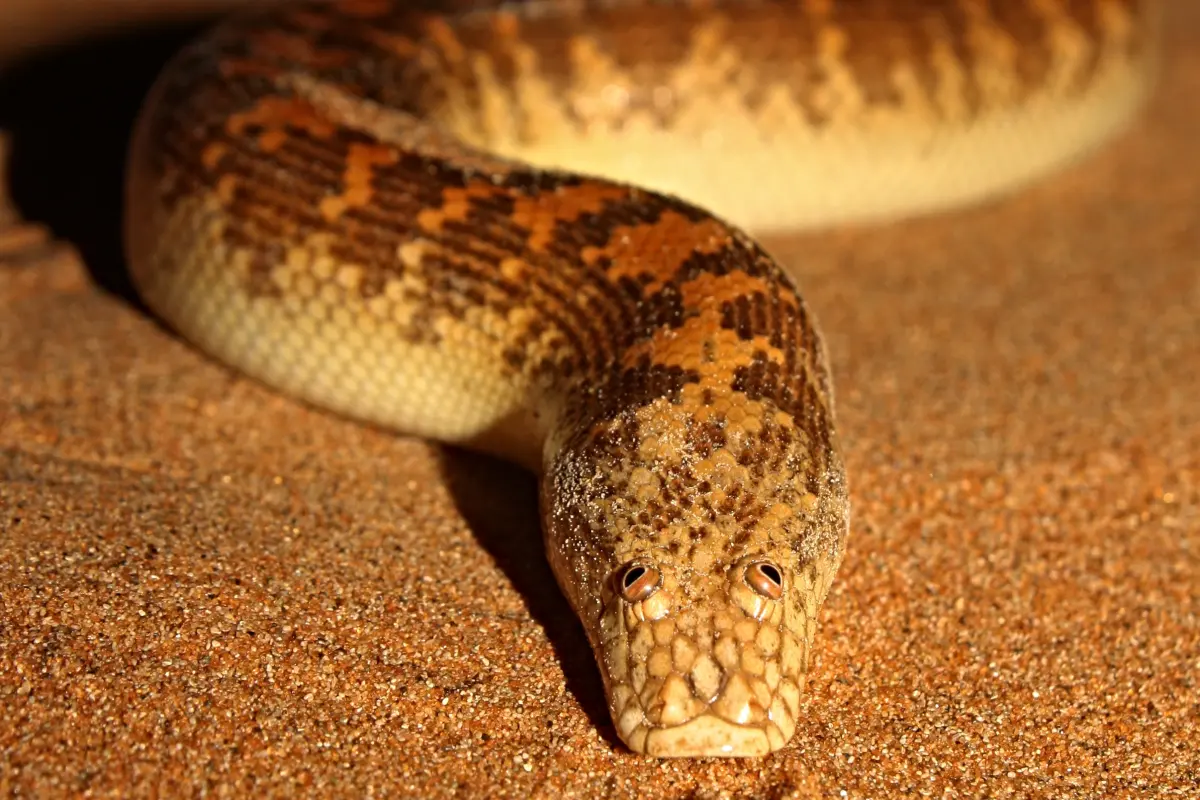
The Arabian sand boa, known scientifically as Eryx jayakari, belongs to the family Boidae — the same family that includes pythons and some of the largest snakes on Earth. Do not let that intimidate you. This particular member of the family tops out at roughly 38 centimeters, or about 15 inches, making it one of the smallest boas in existence.
It carries two common names. Most people call it the Arabian sand boa. Others use Jayakar’s sand boa — a name honoring Atmaram Sadashiv Jayakar, a 19th-century Indian surgeon and naturalist who played a key role in early documentation of the species.
What separates this snake from nearly every other boa in the world is something most people do not expect: it lays eggs. Almost all members of the Boidae family give birth to live young. Eryx jayakari, along with Muller’s sand boa, breaks that rule entirely. It is one of only two known egg-laying species within the entire Boidae family — and that alone makes it a genuinely remarkable animal from a biological standpoint.
There are no color morphs available for this species. Unlike the Kenyan sand boa, which has been bred into dozens of different patterns and colors over decades of captive breeding, what you see in nature is essentially what you get here. That simplicity is part of its charm.
Natural Habitat — Where This Snake Actually Comes From
The natural range of this species spans the full breadth of the Arabian Peninsula. It is found in Saudi Arabia, Oman, Yemen, Kuwait, and parts of southern Iran — specifically in the Khuzestan, Bushehr, and Kerman provinces. Within this range, it sticks to sandy deserts, dune fields, dry scrublands, and rocky terrain with loose, well-draining soil.
It is the only boa species native to the Arabian Peninsula. That distinction matters because the desert environment it evolved in is extreme — scorching heat during the day, steep temperature drops at night, almost no rainfall, and very little shelter above ground.
To survive those conditions, the species became a burrower. It spends daylight hours buried deep beneath the sand where temperatures are more stable and the risk of predation is lower. As dusk arrives, it shifts toward the surface, positioning itself just below the top layer with only its eyes — those famously top-mounted eyes — poking above the sand. From there, it waits. Patiently and completely motionless, it watches for geckos, worm lizards, and small rodents to pass close enough to strike.
The conservation status sits at Least Concern according to the International Union for Conservation of Nature. Wild populations are considered stable across their natural range. That said, habitat loss from urbanization, agricultural expansion, and oil exploration continues to put pressure on desert ecosystems across the region, making responsible sourcing in the pet trade a real concern worth taking seriously.
Physical Characteristics of the Arabian Sand Boa Snake
The physical appearance of the Arabian sand boa snake is one of the main reasons people fall in love with it. There is simply nothing else quite like it.
Size and Build Adults typically reach between 13 and 15 inches in total length, though some individuals push closer to 20 inches. The body is thick, cylindrical, and muscular relative to its length, giving it a stout, almost stubby look. The tail is short and blunt. The head blends almost seamlessly into the body — which is why so many people describe it as looking like a living noodle.
The Eyes This is the feature that defines the species visually. The eyes sit higher on the head than those of any other sand boa species. Positioned directly on top and facing upward, they allow the snake to scan for approaching prey while its entire body remains buried. It is a perfect evolutionary adaptation — and it also happens to look absolutely ridiculous in the best possible way.
Color and Pattern The base coloration runs from yellowish-gray to sandy brown to pale orange, covered in irregular dark brown or black banding and blotching. The belly is pale and clean. The overall effect blends the snake into desert sand so effectively that spotting one in the wild is genuinely difficult.
Sexual Dimorphism Telling males and females apart is relatively straightforward. Females are noticeably larger and have blunter, shorter tails. Males are slimmer with proportionally longer tails. This difference becomes more obvious as the animals mature.
Arabian Sand Boa Teeth — What Every Owner Needs to Know
One of the most common questions new owners ask is about the teeth. This species is completely non-venomous. It has no venom glands and poses no toxicological risk whatsoever to humans. It kills prey by constriction — wrapping its body around a small animal and squeezing until it can no longer breathe.
The teeth themselves are small, sharp, and rear-facing. They are designed to grip slippery prey like geckos and small rodents, not to cause serious damage to anything larger. A bite will produce a small scratch or a ring of pinprick marks. It stings briefly and bleeds minimally. Clean the area with soap and water, apply a small antiseptic if you prefer, and move on.
What catches new owners off guard is the manner of the strike. Most snakes telegraph a bite — they coil back, hiss, flatten out, or show some kind of warning posture. The Arabian sand boa tends to strike sideways, with very little advance notice. It flicks its head laterally rather than lunging straight forward, which is a carry-over from its ambush hunting technique in the wild. If you are not expecting it, the sideways motion can be alarming. Understanding this behavior ahead of time eliminates the shock factor considerably.
A well-handled, calm individual will rarely bite at all. The response is almost always stress-related, appearing most often in animals that have not been socialized to regular human contact.
Temperament and Handling — Is This a Good Pet?
The temperament of this species is generally described as calm but shy. These are not snakes that actively seek out human interaction. Left to their own devices, most will burrow immediately and stay buried for the majority of the day. They are nocturnal animals, so their active period does not overlap much with a typical human schedule.
With that said, regularly handled individuals do settle down considerably. A snake that is picked up gently and consistently from a young age will become tolerant and will move calmly across your hands without trying to escape or bite. Patience matters more than frequency here. Forcing interaction when the snake is stressed or newly acquired will always backfire.
Who is this snake best suited for?
- Beginners who are comfortable with a lower-interaction pet
- Reptile keepers who enjoy observing natural behavior more than regular hands-on time
- Anyone who appreciates a hardy, low-maintenance animal with a long lifespan
- People with limited space, since the enclosure requirements are modest
This is not the right choice for someone who wants a snake they can handle daily right out of the box, or for anyone expecting a display animal that is always visible and active. This is a creature you watch and appreciate on its own terms.
Setting Up the Perfect Enclosure for Your Arabian Sand Boa
Getting the enclosure right is the single most important thing you can do for this species. Fortunately, the requirements are not complicated once you understand the reasoning behind each element.
Tank Size and Structure
A minimum of 15 gallons is needed for one adult. A 20-gallon enclosure is better and gives the snake more room to establish a natural temperature gradient. Floor space matters more than height — this is a ground-dwelling, burrowing species, so width and length are what count. A standard enclosure measuring roughly 20 inches long by 10 inches wide and 10 inches tall works well. Use a glass or plastic terrarium with a secure, escape-proof mesh lid. These snakes are escape artists if any gaps exist.
Substrate
Despite the desert origins of this species, sand is not the best substrate in captivity. When a snake ingests sand during feeding, it can cause an impacted digestive tract — a potentially fatal condition. Wet sand also clumps, raises humidity, and can get into the snake’s mouth in ways that create real problems.
The recommended approach is a mixture of approximately three parts topsoil to one part sand. This blend allows burrowing while keeping ingestion risk low. Aspen snake bedding also works well as a standalone option. Whatever substrate you choose, maintain a minimum depth of two inches to allow the snake to fully conceal itself.
If you feed your snake in a separate container — a practice many experienced keepers follow — you can use a higher percentage of sand in the main enclosure without as much concern.
Temperature
The ambient temperature inside the enclosure should sit between 85 and 88 degrees Fahrenheit. Use an under-tank heating pad on one side to create a gradient, with a warm side and a noticeably cooler side dropping to around 75 to 78 degrees. This gradient allows the snake to self-regulate its body temperature, which is critical to proper digestion and immune function.
A digital thermometer with probes on both sides gives accurate, reliable readings. Avoid stick-on dial thermometers — they are notoriously inaccurate and can mislead you into dangerous temperature errors.
Lighting
These snakes are nocturnal and do not need intense lighting. However, maintaining a consistent 12-hour day and 12-hour night cycle is important for their circadian rhythm. A basic LED or low-output bulb on a digital timer handles this easily. Some keepers add a 5.0 UVB bulb during daylight hours. While not strictly required, UVB exposure supports natural behavior, aids calcium absorption, and may contribute to long-term health.
Humidity
The target humidity range is 30 to 40 percent. Use a hygrometer to monitor this accurately. If humidity climbs above 50 percent consistently, respiratory infections become a real risk. If it drops too low, shedding becomes difficult and retained shed can cause circulation problems around the toes and tail tip.
When your snake is approaching a shed, place a small hideaway filled with damp sphagnum moss on the warm side of the enclosure. The snake can enter this moist hide to soften its skin and facilitate a clean, complete shed. Once shedding is done, remove or dry out the moss to bring humidity back down.
Water
Fresh water should be available every day in a non-porous bowl placed on the cool side of the enclosure. Keeping it on the cool side slows evaporation and prevents unnecessary humidity spikes. This species does not drink heavily, but access to clean water is non-negotiable.
Hides and Enrichment
Provide at least two hides — one on the warm side and one on the cool side. Half-logs, cork bark pieces, and smooth plastic hides all work well. Keep the enclosure simple. Rocks can be added for texture and enrichment, but make sure they are stable and cannot shift to crush the snake underneath.
Feeding Your Arabian Sand Boa
In the wild, this species preys on short-fingered geckos, Baluch rock geckos, worm lizards, and occasionally small rodents. In captivity, mice form the basis of the diet for nearly every keeper.
What and How Much
Hatchlings start on pinkie mice — the smallest, youngest, furless mice available. As the snake grows, you graduate to fuzzy mice, then hopper mice, and eventually adult mice for larger individuals. A good rule of thumb is to offer prey that is roughly the same width as the thickest part of the snake’s body.
Always offer pre-killed or properly thawed frozen prey. Live mice can and do bite, scratch, and seriously injure snakes during a feeding session. Frozen-thawed prey eliminates that risk entirely, and most individuals accept it readily once they learn to associate the scent with food.
Feeding Schedule
Hatchlings and juveniles should eat every five to seven days. Adults do well on a feeding every seven to ten days. Overfeeding causes obesity, which shortens lifespan and creates secondary health problems. These are not large snakes, and they do not need large or frequent meals.
Feeding Time
Offer food after the lights go out in the enclosure. The Arabian sand boa is nocturnal and most active in the evening hours, so food presented at dusk triggers a more natural feeding response. Many individuals are aggressive, enthusiastic feeders once settled and comfortable in their environment.
Arabian Sand Boa for Sale — Finding and Buying One the Right Way
The market for an Arabian sand boa for sale is noticeably thin compared to most popular pet snake species. This snake is genuinely rare in the pet trade relative to something like a corn snake or a ball python. That scarcity drives prices up and makes finding a quality animal more challenging than it would be for more commonly kept reptiles.
What Does One Cost?
Prices typically range from $200 to $1,000 depending on the age, sex, and the reputation of the breeder. Because there are no established color morphs, pricing is based almost entirely on the quality of the individual animal and the track record of the source.
Where to Look
Reputable captive breeders are the only source worth considering. Wild-caught animals frequently arrive with internal parasites, are heavily stressed, and often refuse to feed in captivity for extended periods. Beyond the animal welfare concern, buying wild-caught specimens contributes to pressure on wild populations that are already dealing with ongoing habitat loss.
Look for breeders at reptile expos, on established reptile classifieds, and through specialty forums and social media groups dedicated to sand boas or the genus Eryx. A trustworthy breeder will be transparent about feeding records, the animal’s history, and the conditions it was raised in.
What to Look for When Buying
When evaluating any Arabian sand boa for sale, prioritize these signs of good health: clear, alert eyes; smooth, lustrous scales without raised edges or lesions; a body that feels firm and muscular rather than loose or sunken along the spine; no mucus or discharge around the nostrils or mouth; clean vents; and a documented feeding history confirming the animal accepts frozen-thawed prey.
Avoid any snake that appears lethargic outside of normal rest periods, shows skin irritation or swelling, or has visible mites around the eyes, heat pits, or scale edges.
Health, Lifespan, and Breeding
Lifespan
With proper care and periodic veterinary attention, this species commonly lives 18 to 20 years in captivity. That is a serious long-term commitment and one that deserves careful thought before any purchase. This is not a pet you pick up on impulse and rehome after a couple of years.
Common Health Issues
- Respiratory infection — usually caused by humidity that runs chronically too high. Signs include wheezing, open-mouth breathing, and mucus around the nostrils. Requires veterinary treatment.
- Impaction — caused by swallowing substrate during feeding, most often when sand is used as the primary bedding. Prevented by appropriate substrate selection and feeding in a separate container.
- Dysecdysis — incomplete shedding, caused by low humidity or underlying health issues. A moist hide during shed cycles prevents most cases.
- Mites — external parasites that spread quickly between animals. Treat promptly with reptile-safe treatments and a full enclosure clean-out.
For any health concern beyond a missed meal or a slightly incomplete shed, a reptile-specialist veterinarian is your resource. General practice vets often lack the training needed to properly diagnose and treat exotic reptiles.
Breeding
Eryx jayakari is one of only two egg-laying members of the Boidae family. Females lay small clutches of approximately two to five eggs, which hatch after roughly 66 days at an incubation temperature of around 33 degrees Celsius. Uniquely, hatchlings do not develop an egg tooth — the small structure most reptiles use to crack out of the shell. Instead, the mother physically assists her babies in opening their shells, a behavior that is nearly unheard of in snake species and adds yet another layer of biological intrigue to this remarkable animal.
Hatchlings should be set up in individual five-gallon enclosures and offered their first pinkie mouse after their first shed, which typically occurs within the first week or two of life.
How Does It Compare to Other Sand Boa Species?
If you are weighing your options between sand boa species, here is a quick breakdown of the key differences between the Arabian and Kenyan varieties.
The Kenyan sand boa (Eryx colubrinus) is far more commonly available and comes in a wide range of morphs. It gives birth to live young, is easier to find, and typically costs less. It is widely recommended as a beginner snake for all of those reasons.
The Arabian sand boa offers something different. It is rarer, more visually striking, and carries the biological novelty of being one of the only egg-laying boas on the planet. The top-mounted eyes are more pronounced in this species than in any other sand boa. For the keeper who wants something genuinely unusual — something that will make other hobbyists stop and stare at a reptile expo — this species delivers that experience fully.
The care requirements overlap substantially between the two, so a keeper experienced with one will transition smoothly to the other.
Final Thoughts
This is not a snake for everyone — and that is precisely part of what makes it so appealing to the people it suits. The Arabian sand boa does not demand daily attention or constant interaction. It will not be front and center in its enclosure every time you walk past. What it offers instead is something rarer: a genuinely unusual, biologically fascinating animal with a personality that reveals itself slowly, on its own timeline.
If you are willing to put in the research, source from a responsible breeder, and commit to a two-decade relationship with a creature that looks like it was designed by someone who had never seen a real snake, this species will reward that commitment fully. It is hardy, surprisingly long-lived, and one of the most visually distinctive reptiles you can legally keep anywhere in the world.
Take your time, set the enclosure up correctly before the animal arrives, and let the snake adjust at its own pace. Do all of that, and you will have one of the most rewarding exotic pets the reptile hobby has to offer.
FAQ 1: What is an Arabian sand boa?
The Arabian sand boa (Eryx jayakari) is a small, non-venomous, burrowing snake native to the deserts of the Arabian Peninsula and southern Iran. It belongs to the family Boidae and is best known for its remarkably top-mounted eyes, stout cylindrical body, and habit of spending the majority of its life buried beneath loose desert sand. It is one of the rarest species kept in captivity and one of only two egg-laying boas in the world.
FAQ 2: Is the Arabian sand boa venomous?
No. The Arabian sand boa is completely non-venomous. It has no venom glands and poses no chemical danger to humans whatsoever. Like all boas, it is a constrictor — it subdues prey by wrapping its body around a small animal and squeezing until it stops breathing. A bite from this species produces only a superficial scratch, comparable to a thorn scratch, which heals quickly with basic first aid.
FAQ 3: How big does an Arabian sand boa get?
Most adults reach a total length of 13 to 15 inches (roughly 38 centimeters), making it one of the smallest boa species in existence. Some individuals, particularly females, can push closer to 20 inches. The body is thick and muscular relative to its short length, giving the snake a stout, compact appearance. Males are noticeably slimmer and shorter than females.
FAQ 4: How long does an Arabian sand boa live?
With proper care, the Arabian sand boa commonly lives 18 to 20 years in captivity. Some well-kept individuals may exceed that range. In the wild, lifespan is estimated at around 15 years due to predation, environmental stress, and disease pressure. The long captive lifespan makes this a genuinely long-term commitment for any prospective owner.
FAQ 5: Why does the Arabian sand boa have eyes on top of its head?
The dorsal eye placement is a direct evolutionary adaptation for ambush hunting. By positioning its eyes on top of its head rather than on the sides, the Arabian sand boa can remain almost completely buried beneath desert sand while still watching the surface for approaching prey. When a gecko or small rodent passes close enough, the snake strikes with a rapid sideways flick of its head. No other sand boa species has eyes positioned as high on the head as this one does.
FAQ 6: Is the Arabian sand boa a good pet for beginners?
Yes, with one important caveat. The Arabian sand boa is considered beginner-friendly in terms of care requirements — it needs a modest enclosure, simple temperature management, low humidity, and a straightforward frozen-thawed mouse diet. However, it is extremely rare and expensive in the pet trade, making it difficult to source. For a beginner who can find one from a reputable breeder and commit to a 20-year relationship, it is a highly rewarding first snake.
FAQ 7: What does an Arabian sand boa eat?
In the wild, the Arabian sand boa preys primarily on small geckos (such as short-fingered geckos and Baluch rock geckos), worm lizards, and occasionally small rodents and arthropods. In captivity, the standard diet is frozen-thawed mice sized to match the snake’s body width — pinkies for hatchlings, and small to hopper mice for adults. Live prey is strongly discouraged as it can injure or kill the snake during feeding.
FAQ 8: How often should you feed an Arabian sand boa?
Hatchlings and juveniles should be fed every five to seven days. Adults do well on a feeding schedule of every seven to ten days. Overfeeding is a common mistake with this species, as they are enthusiastic eaters and will accept food even when they do not need it — leading to obesity, which causes liver and heart stress and shortens lifespan significantly. Always stick to a consistent schedule rather than feeding on demand.
FAQ 9: What is the best substrate for an Arabian sand boa?
Despite the name, pure sand is not recommended in captivity because it can be ingested during feeding and cause fatal intestinal impaction. The best approach is a mixture of approximately 75% organic topsoil and 25% play sand at a minimum depth of two inches. This blend allows natural burrowing behavior while keeping ingestion risk low. Aspen snake bedding is a safe alternative. Pine and cedar shavings should never be used as they are toxic to snakes.
FAQ 10: What temperature does an Arabian sand boa need?
The enclosure should have a warm side maintained at 85–90°F and a cool side of 75–78°F. This thermal gradient is essential because the snake is ectothermic and relies on moving between warm and cool zones to regulate its body temperature, which directly controls digestion speed and immune function. An under-tank heating pad on one side of the enclosure, monitored with a digital thermometer on both ends, is the most reliable setup.
FAQ 11: What humidity level does an Arabian sand boa need?
The target humidity range is 30–40% during normal conditions. These are desert-adapted animals and high humidity is genuinely dangerous — levels above 50% sustained over time increase the risk of respiratory infections significantly. A hygrometer should be used to monitor levels accurately. The only exception is during shedding, when a small moist hide packed with damp sphagnum moss can be temporarily added to help the snake complete a clean shed.
FAQ 12: Does the Arabian sand boa bite?
Yes, it can bite, but bites are uncommon in well-socialized individuals. The Arabian sand boa is naturally shy rather than aggressive. Its main defensive behavior is burrowing away from perceived threats. If it does bite, the strike is typically sideways rather than straight-on — a carry-over from its ambush hunting technique — which can catch new owners off guard. The teeth are small and rear-facing, designed for gripping prey, and a bite causes only a minor surface scratch with no venom involved.
FAQ 13: Are there any color morphs for the Arabian sand boa?
No. There are currently no established color morphs for the Arabian sand boa. The natural coloration — yellowish-gray to sandy brown with irregular dark banding — is the only pattern available. This is in sharp contrast to the Kenyan sand boa (Eryx colubrinus), which has been selectively bred into dozens of morphs including albino, snow, striped, and paradox. The extreme rarity of the Arabian species in captivity has made morph development essentially impossible.
FAQ 14: How rare is the Arabian sand boa in the pet trade?
Extremely rare. The Arabian sand boa is one of the scarcest snake species available in captivity. Only a small number of breeders have produced them in the United States, and breeding attempts frequently face challenges including difficult hatchling feeding responses and females retaining eggs (becoming egg-bound), which is often fatal. Prospective buyers should be highly cautious of online listings, as the scarcity of this species makes it a frequent target for scammers who use photos of legitimate animals to defraud buyers.
FAQ 15: How much does an Arabian sand boa cost?
Prices range from approximately $200 to $1,000 depending on the age, sex, and health of the animal and the reputation of the breeder. Because there are no morphs, pricing is based entirely on rarity and animal quality rather than color genetics. Females, which are larger, typically command higher prices than males. The extreme scarcity in the pet trade means prices are considerably higher than for most commonly kept pet snakes of similar size.
FAQ 16: Does the Arabian sand boa lay eggs or give birth to live young?
It lays eggs — which is highly unusual for a boa. Nearly all members of the Boidae family give birth to live young. The Arabian sand boa is one of only two known egg-laying (oviparous) species in the entire family, the other being Muller’s sand boa. Females typically lay clutches of 2 to 13 eggs, which hatch after approximately 66 days at an incubation temperature of around 33°C (91°F). Uniquely, hatchlings do not develop an egg tooth, so the mother physically assists them in breaking out of their shells.
FAQ 17: What tank size does an Arabian sand boa need?
A single adult Arabian sand boa requires a minimum of 15 gallons of enclosure space, with 20 gallons being preferable. Because this is a ground-dwelling burrowing species, floor footprint matters far more than height. A standard enclosure measuring approximately 20 inches long by 10 inches wide is well-suited. The lid must be completely secure and escape-proof — these snakes are skilled escape artists and can push through surprisingly small gaps. Juveniles can be kept in 5–10 gallon setups initially.
FAQ 18: Can you house two Arabian sand boas together?
It is not recommended. The Arabian sand boa is a solitary animal by nature. Males are particularly territorial with one another and will fight if housed together. Even a male and female pair should not be kept together permanently outside of deliberate breeding attempts, as the presence of another snake causes chronic stress. Each animal should have its own dedicated enclosure sized and managed to its individual needs.
FAQ 19: How do you handle an Arabian sand boa?
Approach the enclosure calmly, locate the snake’s head (rather than scooping blindly and risking a stress bite), then gently lift from the middle or rear third of the body. Support its weight fully and let it move across your hands rather than gripping tightly. Keep early handling sessions brief — five to ten minutes — and gradually increase duration as the snake becomes accustomed to contact. Most individuals become notably calmer with consistent, patient handling over several weeks.
FAQ 20: What are the signs of a healthy Arabian sand boa?
A healthy specimen has bright, clear eyes with no cloudiness outside of a shed cycle; smooth, lustrous scales without any raised edges, lesions, or discoloration; a firm, muscular body without visible spine protrusion or loose skin; clean nostrils and mouth with no mucus or bubbling; clean vent with no discharge; and a regular feeding response. A healthy snake will be alert when active and burrow confidently when placed in its enclosure.
FAQ 21: What health problems are common in Arabian sand boas?
The most frequently encountered issues are respiratory infections (caused by excessively high humidity), digestive impaction (from swallowing substrate during feeding), dysecdysis or stuck shed (from low humidity or poor health), obesity (from overfeeding), and external mite infestations. Females used for breeding also face the risk of egg binding (dystocia), which is frequently fatal even with veterinary intervention. Any persistent health concern should be evaluated by a reptile-specialist veterinarian rather than a general practice vet.
FAQ 22: Does the Arabian sand boa need UVB lighting?
UVB lighting is not strictly required for the Arabian sand boa and most keepers do not provide it. However, a 12-hour day and 12-hour night cycle is important for the snake’s circadian rhythm and should be maintained consistently with a digital timer. Some experienced keepers choose to add a low-intensity UVB bulb during daylight hours, as there is evidence it supports immune function, natural behavior, and calcium metabolism in reptiles — even those that are primarily nocturnal and fossorial.
FAQ 23: Where do Arabian sand boas live in the wild?
In the wild, the Arabian sand boa is found across the Arabian Peninsula — specifically in Saudi Arabia, Oman, Yemen, Kuwait, and parts of Qatar, the United Arab Emirates, and Bahrain. A small population also exists in the Khuzestan, Bushehr, and Kerman provinces of southern Iran. The species inhabits sandy and rocky desert environments with loose, well-drained soil. It prefers areas of dune fields and dry scrubland, and has also been recorded near agricultural and suburban areas adjacent to its native desert range.
FAQ 24: What is the difference between an Arabian sand boa and a Kenyan sand boa?
These are two closely related but distinctly different species. The Arabian sand boa (Eryx jayakari) is native to the Arabian Peninsula, lays eggs, has the highest eye placement of any sand boa species, and is extremely rare in captivity with no established morphs. The Kenyan sand boa (Eryx colubrinus) is native to East Africa, gives birth to live young, is widely available in captivity, and has been selectively bred into dozens of color morphs. Care requirements are similar for both, but the Arabian species is considerably more challenging to source and breed successfully. For most beginners, the Kenyan is a more practical starting point; the Arabian is for dedicated keepers who specifically seek out this unusual species.