
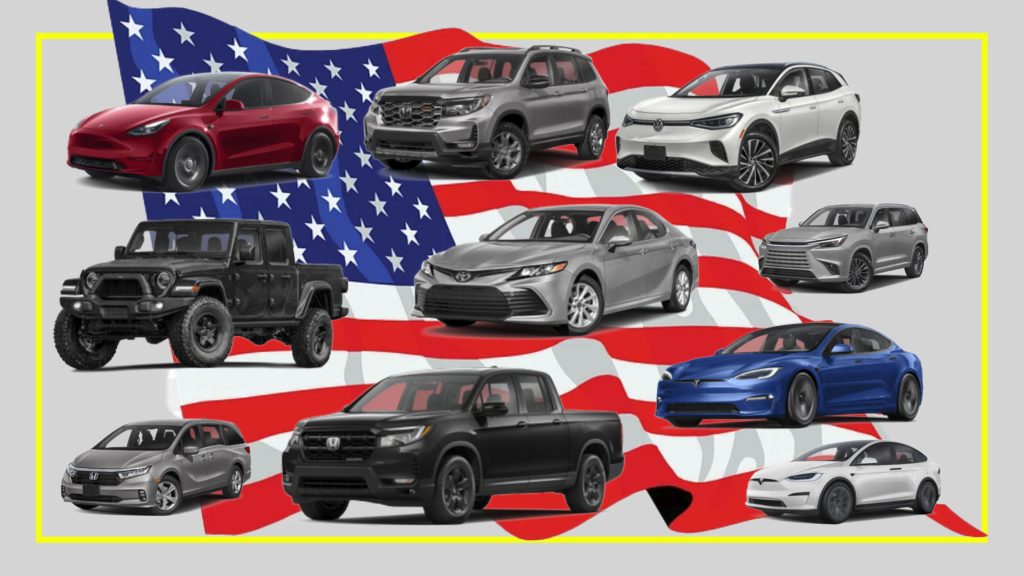
Walk into any dealership today and you will see window stickers plastered with claims about origin. “Assembled in America.” “Built by American workers.” It sounds simple. But the story behind cars made in usa is far more layered than a badge on a bumper.
For millions of shoppers, knowing where their vehicle was built matters deeply. It is about more than patriotism. It is about jobs, supply chains, quality standards, and — increasingly — tax credits that can save you thousands of dollars when buying an electric vehicle.
This guide breaks down everything you need to know. We explain what the “Made in USA” label actually means for automobiles, list the top vehicles with the highest domestic content, cover both American and foreign brands assembling vehicles on U.S. soil, and walk you through exactly how to verify a vehicle’s origin before you sign any paperwork. Whether you are a first-time buyer or a seasoned enthusiast, this is the most practical and up-to-date resource you will find on this topic.
What Does “Cars Made in USA” Actually Mean?
Most people assume that a car carrying an American brand name was built in America. That assumption, more often than not, is wrong. The Federal Trade Commission sets the standard for what qualifies as “Made in USA.” For a product to carry that label, it must be “all or virtually all” made in the United States. In practice, the auto industry gets far more complicated than that — which is why Congress created a separate piece of legislation specifically for vehicles.
The American Automobile Labeling Act (AALA) Explained
The American Automobile Labeling Act, passed in 1992, requires every new passenger vehicle sold in the U.S. to display a label listing its domestic parts content percentage, its country of final assembly, and the countries of origin for its engine and transmission. This label — found on the official window sticker — tells you far more than any advertising campaign ever will. A vehicle might be labeled “Assembled in USA” while using an engine built in Japan or a transmission manufactured in Mexico. The AALA label breaks all of that down so consumers can make properly informed decisions.
Domestic Parts Content vs. Country of Final Assembly
These two things are not the same, and understanding the difference is essential. “Assembled in USA” simply means the final manufacturing step — putting the parts together — happened on American soil. The parts themselves could originate from dozens of countries. The domestic parts content percentage is the figure that actually tells you how much of the vehicle was sourced within the United States and Canada. A high assembly-in-USA claim paired with a low parts content score means the vehicle has more in common with an import than the branding suggests.
The question of which cars made in usa genuinely deliver high domestic content is answered most honestly by looking at that AALA parts content percentage — not the brand origin or where the company’s headquarters sit.
How to Read the Window Sticker
Every new vehicle sold in the U.S. displays a federally mandated Monroney label. Toward the bottom, you will find the AALA section. It shows a percentage score for U.S. and Canadian parts combined. It lists the country where the car was finally assembled. And it notes the origin of the engine and the transmission separately. A score of 75% or higher is generally considered strong. Very few vehicles meet or exceed that threshold — making those that do genuinely stand out.
Which Cars Are Made in the USA: The 2025 Breakdown
Now for the section most readers come here for — the actual breakdown of vehicles built on American soil with meaningful domestic content. The data below reflects NHTSA AALA information for the 2025 model year, which automakers are required to update annually.
American Brand Leaders
Ford, General Motors, and Stellantis still dominate American assembly plants, and several of their flagship models lead in domestic content scores.
- Ford F-150 — Built in Dearborn, Michigan and Kansas City, Missouri. The best-selling vehicle in the U.S. for over four decades, with a domestic parts content typically between 55% and 60% depending on trim level.
- Chevrolet Corvette — Assembled entirely at the Bowling Green Assembly Plant in Kentucky. One of the most genuinely American cars on the road, consistently scoring above 75% in domestic content.
- Jeep Wrangler — Built at the Toledo Assembly Complex in Ohio. This off-roader has been assembled in Ohio for decades and remains one of the strongest symbols of domestic manufacturing.
- Tesla Model Y — Produced at Gigafactory Texas in Austin and Gigafactory California in Fremont. Tesla’s flagship EV is genuinely domestically built with growing U.S. battery content.
- Ford Explorer — Assembled at the Chicago Assembly Plant in Illinois, carrying a domestic content score of approximately 65%.
It is worth noting that even among well-known American brands, not every model is built at home. The Ford Maverick, for example, is assembled in Hermosillo, Mexico — a reminder that brand identity and manufacturing location are two very different things.
Foreign-Brand Vehicles Assembled in the USA
This is where the conversation gets genuinely interesting. Several Japanese, German, and South Korean brands operate enormous assembly plants across the American South and Midwest — and their vehicles often outscore traditional American brands on domestic content.
- Toyota Camry — Assembled at Toyota Motor Manufacturing Kentucky in Georgetown, KY. The Camry consistently earns one of the highest domestic content scores of any passenger car sold in America, typically between 75% and 85%.
- Honda Accord — Built at the Marysville Auto Plant in Ohio since 1982. Honda has been making cars in America longer than most consumers realize, and it shows in the numbers.
- BMW X5 and X7 — Produced at BMW’s Spartanburg plant in South Carolina. This is BMW’s largest manufacturing facility in the entire world — not in Bavaria, but in the American South.
- Subaru Outback and Legacy — Assembled at Subaru of Indiana Automotive in Lafayette, Indiana, with strong domestic content scores.
- Mercedes-Benz GLE and GLS — Built at the Vance, Alabama plant, which also produces vehicles for export to global markets.
- Hyundai IONIQ 5 and IONIQ 6 — Now rolling off the line at Hyundai’s Metaplant in Bryan County, Georgia, which opened in 2024 and stands as one of the most technologically advanced auto facilities in the country.
Trucks and SUVs With the Highest Domestic Content in 2025
If maximizing domestic content is your priority when choosing among cars made in usa, these models consistently rank at the top:
- Toyota Camry (Georgetown, KY) — up to 85% domestic content
- Honda Odyssey (Lincoln, AL) — up to 80%
- Jeep Cherokee (Belvidere, IL) — approximately 74%
- Chevrolet Traverse (Lansing, MI) — approximately 72%
- Ford Explorer (Chicago, IL) — approximately 65%
The pattern is clear. Crossovers and sedans assembled in the Midwest or South often carry higher domestic content than performance vehicles or luxury models, which rely more heavily on imported specialty components.
The Big Three and Their American-Made Lineup
Ford, General Motors, and Stellantis have operated American factories for over a century. While globalization has pushed some production offshore, these companies still employ hundreds of thousands of workers across dozens of U.S. facilities. Their combined manufacturing footprint remains one of the largest industrial employers in the country.
Ford’s Most American-Built Vehicles in 2025
Ford currently operates major assembly plants in Michigan, Kentucky, Missouri, Ohio, and Illinois. Its core domestically built lineup includes:
- Ford F-150 and F-250 Super Duty (Dearborn, MI and Kansas City, MO)
- Ford Explorer (Chicago, IL)
- Ford Mustang (Flat Rock, MI)
- Ford Bronco (Wayne, MI)
Ford is also investing heavily in domestic EV infrastructure. The BlueOval City complex in Stanton, Tennessee is scheduled to produce next-generation electric F-Series trucks, adding another major domestic plant to the company’s footprint.
Chevrolet, GMC, and Buick Models Assembled Domestically
General Motors maintains one of the strongest domestic production bases in the industry, particularly for trucks and full-size SUVs.
- Chevrolet Silverado and GMC Sierra — Assembled in Fort Wayne, Indiana and Flint, Michigan
- Chevrolet Colorado and GMC Canyon — Wentzville, Missouri
- Chevrolet Corvette — Bowling Green, Kentucky
- Cadillac Escalade, Chevrolet Tahoe, and Chevrolet Suburban — Arlington, Texas
GM also operates the Factory Zero plant in Detroit-Hamtramck, Michigan, which is dedicated exclusively to electric vehicles.
Stellantis: Jeep, Ram, and Dodge Plants Across the Midwest
Stellantis — the parent company of Jeep, Ram, Dodge, and Chrysler — operates plants concentrated in Ohio and Michigan.
- Jeep Wrangler and Jeep Gladiator — Toledo, Ohio
- Ram 1500 Classic — Sterling Heights, Michigan
- Dodge Challenger and Charger (Charger Daytona EV) — The legacy models were built in Brampton, Ontario, Canada, though next-generation models are in transition
Buyers interested in Stellantis products should always verify the specific assembly location of their chosen model and trim, as production locations can shift with new model generations.
Electric Vehicles and Cars Made in the USA
The electric vehicle revolution has added an entirely new layer to the domestic manufacturing conversation — one with real financial consequences for everyday buyers.
How the Inflation Reduction Act Reshaped the Market
The Inflation Reduction Act (IRA), signed in 2022 and implemented through 2025, tied the $7,500 federal EV tax credit directly to where a vehicle is assembled and where its battery components originate. To qualify for the full credit in 2025, an EV must be finally assembled in North America and meet battery mineral and component sourcing requirements. This means that many EVs sold in the U.S. — including popular European and some Asian models — do not qualify for the credit at all. Knowing which cars made in usa qualify for the credit can save a buyer thousands of dollars at the point of sale.
Leading American-Built EVs in 2025
- Tesla Model Y and Model 3 — Fremont, CA and Austin, TX. Tesla vehicles qualify for the full credit for eligible buyers.
- Ford F-150 Lightning — Assembled at the Rouge Electric Vehicle Center in Dearborn, Michigan.
- Chevrolet Silverado EV — Factory Zero, Detroit-Hamtramck, Michigan.
- Rivian R1T and R1S — Produced at Rivian’s Normal, Illinois facility.
- Cadillac LYRIQ — Spring Hill, Tennessee.
- Hyundai IONIQ 5 and IONIQ 6 — Now qualifying after U.S. production launched at the Georgia Metaplant.
Which EVs Qualify for the $7,500 Federal Tax Credit in 2025?
Final assembly location is the first requirement, but battery sourcing rules are equally important. The IRA requires an increasing percentage of battery components to come from North America or countries with active U.S. free-trade agreements. This threshold tightens every year through 2029. Buyers should check the IRS’s EV credit eligibility list before committing to any purchase, as qualifying vehicles can change from quarter to quarter based on supply chain shifts.
The Battery Sourcing Challenge
Even when a vehicle is assembled in America, its battery cells may originate from China or South Korea. Automakers are racing to build domestic battery gigafactories — including the GM-LG Energy Solution Ultium Cells facilities in Ohio and Tennessee, and the Ford-SK BlueOval battery plants in Kentucky and Tennessee. Over the next several years, the battery supply chain will become dramatically more domestic, which will further strengthen the case for American-built EVs.
Why Buying Cars Made in the USA Matters
Choosing a domestically built vehicle is a decision that ripples outward far beyond the dealership. The benefits are economic, environmental, and practical all at once.
Supporting American Jobs and Local Economies
A single auto assembly plant employs thousands of workers directly. But the indirect employment effect is even larger. For every job inside an assembly plant, economists estimate that four to seven additional jobs are sustained in the surrounding supply chain — from steel producers and parts manufacturers to logistics companies and local restaurants. The United Auto Workers represent hundreds of thousands of employees across Ford, GM, and Stellantis plants. Their wages circulate through communities across Michigan, Ohio, Indiana, and beyond in ways that are difficult to fully quantify but impossible to ignore.
Shorter Supply Chains Mean Greater Resilience
The COVID-19 pandemic taught the auto industry a painful and expensive lesson. When semiconductor chips — manufactured primarily in Taiwan — became scarce in 2021 and 2022, U.S. automakers were forced to halt production lines, build vehicles without certain features, and park partially finished trucks in empty lots waiting for parts. Millions of units of potential output were lost. Vehicles assembled domestically with a higher percentage of locally sourced components are far less exposed to these kinds of global supply disruptions. Buying a car built in America is not just an emotional decision — it is a genuinely strategic one.
Environmental Benefits Worth Considering
Shipping a finished vehicle from Japan, Germany, or South Korea to a U.S. dealership generates a significant carbon footprint from ocean freight alone. Domestically produced vehicles travel far shorter distances from factory to showroom. For buyers who weigh environmental impact as part of their purchase decision, origin of manufacture is another meaningful factor in the calculation.
How to Verify If a Car Was Built in America
Do not rely solely on a salesperson’s claims. Verifying a vehicle’s domestic origin is straightforward if you know where to look. There are three reliable methods every buyer should use before signing any paperwork.
Use the NHTSA AALA Database
The National Highway Traffic Safety Administration maintains an online database through its Vehicle and Product Information Catalog (VPIC) portal. You can look up any vehicle by make, model, and year to find its AALA disclosure — domestic content percentage, country of final assembly, and source of the engine and transmission. This is the most authoritative and unbiased source of information available to consumers shopping for cars made in usa.
Decode the VIN
Every vehicle carries a 17-character Vehicle Identification Number stamped on the dashboard and printed on every ownership document. The very first character is the country code for the country of assembly:
- 1, 4, or 5 = United States
- 2 = Canada
- 3 = Mexico
- J = Japan
- W = Germany
- K = South Korea
This single character gives you an instant answer without needing any additional research.
Read the Monroney Label Carefully
Federal law requires every new vehicle sold in the United States to display a Monroney window sticker. Toward the lower portion of that sticker, the AALA section lists the domestic parts content percentage, the final assembly country, and the origin of the powertrain components. Take the time to read every line of that sticker before making any final decision. It exists precisely to give buyers this information in an accessible format.
Conclusion
The phrase “cars made in usa” is more than a marketing slogan — it is a measurable, verifiable claim backed by federal law and publicly available data. The good news is that American consumers have more choice than ever before. Whether you prefer a classic American truck brand, a Japanese-named sedan assembled in Kentucky, or a cutting-edge electric vehicle rolling out of a Texas gigafactory, options exist at every price point and in every vehicle category.
Understanding the real difference between final assembly location and domestic parts content gives you genuine power as a buyer. Use the NHTSA AALA database, read the window sticker carefully, and decode the VIN before you commit to any purchase.
The American auto industry is not fading — it is evolving. New plants are opening. EV investment is accelerating faster than any previous technology shift in the sector. Foreign brands are building world-class facilities on U.S. soil and employing hundreds of thousands of American workers. If you care about where your next vehicle comes from, the tools to find out are right at your fingertips. Use them.
1 What cars are actually made in the USA in 2025?
In 2025, there are 117 new car and truck models with final assembly in the U.S., according to CarEdge. Top examples include the Tesla Model Y (Austin, TX), Ford F-150 (Dearborn, MI), Jeep Wrangler (Toledo, OH), Toyota Camry (Georgetown, KY), Honda Accord (Marysville, OH), BMW X5 (Spartanburg, SC), and Hyundai IONIQ 5 (Bryan County, GA). The brand name on the hood does not tell you where the car was built — what matters is the assembly plant location and domestic parts content percentage shown on the window sticker.
2 Is any car 100% made in the USA?
No. Not a single vehicle sold in the U.S. is 100% domestically made. Even Ford’s F-150 — assembled entirely in Michigan — draws parts from at least 24 countries, including Mexico, Germany, and Japan, according to Caresoft engineering data reported by CNBC. Industry experts at Wedbush Securities have called the idea of a fully U.S.-made car “a fictional tale that does not exist.” The best-performing vehicles on domestic content reach around 75–85%, with the Kia EV6 (assembled in Georgia) and Tesla Model 3 leading in 2025.
3 Which car has the highest percentage of American-made parts in 2025?
According to the Cars.com American-Made Index and NHTSA AALA data for 2025, the Tesla Model 3 Long Range ranks first with approximately 75% U.S./Canadian content. The Kia EV6, assembled in West Point, Georgia, has the highest raw parts content score at around 80%, placing it in the top six overall. Other high scorers include the Honda Ridgeline AWD Trail Sport, Jeep Gladiator (74%), and Toyota Camry (up to 85% in some configurations). Notably, no Ford or GM vehicle made the Cars.com top 10 in 2025.
4 Does buying a car made in the USA avoid the 2025 auto tariffs?
Partially. President Trump’s 25% tariff, implemented April 3, 2025, applies to imported vehicles — so cars assembled in the U.S. avoid the vehicle-level tariff. However, domestically assembled vehicles are not fully immune. The tariff on imported auto parts means that even U.S.-built models face higher production costs if they rely on foreign parts — which nearly all of them do. According to Bernstein analysis, 57% of the value content in U.S.-assembled vehicles is still imported. Domestically assembled cars saw price increases of $1,600–$2,000 due to higher steel, aluminum, and parts costs, per Digital Dealer.
5 Is the Ford F-150 made in the USA?
Yes. The Ford F-150 is assembled exclusively in the United States — at the Dearborn Truck Plant in Michigan and the Kansas City Assembly Plant in Missouri. Ford’s domestic production rate is among the highest of any automaker; approximately 80% of all Ford vehicles sold in the U.S. are manufactured domestically. However, domestic content of F-150 parts is approximately 40–55% depending on trim level, meaning a substantial portion of its components still comes from abroad, particularly Mexico.
6 Are Tesla cars made in the USA?
Yes. All Tesla vehicles sold in the U.S. are assembled in the United States. The Model 3 and Model Y are built at Gigafactory California in Fremont and Gigafactory Texas in Austin. The Model S, Model X, and Cybertruck are also assembled at Fremont. Tesla’s Model 3 Long Range ranked #1 on the Cars.com American-Made Index in 2025, and Tesla dominated the top four spots overall, marking the first time in the index’s history that EVs claimed those positions. Tesla’s average total domestic content sits around 81%, making it the most American automaker by that metric.
7 Which Toyota models are made in the USA?
Toyota assembles several models in the U.S., primarily in Kentucky and Texas. The Toyota Camry is built in Georgetown, Kentucky — one of the most American cars sold in the U.S. by parts content, often reaching 75–85%. The Toyota Corolla Cross is also assembled in Alabama. The full-size Tundra truck and Sequoia SUV are built at the Toyota Texas plant in San Antonio. Toyota is not 100% American-made in any model, but its Georgetown plant is one of the longest-running transplant facilities in the country, having operated since 1988.
8 How do I check if a car was made in the USA before buying it?
There are three reliable ways to verify. First, visit the NHTSA AALA database (nhtsa.gov) and look up the vehicle by make, model, and year — it shows domestic parts content and assembly country. Second, check the VIN: if the first character is 1, 4, or 5, the car was assembled in the U.S. (2 = Canada, 3 = Mexico, J = Japan, W = Germany). Third, read the Monroney window sticker on any new vehicle — federal law requires the domestic content percentage and final assembly country to be listed. All three methods are free and require no special knowledge.
9 Are Honda cars made in the USA?
Yes — Honda has been assembling cars in the U.S. since 1982. The Honda Accord and CR-V are built at the Marysville Auto Plant and East Liberty Auto Plant in Ohio. The Honda Odyssey minivan is assembled in Lincoln, Alabama, and the Ridgeline truck is also made in Alabama. Honda’s domestic content scores are consistently strong; the Accord Hybrid and CR-V Hybrid are among the most American-made hybrids available. Honda’s total domestic content ranking in the U.S. is second only to GM among all automakers.
10 Is the Jeep Wrangler made in the USA?
Yes. The Jeep Wrangler and Jeep Gladiator are assembled at the Toledo Assembly Complex in Toledo, Ohio — one of the most iconic American auto plants. Both models carry a domestic parts content of approximately 74%, with the engine and transmission sourced from the U.S. The Jeep Gladiator ranked fifth on the Cars.com American-Made Index in 2025. However, not all Jeep models are made in the U.S. — the Compass and Wagoneer S were previously assembled in Mexico, and Stellantis has shifted some production in response to tariff pressures.
11 Do cars made in the USA qualify for the $7,500 EV tax credit?
North American final assembly is a required condition for the $7,500 Inflation Reduction Act EV tax credit, but it is not the only requirement. Battery component sourcing rules also apply — an increasing percentage of battery materials must come from North America or U.S. free-trade-agreement countries, with thresholds tightening annually through 2029. Additionally, income caps and vehicle price limits apply to buyers. Not every domestically assembled EV qualifies — for example, some Tesla trims periodically lose eligibility due to battery sourcing changes. Always verify current eligibility on the IRS website before purchasing.
12 What does the American Automobile Labeling Act (AALA) require?
The American Automobile Labeling Act, passed in 1992, requires every new passenger vehicle sold in the U.S. to display a label — as part of the Monroney window sticker — that discloses: the percentage of U.S. and Canadian parts content (combined), the country where the car was finally assembled, and the country of origin of the engine and transmission separately. Automakers must file updated AALA reports with NHTSA annually for each model year. The NHTSA publishes this data publicly on its website, giving consumers a reliable tool to verify manufacturer claims.
13 Is BMW made in the USA?
Several BMW models are assembled in the United States. BMW’s Spartanburg, South Carolina plant produces the X3, X4, X5, X6, X7, and XM models — making it BMW’s largest manufacturing facility in the world by volume. The plant exported more vehicles than it sold domestically in recent years, making BMW one of America’s top automotive exporters. However, BMW’s domestic parts content is relatively low by NHTSA AALA standards — the X3, for example, shows only around 9% U.S./Canadian parts content, as major components like the engine come from Austria or Germany.
14 What American-made cars are cheapest in 2025?
The most affordable domestically assembled vehicles in 2025 include the Toyota Corolla Cross (assembled in Alabama), Honda CR-V (Ohio), Jeep Wrangler (Ohio), and Kia EV6 (Georgia). However, Cox Automotive analysis notes that 80% of new vehicles priced under $30,000 are imports — meaning genuinely affordable, U.S.-assembled cars are limited. The 25% auto tariff on imported vehicles has also pushed many low-priced foreign-assembled models higher in price, narrowing the gap between imports and domestic options at the entry level.
15 How many cars are assembled in the USA each year?
In 2024, Americans purchased approximately 16 million cars, SUVs, and light trucks. Of those, about 8 million were assembled in the U.S. — the other 8 million were imports, representing roughly 50% of total sales, per White House figures. The U.S. had over 30 active vehicle assembly plants as of 2025, spread across Michigan, Ohio, Kentucky, Tennessee, Alabama, South Carolina, Georgia, Indiana, and Texas. In 1985, by comparison, American-owned U.S. facilities manufactured 11 million vehicles — representing 97% of total domestic production — illustrating how significantly globalization has reshaped the industry.
16 Which American-made cars have the best resale value?
Domestically built trucks and SUVs consistently hold their value best. The Ford F-150, Jeep Wrangler, and Chevrolet Silverado regularly rank among the top vehicles for resale value across the industry. Among EVs, the Tesla Model Y has shown strong residuals relative to other electric models. Vehicles with high domestic content and strong brand loyalty tend to retain value better during periods of supply constraint — a dynamic that became clear after the 2021–2022 semiconductor shortage drove used vehicle prices to historic highs. Strong demand + limited supply = stronger residuals for American-assembled models.
17 Why does the U.S. AALA label combine U.S. and Canadian parts together?
The AALA has historically grouped U.S. and Canadian parts content together because of longstanding trade agreements — first NAFTA and now the USMCA — that treat the two countries as a shared North American manufacturing zone. This means a car can score 80% “domestic content” while including significant Canadian-made components. In 2025, amid debates about tariff policy and domestic job creation, NHTSA is considering separating U.S. and Canadian content into distinct figures on the AALA label, which would give consumers a clearer picture of how much was truly made on American soil specifically.
18 What electric cars are made in the USA in 2025?
The most prominent American-assembled EVs in 2025 include: Tesla Model Y and Model 3 (California and Texas), Tesla Cybertruck (Texas), Ford F-150 Lightning (Dearborn, MI), Chevrolet Silverado EV and GMC Hummer EV (Detroit, MI), Rivian R1T and R1S (Normal, IL), Cadillac LYRIQ (Spring Hill, TN), Hyundai IONIQ 5 and IONIQ 6 (Bryan County, GA), and Kia EV6 (West Point, GA). The Inflation Reduction Act requires North American final assembly for EV tax credit eligibility, making domestic EV production a significant financial advantage for buyers who qualify.
19 What luxury cars are made in the USA?
Several luxury vehicles are assembled on U.S. soil. BMW builds the X3, X5, X6, X7, and XM in Spartanburg, South Carolina. Mercedes-Benz assembles the GLE, GLS, and GLE Coupe in Vance, Alabama. Cadillac produces the Escalade in Arlington, Texas and the LYRIQ EV in Spring Hill, Tennessee. Lincoln builds the Navigator in Louisville, Kentucky. The Chevrolet Corvette — often considered a luxury performance vehicle — is assembled in Bowling Green, Kentucky. However, luxury vehicles often have lower domestic parts content than trucks and crossovers due to their reliance on imported specialty components.
20 How have 2025 tariffs changed which cars are being made in the USA?
The 25% auto tariff effective April 3, 2025 has already triggered notable production shifts. Stellantis halted production of the Jeep Compass and Wagoneer S in Mexico. Several automakers are accelerating plans to move manufacturing to the U.S. Interest in the Cars.com American-Made Index surged significantly in 2025 amid broader tariff nationalism, according to Cars.com’s own reporting. Hyundai’s new Georgia Metaplant has gained strategic importance, and BMW is re-evaluating its South Carolina versus European production balance. The tariff environment is directly reshaping which vehicles can be profitably built where.
21 How much would a truly 100% American-made car cost?
Industry experts say building a 100% U.S.-made vehicle is currently “unrealistic” and would be extraordinarily expensive. Multiple auto supplier executives told CNBC it is impossible to profitably achieve today due to the global raw material supply chain. Even reaching 95% domestic content would take over a decade and require billions in new domestic processing infrastructure. One automaker executive estimated that attempting maximum U.S. parts sourcing for a full-size American pickup would add at least $7,000 to the average vehicle cost. Currently, the best-performing models top out around 80–85% domestic content.
22 Are Subaru vehicles made in the USA?
Yes. Subaru assembles the Outback, Legacy, Ascent, and Impreza at Subaru of Indiana Automotive (SIA) in Lafayette, Indiana. The Lafayette plant, which has operated since 1989, is Subaru’s only manufacturing facility outside Japan and supplies approximately 45% of the vehicles Subaru sells in the U.S. Subaru’s Indiana plant has a significant workforce and contributes meaningfully to the local Indiana economy. Other Subaru models — including the Forester, Crosstrek, and BRZ — are imported from Japan.
23 Which states have the most car manufacturing plants in the USA?
Michigan is the traditional capital of American auto manufacturing, home to Ford’s Dearborn and Michigan Assembly plants, GM’s Flint facility, and Stellantis’s Sterling Heights plant. Ohio is home to Honda (Marysville, East Liberty), Jeep (Toledo), and GM (Lordstown area). Kentucky houses Toyota’s Georgetown plant and Ford’s Kentucky Truck Plant. Tennessee hosts GM’s Spring Hill facility and Ford’s BlueOval City under construction. South Carolina (BMW Spartanburg), Alabama (Mercedes-Benz, Honda), Georgia (Hyundai Metaplant, Kia), Indiana (Subaru), and Texas (Tesla Gigafactory) round out the major states.
24 How has the definition of “made in USA” for cars changed over the decades?
In the 1970s, before the AALA was enacted, the U.S. market was dominated by GM, Ford, and Chrysler — with parts content approaching 100% domestic, primarily from U.S. and Canadian sources. By 2007, the top 16 vehicles on NHTSA’s charts — all from GM and Ford — still had 90% or more U.S./Canadian content. By 2024, that picture had changed dramatically: even the best-performing vehicles average around 75–80%, and of the 16 million vehicles sold annually, only about 25% of total vehicle content can genuinely be categorized as Made in America, per the White House’s own 2025 analysis. Globalization, technology complexity, and supply chain optimization drove this shift over four decades.