
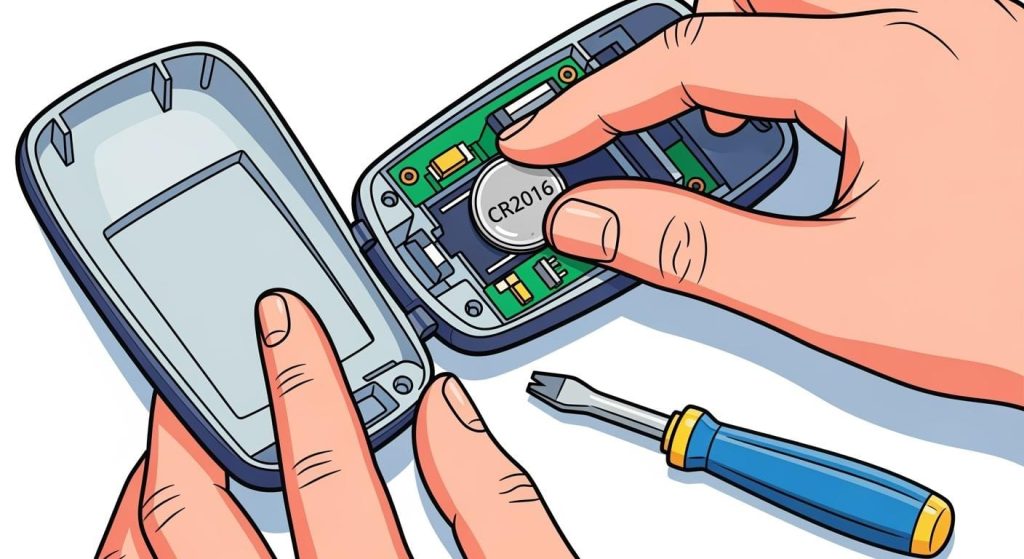
You reach for your car key fob, press the button, and nothing happens. Or your wristwatch stops ticking out of nowhere. You flip it over, pop the back open, and there it is — a tiny silver disc sitting quietly in its slot. That little coin is likely a CR2016 battery, and it powers more of your everyday gadgets than you might realize.
Most people never think about batteries until something stops working. And when it does, they grab whatever’s on the shelf — sometimes the right one, sometimes not. This guide is here to change that. Whether you’re replacing a dead cell, stocking up for the future, or just trying to understand what makes this particular battery tick, you’ll find everything you need right here.
What Exactly Is a CR2016 Battery?
Before buying or replacing one, it helps to understand what you’re actually dealing with. The name “CR2016” is not random — it follows an international naming system that tells you everything about the cell at a glance.
Breaking Down the Name
The letter C indicates the battery uses lithium chemistry. R means it’s round or cylindrical in shape. The number 20 refers to its diameter of 20 millimeters, and 16 refers to its thickness of 1.6 millimeters. That’s it. Simple once you know the code.
This is a lithium CR2016 battery, which means it is not alkaline and it is not rechargeable in its standard form. It delivers a nominal output of 3 volts, which is consistent throughout most of its discharge cycle — one of the key advantages of lithium chemistry over older alkaline alternatives.
Key Technical Specifications
Here’s a quick look at the core specs you need to know:
- Diameter: 20mm
- Thickness: 1.6mm
- Voltage: 3V (nominal)
- Capacity: Approximately 75–90 mAh
- Chemistry: Lithium manganese dioxide
- Operating Temperature: Typically -30°C to +60°C
- Shelf Life: Up to 10 years when stored unused
The capacity of 75–90 mAh is relatively modest, but it’s more than enough for the low-power devices this battery is designed to run. Its slim profile is what makes it irreplaceable in certain applications — there simply is no thicker substitute that will fit.
Where Is the CR2016 Battery Used?
One of the most common questions people ask is: what devices actually use this battery? The answer might surprise you. It shows up in more places than most people expect.
Everyday Consumer Devices
The CR2016 battery is found in a wide range of products, including:
- Wristwatches and fashion watches — especially thin-cased designs that can’t accommodate a thicker battery
- Car key fobs and remote entry systems — particularly in older vehicles or compact remote designs
- Calculators and pocket organizers — small devices that need long-lasting, stable power
- Small LED lights and laser pointers — low-drain items that benefit from lithium’s long shelf life
- Children’s toys — especially small light-up or interactive toys
- Glucose monitors and medical accessories — devices where reliable voltage is critical
- Fitness trackers and older pedometers — compact wearables from the earlier generation of activity devices
Niche and Industrial Uses
Beyond consumer products, the CR2016 3V battery also turns up in:
- BIOS/CMOS backup batteries in some older computer motherboards, though the CR2032 is more common here
- Small environmental sensors used in industrial and smart-home settings
- Garage door accessories and certain remote controls
- IoT micro-devices where space is at an absolute premium
One important note: always check your device manual before assuming a CR2016 fits. Some devices look identical on the outside but require a slightly different cell. Getting it right from the start saves time and protects your device.
CR2016 Battery vs CR2032 — Which One Do You Actually Need?
This is hands-down the most common source of confusion when shopping for coin cell batteries. The CR2016 and CR2032 look almost identical at first glance. Both are round, both are silver, and both output 3 volts. But they are not the same, and in most cases, they are not interchangeable.
The Key Differences
The critical difference between these two batteries comes down to thickness. The CR2032 measures 3.2mm thick, while the CR2016 is just 1.6mm — exactly half the thickness. That single dimension has a major impact on both fit and battery life.
Because the CR2032 is physically larger (same diameter, but twice as thick), it can hold significantly more energy. The CR2032 typically stores around 225 mAh of capacity, compared to the CR2016’s 75–90 mAh. That translates to a much longer active lifespan under similar conditions.
Here’s a side-by-side breakdown:
| Feature | CR2016 | CR2032 |
|---|---|---|
| Diameter | 20mm | 20mm |
| Thickness | 1.6mm | 3.2mm |
| Voltage | 3V | 3V |
| Capacity | ~75–90 mAh | ~225 mAh |
| Typical Lifespan | 1–2 years (active use) | 3–5 years (active use) |
| Typical Price | Slightly lower | Slightly higher |
When to Choose the CR2016
The CR2016 battery isn’t a lesser option — it’s the right option when the device demands it. Slim-profile watches, compact remotes, and certain precision instruments are designed specifically around its 1.6mm thickness. Forcing a thicker battery into the slot can crack the casing, damage contacts, or simply won’t close properly.
If your device manual says CR2016, use a CR2016. If you’re unsure, check the old battery before discarding it — the model number is printed right on it.
The Stacking Myth
Here’s something worth addressing directly: some people try to use two CR2016 batteries stacked on top of each other to replace a single CR2032. In theory, two 1.6mm cells stacked together equal 3.2mm, and both output 3V each — meaning stacked, they’d deliver 6V, which is too much for most devices.
Even if wired in parallel, the fit and contact reliability is unreliable. This is a workaround, not a solution. In an emergency where no CR2032 is available, a single CR2016 may work temporarily in a CR2032 slot if the contacts still make connection, but the battery life will be much shorter. Always replace with the correct cell as soon as possible.
How Long Does a CR2016 Battery Last?
Battery life is one of the most searched questions around any cell type, and for good reason — it affects how often you’re reaching into a junk drawer or making a pharmacy run.
Expected Lifespan in Real-World Use
When stored, an unused CR2016 3V battery can last up to 10 years on the shelf. This is one of lithium’s biggest advantages — it has an extremely low self-discharge rate, meaning it barely loses charge just sitting in a package.
In active use, lifespan depends heavily on the device:
- Wristwatches: Typically 1 to 2 years
- Car key fobs: Often 1 to 3 years depending on usage frequency
- Calculators and low-use devices: Can last several years
- Medical sensors: Varies widely based on reading frequency and signal load
What Drains a Battery Faster
Several factors reduce battery life more quickly than expected:
- Temperature extremes — both heat and cold accelerate discharge
- High-frequency use — a key fob pressed dozens of times daily drains faster than one used occasionally
- Device age — older electronics with worn contacts sometimes draw more power than they should
- Counterfeit or low-quality cells — these often have lower actual capacity than labeled
Signs Your Battery Is Running Low
Don’t wait for total failure, especially in devices you rely on. Look for these early warning signs:
- Your watch loses a few minutes daily or stops suddenly
- Your key fob needs to be held closer to the car than usual
- A laser pointer or LED light appears dimmer than before
- A medical device shows a low battery indicator
In devices like glucose monitors or medical alarms, proactive replacement is strongly recommended. Don’t test the limits there.
CR2016 Battery Equivalent — What Can You Use as a Substitute?
Sometimes the exact battery isn’t available at your local store. Knowing which alternatives work — and which don’t — can save you a trip and prevent accidental damage to your device.
Safe and Direct Equivalents
The following batteries are functionally identical to or compatible with the CR2016:
- DL2016 — Duracell’s own branding for the same battery. Same chemistry, same size, same voltage. A direct swap.
- ECR2016 — Energizer’s equivalent. Again, no performance difference worth noting.
- BR2016 — Uses lithium carbon monofluoride chemistry instead of lithium manganese dioxide. Works in most devices, though its voltage curve is slightly flatter. May show shorter life in high-drain applications but performs excellently in low-drain uses.
- KCR2016 / LCR2016 — Panasonic and other manufacturer equivalents. Fully compatible.
| Battery Code | Brand/Type | Compatible? |
|---|---|---|
| DL2016 | Duracell | Yes — direct equivalent |
| ECR2016 | Energizer | Yes — direct equivalent |
| BR2016 | Carbon monofluoride | Yes — most devices |
| KCR2016 | Panasonic | Yes — direct equivalent |
| ML2016 | Rechargeable manganese | No — only if device supports it |
| LIR2016 | Li-ion rechargeable | No — 3.6V, can damage devices |
Equivalents to Avoid
The ML2016 is a rechargeable manganese lithium cell. Unless your device explicitly states it supports rechargeable coin cells, do not use it as a swap. Similarly, the LIR2016 is a lithium-ion rechargeable cell that outputs 3.6V — higher than the standard 3V. Feeding higher voltage into a device designed for 3V can permanently damage the circuitry.
When shopping for a CR2016 battery equivalent, the rule is simple: match the voltage first (3V), then the size (20mm x 1.6mm), then the chemistry. If all three match, you’re good to go.
Reading Your Device Manual for Compatibility
Most manuals will list the battery as “CR2016 or equivalent.” This gives you flexibility to use DL2016 or ECR2016 without issue. If the manual says only “CR2016,” that’s a size specification, not necessarily a chemistry restriction — but sticking to the listed code is always the safest move.
Buying Guide — How to Choose the Right CR2016 Battery
Not all coin cells are created equal. A cheap battery that leaks or underperforms can cost you far more than the few dollars you saved upfront — especially in a watch or medical device.
Brands Worth Trusting
The coin cell market is dominated by a handful of reliable names. Each has slightly different strengths:
- Panasonic — consistently rated among the highest for capacity and longevity. A top pick for medical devices and watches.
- Duracell (DL2016) — strong shelf life, widely available, reliable performance across most applications.
- Energizer (ECR2016) — great for key fobs and everyday electronics. Good value for multipacks.
- Sony / Murata — Sony’s battery division is now operated by Murata. Premium quality, especially in watches.
- Maxell — popular in Asian markets, solid performance and a trusted name in thin coin cells.
For critical devices like glucose monitors or hearing aid accessories, always go with a brand-name cell. The small price premium is worth the reliability.
Single Pack vs. Bulk Pack
Buying in bulk makes sense if you use multiple devices or want to stock spares. A 5- or 10-pack from a trusted brand often costs less per cell than a single unit and keeps you prepared for future replacements.
However, if you rarely need this battery type, stick to a single or double pack. Batteries that sit in a drawer for years can degrade if the packaging is compromised. Always check the expiry date when buying bulk — look for cells manufactured within the past year or two to maximize shelf life.
Where to Buy
- Online retailers — broader selection, often better prices, and easy access to bulk packs. Stick to seller-fulfilled listings from verified brands rather than third-party marketplace resellers with no ratings.
- Pharmacies and grocery stores — convenient for urgent replacements. Typically carry major brands like Duracell and Energizer.
- Electronics and hardware stores — good for specialty brands and a wider range of pack sizes.
- Avoid unbranded or counterfeit batteries — if the price seems too low to be real, it probably is. These often have inferior capacity and a higher risk of leaking.
How to Replace a CR2016 Battery Step by Step
Replacing a coin cell is easier than most people think. You don’t need a professional or special equipment — just a steady hand and a couple of minutes.
Tools You’ll Need
- A small flathead screwdriver or a coin (for watch case backs)
- A clean, dry, lint-free surface to work on
- A pair of non-conductive tweezers (optional but helpful)
- The replacement battery — positive side (+) facing the right direction
Avoid touching the flat surfaces of the battery with bare fingers. Natural skin oils can affect the electrical contact over time. Handle the cell by its edges if possible.
Replacing in a Watch
- Turn the watch face-down on your clean surface.
- Use a coin or flathead to turn the case back counterclockwise until it lifts off.
- Before removing the old battery, take a quick photo of its orientation — note which side faces up.
- Gently pop or slide the old battery out using a non-metallic tool or your fingernail.
- Insert the new CR2016 battery in the same orientation (typically positive side up).
- Replace the case back and seal it by pressing and turning clockwise.
- Set your watch time and you’re done.
Replacing in a Key Fob
- Find the seam on the key fob casing — usually on the side or back.
- Insert a flat tool into the seam and gently twist to split the halves apart.
- The battery will be visible. Note its orientation.
- Pop the old cell out and drop in the new one with the same side facing up.
- Snap the two halves back together firmly. Test the fob to confirm it works.
Replacing in a Calculator
- Locate the battery compartment — usually a slide-off or screw-off panel on the back.
- Open the compartment, remove the old battery.
- Insert the new one matching the +/- markings inside the compartment.
- Replace the cover and power on the calculator.
Pro tip: If your device doesn’t turn on immediately after replacement, press and hold the power button for three to five seconds. Some devices need a brief moment to reset after a battery swap.
Storage, Disposal, and Environmental Notes
Buying extras is smart, but how you store them matters. And when the battery is dead, how you dispose of it matters just as much.
How to Store Spare Batteries
- Keep them in the original sealed packaging until use
- Store in a cool, dry place — a kitchen drawer away from heat sources works well
- Avoid storing loose batteries in a bag or junk drawer where they can contact metal objects like coins or keys — this can discharge them prematurely
- Never store coin cells in extreme heat (above 60°C) or in humid environments
Responsible Disposal
Lithium batteries should never go in the regular trash. The materials inside — including lithium and trace metals — can leach into soil and water when they end up in landfill. Most countries now have regulations requiring proper disposal.
Drop-off options include:
- Electronics retailers — most major chains like Best Buy (US) have free battery recycling bins at the entrance
- Pharmacies — many participate in battery recycling programs
- Municipal recycling centers — check your local government’s website for drop-off schedules
- Manufacturer take-back programs — some brands offer mail-in recycling
Even a single coin cell adds up when millions of people toss them in the bin. It takes an extra 30 seconds to dispose of them properly, and it makes a real difference.
Final Thoughts
The CR2016 battery is small in size but significant in function. It quietly keeps your watch running, your key fob talking to your car, and your pocket devices powered without you ever giving it a second thought — until it stops working.
Now you know exactly what it is, where it fits, how long it lasts, and how to replace or substitute it properly. The next time a device goes quiet, you won’t be guessing. You’ll know whether you need a CR2016 or something else entirely, which brands to trust, and how to swap it out yourself in under five minutes.
Buy the right battery, handle it properly, and recycle it responsibly when it’s done. It’s a small thing — but then again, so is the battery.
FAQ 1: What is a CR2016 battery? A CR2016 battery is a flat, round lithium coin cell battery that measures 20mm in diameter and 1.6mm in thickness. It delivers a stable 3 volts of power and belongs to the lithium manganese dioxide (LiMnO2) chemistry family. It is widely used in slim-profile electronic devices where space is extremely limited.
FAQ 2: What does CR2016 mean on a battery? Each part of the name tells you something specific. “C” stands for lithium chemistry, “R” means the battery is round in shape, “20” refers to the 20mm diameter, and “16” refers to the 1.6mm thickness. So the name itself is actually a physical specification code — not a brand or model name.
FAQ 3: What voltage is a CR2016 battery? The CR2016 battery operates at a nominal voltage of 3 volts. Pkcell Battery This voltage remains consistent throughout most of its discharge cycle, which is one of the main advantages of lithium chemistry over alkaline alternatives. It should not be confused with rechargeable variants like the LIR2016, which outputs 3.6V.
FAQ 4: What is the capacity of a CR2016 battery in mAh? A typical CR2016 battery has a capacity of 90 mAh, and the button battery will last for about 6 hours when using it with an average load of 15 mA. Utmel Capacity varies slightly between manufacturers, typically ranging from 75 to 90 mAh depending on build quality and brand.
FAQ 5: How much does a CR2016 battery weigh? The CR2016 weighs around 1.8 grams. Allelcoelec Its minimal weight is one of the key reasons it is preferred in wearable devices, slim watches, and lightweight medical accessories where every gram matters.
FAQ 6: Is the CR2016 battery the same as CR2032? No, they are not the same battery. The CR2016 is 20mm in diameter and 1.6mm tall, while the CR2032 is 20mm in diameter and 3.2mm in height. Ersa Electronics Both deliver 3 volts, but the CR2032 holds nearly three times more energy due to its greater thickness. In most devices, they are not interchangeable.
FAQ 7: Can I use a CR2032 instead of a CR2016? The thicker CR2032 battery will not fit into the CR2016 battery compartment in most devices that use a single CR2016 cell. Utmel Forcing a thicker cell into a slot designed for a thinner one can crack the device casing, damage battery contacts, or prevent the compartment from closing properly. Always use the exact battery size your device calls for.
FAQ 8: Can I stack two CR2016 batteries to replace a CR2032? Stacking two CR2016s yields 6V (3V+3V) rather than the 3V provided by a single CR2032, and this is not recommended. Utmel Two batteries stacked in series will double the voltage, which can permanently damage or destroy your device’s circuitry. The dimensions may seem to match, but the electrical output does not.
FAQ 9: What is the CR2016 battery equivalent? CR2016 size batteries are used as replacements for: 5000LC, BR2016, CR2016, DL2016, ECR2016, KCR2016, KECR2016, Seiko SB-T11, and Timex FA. Micro Battery All of these designations refer to batteries of the same physical dimensions and 3V output, just sold under different brand or manufacturer codes. The most common you’ll find in stores are DL2016 (Duracell) and ECR2016 (Energizer).
FAQ 10: Can I use a CR2025 instead of a CR2016? CR2025 and CR2016 have the same 20mm diameter, but differ in thickness. Hirosart The CR2025 is 2.5mm thick versus the CR2016’s 1.6mm. In some loose-fitting compartments, a CR2025 may physically fit and work, but it is not a direct equivalent and can cause contact issues in tightly engineered battery slots. When in doubt, use the exact specified battery.
FAQ 11: Can I use a CR2016 instead of a CR1616? No. The CR2016 is 20mm in diameter, and it will not fit in any holder that is designed to hold the CR1616. Quora The CR1616 is only 16mm in diameter. Despite both having the same 1.6mm thickness and 3V output, the different diameters mean they are physically incompatible.
FAQ 12: Is the DL2016 battery the same as the CR2016? Yes, completely. The DL2016 is Duracell’s proprietary product designation for the same battery that other manufacturers call CR2016. It has identical dimensions, voltage, chemistry, and performance. You can use a DL2016 wherever a CR2016 is specified without any concern about compatibility.
FAQ 13: How long does a CR2016 battery last? The shelf life of CR2016 batteries is usually six years, though some manufacturers claim up to ten years. According to watch manuals, a CR2016 can run the device for two years, especially those from G-Shock watches. Utmel In low-drain devices like calculators or backup sensors, the battery can last considerably longer before needing replacement.
FAQ 14: How long does a CR2016 battery last on the shelf when unused? At room temperature (25°C), it loses only about 1% of its charge per year, meaning it can sit in a drawer for over 5 years and still work when needed. Pkcell Battery Some premium manufacturers claim shelf life of up to 10 years under ideal storage conditions — cool, dry, and in original sealed packaging.
FAQ 15: Is there a difference in quality between CR2016 battery brands? Yes, there are meaningful differences. The primary discriminator is capacity in use, not just terminal voltage, which is why the better battery testers provide a test under load appropriate to the cell size. Candle Power Flashlight Forum Premium brands like Panasonic, Energizer, and Sony/Murata use higher-quality materials and tighter quality controls, which translates to more consistent voltage delivery and better leak resistance compared to unbranded or budget options.
FAQ 16: What devices use a CR2016 battery? Recommended devices include watches, computer motherboards, calculators, PDAs, electronic organizers, garage door openers, toys, games, MP3 players, digital voice recorders, door chimes, pet collars, LED lights, sporting goods, pedometers, calorie counters, stopwatches, and glucometers. Amazon Its slim 1.6mm profile makes it the preferred choice wherever a thicker coin cell simply won’t fit.
FAQ 17: Can a CR2016 battery be used in an Apple AirTag? The CR2016 has a much lower capacity of 90 milliamp-hours, versus 240 milliamp-hours in the thicker CR2032. Apple Community The AirTag is designed specifically for the CR2032. A CR2016 may temporarily work in an AirTag if physical contact is made, but battery life would be dramatically shorter and the fit would be unreliable. Always use the manufacturer-specified CR2032 for AirTag replacements.
FAQ 18: Is a CR2016 battery dangerous if swallowed? Yes — extremely so. A button battery stuck in the esophagus can cause burns and life-threatening complications within just 2 hours if not removed. The CR2016 is specifically identified as one of the high-risk 20mm lithium coin cells. Poison Control If a child swallows one, go to the emergency room immediately — do not wait for symptoms to appear.
FAQ 19: What should I do if my child swallows a CR2016 battery? If you suspect a child has ingested a button battery, take your child to the emergency room or call 911 immediately, and let doctors and nurses know it might be a lithium coin battery. HealthyChildren.org If the child is over 12 months old and the battery was likely swallowed in the last 12 hours, give 2 teaspoons of honey on the way to the ER — up to 6 doses, 10 minutes apart. HealthyChildren.org Do not induce vomiting. You can also call the National Battery Ingestion Hotline at 800-498-8666.
FAQ 20: Can a dead CR2016 battery still be dangerous? Yes. Do not throw button batteries in the trash when removed from a device — a button battery that no longer powers a device can still cause injury inside the body. Helping Hands Even a fully discharged coin cell retains enough residual chemical energy to cause burns if swallowed or inserted. Always tape discharged batteries and bring them to a proper recycling facility.
FAQ 21: How should I store spare CR2016 batteries? Avoid extreme temperatures — lithium batteries function best at room temperature, and exposure to extreme cold or heat can reduce their capacity and lifespan. Keep your devices away from direct sunlight and avoid leaving them in hot cars or freezing environments. Allelcoelec Always store spare batteries in their original sealed packaging to maintain maximum shelf life and prevent accidental contact with metal objects.
FAQ 22: How do I safely dispose of a CR2016 battery? Many communities have battery drop-off bins where you can take used batteries. KidsHealth Major electronics retailers, pharmacies, and municipal recycling centers typically accept lithium coin cells. Before disposal, place a strip of non-conductive electrical tape over both faces of the battery to prevent residual current discharge. Never place lithium batteries in household trash or recycling bins.
FAQ 23: How do I know if my device needs a CR2016 battery? The easiest way is to check the old battery directly — the model code is printed or engraved on the battery’s surface. If the battery is already gone, check the inside of the battery compartment, your device’s user manual, or the manufacturer’s website. Most manuals specify the exact battery code. If the compartment is designed for a slim coin cell, a CR2016 is one of the most likely candidates.
FAQ 24: Why is my new CR2016 battery draining so fast? Fast drain after a fresh replacement usually points to one of four causes: a counterfeit or low-quality battery with below-rated capacity; a device drawing more current than expected due to worn contacts or a hardware fault; extreme operating temperatures reducing lithium performance; or using a rechargeable variant (like LIR2016) in a device designed for standard primary cells. The primary discriminator of quality in coin cells is capacity in use, not just terminal voltage Candle Power Flashlight Forum — which is why sticking to trusted brands makes a real difference in real-world battery life.

