
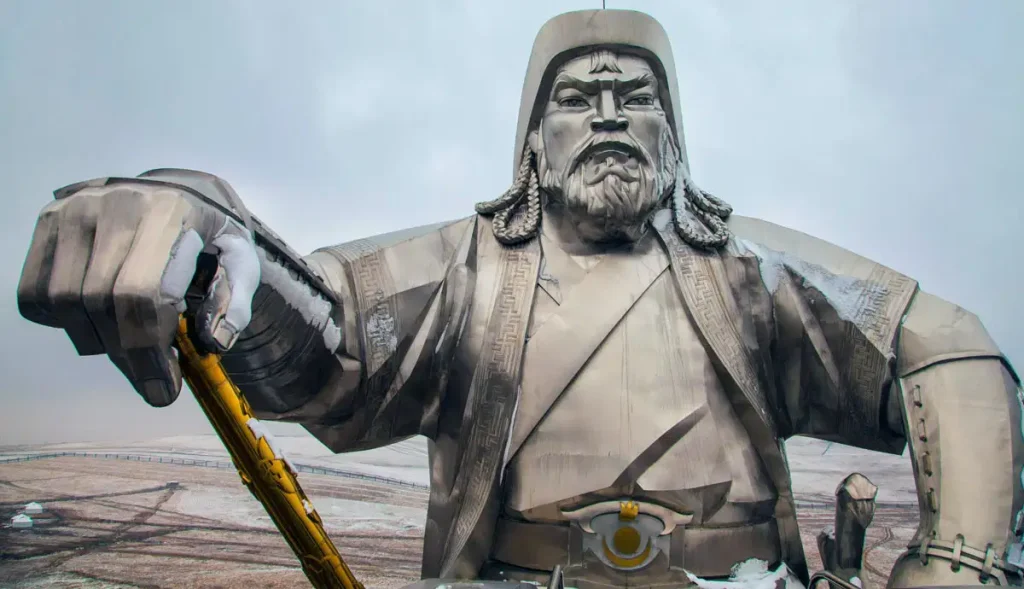
Genghis Khan is one of the most recognized names in human history. He built the largest contiguous empire the world has ever seen. He led armies across deserts, mountains, and steppes with a military precision that stunned every civilization he encountered. Yet for all the records written about his campaigns and conquests, one surprisingly simple question still does not have a definitive answer: what was Genghis Khan’s height?
This is not just idle curiosity. The physical stature of a ruler meant something very real in the 13th century. It was tied to authority, divine favor, and battlefield presence. Genghis Khan’s height has been debated by historians, archaeologists, and scholars for decades, and the answer is far more nuanced than most people expect.
In this article, we are going to walk through every credible source, every historical clue, and every archaeological finding that sheds light on how tall Genghis Khan actually was. By the end, you will have a clear and honest understanding of what history knows, what it suspects, and what may remain a mystery forever.
Why Genghis Khan Height Remains One of History’s Great Unknowns
It seems strange that a man of such enormous historical importance left behind so little physical evidence. But when you understand the world Genghis Khan lived in, it starts to make sense.
No Portraits or Sculptures Survived From His Lifetime
Genghis Khan reportedly refused to allow his image to be depicted in paintings or sculptures during his lifetime. The portraits that exist today were all created after his death, during the Yuan Dynasty, and are considered artistic interpretations rather than accurate likenesses. None of them were drawn from life.
This is a significant problem for historians trying to understand his physical appearance. Without a contemporary likeness, everything comes down to written descriptions, and those descriptions are frustratingly vague.
The Secret History of the Mongols Offers No Measurements
The Secret History of the Mongols, written around 1240, is the oldest surviving Mongolian text and the most important primary source on Genghis Khan’s life. But it was written to document his deeds, his lineage, and his spiritual power. It contains no physical measurements of any kind.
This was entirely normal for the era. Medieval chroniclers did not think to record a ruler’s height in centimeters or feet. What mattered was what a man did, not how tall he stood.
Most Accounts Were Written by People Who Never Met Him
Several of the most cited descriptions of Genghis Khan’s appearance come from historians and chroniclers who never saw him in person. The Persian historian Rashid al-Din, for example, wrote his account of Genghis Khan’s appearance in the early 14th century, nearly a century after the Khan’s death in 1227. He was working from secondary sources, oral traditions, and the accounts of others.
This does not make those accounts worthless, but it does mean they carry uncertainty. When we talk about Genghis Khan height based on these sources, we are really talking about educated estimates filtered through layers of cultural interpretation.
What Historical Sources Actually Say About His Physical Stature
Despite the limitations, there are several historical records that give us real clues about what Genghis Khan looked like. Let us go through the most important ones carefully.
Chinese Diplomatic Records — The Most Reliable Source
The most credible firsthand account of Genghis Khan’s appearance comes from Zhao Hong, a Chinese diplomat who visited the Mongol court during Khan’s lifetime. His records describe Genghis Khan as a man with “a broad brow and long beard,” projecting a commanding physical presence.
Chinese historical records consistently described the Mongols as tall and powerfully built. They portrayed them as resembling a “prototypical Mongol wrestler,” which is a meaningful comparison. Mongolian wrestling, known as Bökh, was a central part of Mongol culture, and wrestlers were trained from childhood to be physically formidable. The diet — rich in red meat and dairy products — produced men who were heavier and more muscular than most neighboring populations.
To Chinese observers, Genghis Khan looked like the ideal version of a Mongol warrior. That impression, even without a precise number, tells us something important about his build.
Rashid al-Din’s Account — Helpful But Contested
The 14th-century Persian historian Rashid al-Din described Genghis Khan as tall and commanding, with features that stood out among his contemporaries. His account has sometimes been cited as claiming Genghis had red hair and green eyes, which has sparked enormous debate.
Modern historians, however, largely believe this was a mistranslation or misinterpretation. The original text is more accurately read as describing a ruddy complexion — not red hair. Nomadic Mongols who lived their entire lives exposed to the wind, cold, and sun often developed deeply reddened skin and cheeks. Rashid al-Din was likely describing that, not an unusual hair color.
Similarly, the references to unusual eyes are now interpreted as descriptions of the epicanthic fold common among Mongolic and Turkic populations, not a literal eye color. These were the features of a Mongol, not a European, as some popular theories have suggested.
What remains consistent in Rashid al-Din’s account is the emphasis on Genghis Khan’s imposing physical presence — tall, broad, with a long beard that was itself unusual among Mongols, who generally struggle to grow full facial hair.
Juzjani and Other Islamic Chroniclers
Minhaj al-Siraj Juzjani was a Persian-Afghan historian writing in the Delhi Sultanate in the 1250s. He had no personal love for Genghis Khan, whose armies had forced him to flee the Khwarezmian Empire. His account describes Genghis Khan in terms that reflect both fear and a degree of grudging acknowledgment of his physical authority.
Juzjani’s “cat-eyed” description, often taken out of context, is now understood by scholars as a reference to the epicanthic fold, not a supernatural eye appearance. It was his way of marking Genghis Khan as distinctly Mongolian in a physical sense — sharp-eyed and intense.
Across all these accounts, the pattern is consistent. Nobody describes Genghis Khan as short or ordinary-looking. Every source that mentions his appearance describes a man who made an impression.
Genghis Khan Height in CM — What Archaeology and Science Suggest
When written records run out, archaeology and science pick up the thread. In recent decades, research into 12th and 13th-century Mongolian burial sites has given historians a much better understanding of the average physical profile of Mongol men during Genghis Khan’s era.
Average Male Height in 13th-Century Mongolia
Archaeological studies of Mongolian burial sites from the 12th and 13th centuries have estimated the average height of adult Mongol men at approximately 166 to 168 cm — roughly 5’5″ to 5’6″. This was actually slightly taller than many other East Asian male populations of the same period, a fact historians attribute to the high-protein, high-calcium diet of the steppe.
If Genghis Khan was described by multiple independent sources as notably taller and more physically impressive than other Mongol men, then he likely stood somewhere above that average. Most historians today place genghis khan height in cm at approximately 168 to 175 cm — somewhere between 5’6″ and 5’9″.
Some sources push this estimate higher, toward 5’11″ or even 6 feet, based on descriptions that suggest he towered over his contemporaries. The truth is likely somewhere in that range, with 5’8″ representing a reasonable middle estimate that aligns with most of the available evidence.
The Borjigin Clan’s Physical Profile
Genghis Khan was born into the Borjigin clan, which was historically described as physically larger and more imposing than neighboring Mongolian tribes. Rashid al-Din’s text specifically describes the Borjigin ancestors as tall, long-bearded, and broad-shouldered.
If we take this clan-level description seriously, it supports the idea that Genghis Khan came from a genetic background predisposed to above-average stature. The Borjigin elite had access to the best food, the most intensive physical training, and a lifestyle that would have maximized physical development.
The Steppe Diet and Physical Development
The traditional Mongolian diet of the 13th century was extraordinarily protein-rich. Red meat — mutton, beef, and horse — formed the core of daily nutrition. Dairy products, including fermented mare’s milk (airag), were consumed constantly. This diet provided excellent calcium and protein intake from early childhood.
Compare this to the grain-heavy diets of the settled civilizations Genghis Khan conquered — the Chinese, the Persians, the Eastern Europeans — and it becomes clear why Mongolian warriors were routinely described as physically larger and stronger. Genghis Khan, as the leader of this group and a member of the elite Borjigin clan, would have had the best of this diet from birth.
Genghis Khan Height and Weight — Building the Full Physical Picture
Understanding genghis khan height and weight together gives us a more complete picture of the man behind the legend.
Estimating His Weight
Based on the estimated height range and the consistently described muscular, stocky build, historians suggest Genghis Khan likely weighed somewhere between 70 and 100 kg — approximately 155 to 220 pounds. The upper end of that range is entirely plausible given the wrestler’s physique described by Chinese sources and the physically demanding lifestyle of a nomadic warrior-king.
Mongolian wrestlers of the era were not lean athletes. They were built for raw power — wide shoulders, thick legs, and a low center of gravity suited to grappling and horsemanship. Genghis Khan was described as embodying that build.
Genghis Khan Weight and Height in the Context of His Warriors
When we consider genghis khan weight and height alongside what we know about Mongol warriors more broadly, the picture becomes even clearer. His top generals — men like Subutai, Jebe, and Muqali — were all described in physically commanding terms. The Mongol military culture was brutally selective. Men who rose to command positions had survived years of the most demanding physical training and combat imaginable.
Genghis Khan was not just the political leader of this group. He was its greatest warrior-chief. He was still riding into battle well into his sixties. His physical endurance was remarkable by any standard, and that kind of endurance requires a solid physical foundation.
How His Physical Presence Shaped His Leadership
In the 13th century, a leader’s body was not separate from his authority. It was part of it.
Stature and Divine Mandate in Mongol Culture
The Mongols believed in Tengri — the eternal blue sky god — as the supreme force in the universe. A leader who was physically imposing, who seemed to carry an almost supernatural presence, was understood to carry Tengri’s blessing. Height, strength, and physical dominance were not just practical assets in a warrior culture. They were spiritual signals.
Genghis Khan’s physical appearance reinforced his claim to divine favor. Multiple sources describe him as projecting an overwhelming presence — not just in battle, but in any room he entered. That presence was a combination of his actual physical size, his bearing, and the psychological weight of who he was.
Legends and the Inflation of Physical Descriptions
At the same time, we have to be honest about the way legends work. When an enemy writes about the man who destroyed their civilization, there is a natural tendency to describe him as superhuman. Making the conqueror into a giant makes defeat feel less humiliating.
This is a well-documented phenomenon in medieval historiography. Oral traditions passed stories from generation to generation, and with each retelling, physical details could grow. A tall man becomes a giant. A strong man becomes unbeatable. The lack of standardized units of measurement in the 13th century made these inflations easy to embed in the record.
This does not mean every description was exaggerated. But it does mean historians apply careful judgment when sources describe Genghis Khan as towering over all other men.
Comparing His Height to Other Historical Leaders of the Era
Putting genghis khan height into a broader historical context helps clarify what “tall” actually meant in the medieval world.
Average Heights in the Medieval World
The average height for adult men across most of the medieval world — including Europe, the Middle East, and East Asia — ranged from about 5’4″ to 5’7″ depending on region and social class. Nobility and warrior classes tended toward the taller end of that range due to better nutrition.
At an estimated 5’8″ to 5’9″, Genghis Khan would have been noticeably taller than the average man in virtually any civilization of his time. Not a giant, but genuinely tall for his era — the kind of man who stands out in a crowd without requiring exaggeration.
Other Famous Medieval Rulers for Comparison
- Alexander the Great is estimated at around 5’7″ — considered tall for his era
- Richard the Lionheart reportedly stood near 6’4″ — genuinely exceptional
- Saladin, his great contemporary, was described as lean and of medium height
- Kublai Khan, Genghis’s grandson, was described as broad and heavy-set
Among these figures, an estimated 5’8″ to 5’9″ for Genghis Khan places him solidly in the upper tier of medieval rulers in terms of physical stature — but not in some impossibly superhuman category.
The Ongoing Mystery — Will We Ever Get a Definitive Answer?
The honest answer is that we may never know Genghis Khan’s exact height with certainty. And the reason for that comes down to one extraordinary fact: his tomb has never been found.
The Secret Burial and What It Could Tell Us
Genghis Khan died in 1227. Per Mongol tradition, he was buried in a secret location, and everyone present at the burial was reportedly killed to protect the secret. Thousands of horsemen are said to have ridden over the site to erase all traces. A river may have been diverted over it.
The suspected burial area lies somewhere in the Khentii mountains of northeastern Mongolia, but no confirmed site has ever been excavated. If his remains were ever found, forensic anthropologists could determine his height with remarkable precision — within a centimeter or two — using measurements of the femur and tibia.
DNA analysis of his remains could also provide insight into the physical genetics of the Borjigin clan, confirming or refining what we currently know from secondary sources.
Mongolia’s Archaeological Restrictions
The Mongolian government has placed significant restrictions on archaeological excavation near the Khentii region, partly out of respect for Genghis Khan’s sacred status in Mongolian national identity, and partly to protect the site from commercial exploitation. These restrictions mean that even as technology advances, the answer may remain off-limits for years or even decades.
Until that changes, the question of genghis khan height will continue to be answered with careful estimates rather than certainty.
Conclusion
So where does all of this leave us? Genghis Khan’s height, based on the best available historical, archaeological, and contextual evidence, was most likely somewhere between 168 and 175 cm — approximately 5’6″ to 5’9″. That range may not be as dramatic as popular myths suggest, but it was genuinely tall for the 13th century. It was the height of a man who stood out among his own people and made an impression on every diplomat, historian, and enemy who encountered him.
His weight, paired with a consistently described muscular and stocky build, likely fell between 70 and 100 kg — the physique of a serious warrior and wrestler, not a slender diplomat.
But here is the most important thing to take away: Genghis Khan’s legacy was never built on his physical size. It was built on his strategic brilliance, his political genius, his ability to unite feuding clans into an unstoppable military force, and his vision for an empire that connected East and West in ways the world had never seen. His height may have given him an edge in a culture that valued physical presence. But it was his mind, his will, and his extraordinary capacity for leadership that made him Genghis Khan.
The question of genghis khan height mirrors the mystery of the man himself — endlessly fascinating, frustratingly incomplete, and all the more compelling for it.
FAQ 1 Q: What was Genghis Khan’s height? A: Genghis Khan’s exact height was never recorded, but most historians estimate it at around 5’6″ to 5’9″, which is roughly 168 to 175 cm. Multiple historical accounts describe him as notably taller and more physically imposing than the average Mongol man of his time, which suggests he stood above the era’s norm of around 166 to 168 cm.
FAQ 2 Q: How tall was Genghis Khan in cm? A: Based on historical accounts and archaeological studies of 12th and 13th-century Mongolian burial sites, Genghis Khan’s height in cm is estimated at approximately 168 to 175 cm. Some sources push this closer to 180 cm (5’11”) based on accounts that described him as towering over his fellow Mongol warriors, though 175 cm remains the most widely accepted upper estimate.
FAQ 3 Q: What was Genghis Khan’s height and weight? A: Genghis Khan’s height is estimated at 5’6″ to 5’9″ (168–175 cm), and his weight is believed to have been between 70 and 100 kg (155 to 220 lbs). Historical sources consistently describe him as stocky, broad-shouldered, and powerfully built — consistent with the physique of a Mongolian wrestler, which was the culturally dominant physical ideal of the era.
FAQ 4 Q: Was Genghis Khan tall for his time period? A: Yes, Genghis Khan was almost certainly above average height for the 13th century. Archaeological evidence from Mongolian burial sites places average male height at around 166 to 168 cm during his era. If multiple independent sources — Persian, Chinese, and Islamic — all describe him as physically imposing and taller than his peers, he clearly stood out from the crowd without requiring any exaggeration.
FAQ 5 Q: Why don’t we know Genghis Khan’s exact height? A: No precise physical measurements of Genghis Khan were ever recorded during his lifetime. He reportedly forbade any portraits or sculptures of himself, partly for cultural and religious reasons tied to Mongol shamanic beliefs about images limiting a person’s spirit. Medieval chroniclers of the era focused on deeds, conquests, and lineage — not body measurements. The oldest Mongolian text, the Secret History of the Mongols, contains no physical details at all.
FAQ 6 Q: What did Genghis Khan look like physically? A: Historical accounts paint a consistent picture: Genghis Khan was tall, broad-shouldered, and stockily built with a long, full beard — which was itself unusual among Mongols, who typically struggle to grow thick facial hair. He is described as having cat-like eyes (now interpreted by scholars as referring to the Mongolian epicanthic fold) and a commanding physical presence that made a strong impression on Chinese diplomats and Persian historians alike.
FAQ 7 Q: Did Genghis Khan have red hair and green eyes? A: This claim originates from the Persian historian Rashid al-Din, writing in the early 14th century — nearly a century after Genghis Khan’s death. Modern historians largely interpret “red hair” as a reference to his ruddy skin complexion from a lifetime of outdoor nomadic living. The reference to unusual eyes is now understood as a description of the Mongolian epicanthic fold, not a literal eye color. He almost certainly had the dark hair and features typical of the Borjigin Mongol clan.
FAQ 8 Q: How does Genghis Khan’s height compare to other historical rulers? A: At an estimated 5’8″ to 5’9″, Genghis Khan would have been taller than most medieval rulers. Alexander the Great is estimated at around 5’7″, Saladin at a lean medium height, and the average medieval European or Asian ruler at roughly 5’5″ to 5’7″. While not in the exceptional range of someone like Richard the Lionheart (reportedly 6’4″), Genghis Khan was genuinely tall by any 13th-century standard.
FAQ 9 Q: What sources describe Genghis Khan’s physical appearance? A: The primary sources include: (1) Chinese diplomat Zhao Hong’s records, which describe “a broad brow and long beard”; (2) the 13th-century Persian historian Juzjani’s account, which describes “cat-like eyes” and a commanding aura; (3) Rashid al-Din’s 14th-century Persian chronicles, which describe him as tall and strongly built; and (4) the World History Encyclopedia’s citation of Juzjani calling him “a man of tall stature, of vigorous build.” No source describes him as short or unremarkable.
FAQ 10 Q: Did Genghis Khan’s height give him a military advantage? A: In a practical sense, yes. A taller rider on horseback has a longer reach with a composite bow, which was the Mongol army’s primary weapon. Physical height also reinforced psychological dominance in hand-to-hand combat and in political settings. In Mongol warrior culture, physical size was associated with divine favor from Tengri — the sky god — which meant that being visibly larger than rivals and enemies directly strengthened Genghis Khan’s claim to leadership and divine mandate.
FAQ 11 Q: What was the average height of Mongol warriors in Genghis Khan’s time? A: Archaeological studies of 12th and 13th-century Mongolian burial sites estimate the average male height at approximately 166 to 168 cm (5’5″ to 5’6″). This was slightly above average for East Asian populations of the same era, largely attributed to the protein- and calcium-rich Mongolian steppe diet of red meat and dairy products. Mongol warriors were generally more muscular and physically developed than the settled agricultural populations they conquered.
FAQ 12 Q: How much did Genghis Khan weigh? A: Genghis Khan’s weight is estimated at between 70 and 100 kg (roughly 155 to 220 lbs). This range is consistent with his described build — stocky, muscular, and broad-shouldered, similar to a Mongolian wrestler’s physique. His lifestyle as a mounted warrior, horseman, and military leader from childhood would have supported significant muscle mass rather than a lean build. Mongolians of the era who consumed a high-protein meat-and-dairy diet generally carried more weight than neighboring grain-farming populations.
FAQ 13 Q: Could Genghis Khan’s tomb reveal his actual height? A: Yes, definitively. If his burial site were ever discovered, forensic anthropologists could determine his height with remarkable precision — within one to two centimeters — by measuring the femur and tibia bones. Unfortunately, his tomb has never been found. Per Mongol tradition, he was buried in a secret unmarked location, and those present at the burial were reportedly killed to protect the secret. The Mongolian government also maintains restrictions on excavations near the suspected Khentii mountain region.
FAQ 14 Q: Was Genghis Khan’s height ever recorded in the Secret History of the Mongols? A: No. The Secret History of the Mongols, written around 1240, is the oldest surviving Mongolian text and the most important primary source on Genghis Khan’s life. However, it records his deeds, lineage, and spiritual power — not his physical measurements. Medieval chroniclers simply did not record heights in the way modern biographers do. The absence of this information is not unusual for the era; it applies to virtually every 13th-century historical figure.
FAQ 15 Q: How tall was Genghis Khan compared to the average person in the 13th century? A: The average adult male height in the 13th century ranged from about 5’4″ to 5’7″ across most of Asia and Europe, depending on region and social class. At an estimated 5’6″ to 5’9″, Genghis Khan would have been at or above the tall end of that range in virtually every civilization of his time. He would not have appeared unusually tall to a modern eye, but to his contemporaries, he stood out as a physically impressive figure.
FAQ 16 Q: Is the Genghis Khan height claim of “over 6 feet” accurate? A: This claim appears in some popular sources but is not well supported by the available evidence. While it cannot be definitively ruled out, the archaeological record suggests average Mongol male height was around 166 to 168 cm, and the written sources — though they emphasize his imposing presence — do not suggest he was in a truly exceptional physical category. The “over 6 feet” claim likely reflects the cultural tendency to mythologize powerful rulers through exaggerated physical attributes.
FAQ 17 Q: What role did Genghis Khan’s physical stature play in Mongol culture? A: In Mongol society, physical size was not just a practical asset — it carried deep spiritual meaning. The Mongols believed in Tengri, the eternal sky god, and a leader who projected physical dominance was understood to carry divine blessing. Being visibly larger than rivals strengthened a leader’s claim to authority. Genghis Khan’s commanding presence, reinforced by his physical size and bearing, was an integral part of how he maintained loyalty among his warriors and inspired fear in his enemies.
FAQ 18 Q: Why do different sources give different estimates for Genghis Khan’s height? A: The variation in estimates comes from several factors. First, no precise measurement was ever recorded. Second, medieval descriptions were impressionistic (“tall,” “vigorous build”) rather than numerical. Third, medieval units of measurement were not standardized, making comparisons difficult. Fourth, oral tradition tends to inflate physical details over generations, particularly for powerful rulers. Fifth, some sources were written by enemies who had reason to make their conqueror sound superhuman. All of this means modern historians must interpret rather than simply read the historical record.
FAQ 19 Q: How did the Mongolian diet affect Genghis Khan’s height and build? A: The traditional Mongolian steppe diet of the 13th century was extraordinarily protein-rich, centered on red meat — mutton, beef, and horse — along with high volumes of dairy products including fermented mare’s milk. This provided excellent calcium and protein intake from early childhood, supporting bone density and muscle development that exceeded what was possible on the grain-heavy diets of settled civilizations. As a member of the elite Borjigin clan, Genghis Khan would have had the best access to this diet from birth, maximizing his physical potential.
FAQ 20 Q: Did Genghis Khan’s height influence how he rode his horse? A: This is a reasonable consideration. Mongolian horses were relatively small — standing between 12 and 14 hands high, similar to sturdy ponies. A taller rider on a smaller horse actually holds a tactical advantage in archery, as the height differential increases the effective range and angle of a composite bow shot. Some historians note that the Mongol cavalry’s devastating effectiveness with mounted archery may have been partly influenced by the physical stature of its elite warriors, including Genghis Khan himself.
FAQ 21 Q: What is the Juzjani description of Genghis Khan, and what does it tell us about his height? A: The 13th-century Persian-Afghan historian Juzjani, writing around 1260, described Genghis Khan as “a man of tall stature, of vigorous build, robust in body.” This is one of the most direct physical descriptions from a source that, while not a firsthand witness, had access to people who had encountered the Khan. The phrase “tall stature” is significant because Juzjani was writing for an audience familiar with what tall looked like — it was not a vague compliment, but a meaningful physical assessment.
FAQ 22 Q: How does Genghis Khan’s height compare to his grandson Kublai Khan? A: Historical descriptions of Kublai Khan, who ruled the Mongol Empire from 1260 to 1294, paint a quite different physical picture. Kublai is described as broad and increasingly overweight in later life, with a darker complexion compared to his grandfather. The contrast between Genghis Khan’s described lean, powerful warrior physique in his prime and Kublai’s more sedentary, courtly build reflects the shift from a nomadic, conquest-driven empire to a settled, administrative one. Both were tall by the standards of their era, but their builds differed significantly.
FAQ 23 Q: Is there any DNA evidence that tells us about Genghis Khan’s physical build or height? A: Not directly. Genetic studies, including the landmark 2003 study that identified a Y-chromosome lineage potentially traced to Genghis Khan across roughly 16 million living men, tell us about his reproductive legacy rather than his physical traits. Height and build are determined by hundreds of genetic variants, making it impossible to estimate stature from the Y-chromosome studies conducted so far. A 2026 study published in PNAS further complicated the picture, suggesting the lineage may predate Genghis Khan himself. Until his actual remains are found, DNA cannot confirm his height.
FAQ 24 Q: What is the most reliable estimate of Genghis Khan’s height accepted by historians today? A: The most widely accepted estimate among historians and archaeologists today places Genghis Khan’s height between 5’6″ and 5’9″ (168 to 175 cm). This range is supported by the convergence of three lines of evidence: written descriptions from Persian, Chinese, and Islamic sources that consistently describe him as above average in stature; archaeological data from Mongolian burial sites establishing the era’s baseline height; and the known physical profile of the Borjigin clan, which was described as taller and broader than neighboring Mongol tribes. It is a measured, evidence-based estimate — not a myth, and not a guess.

