
Picture this — you notice a damp patch spreading across your ceiling after a heavy rainstorm. You call a roofer, and the first thing they ask is: “What’s the gradient on that roof?” If you don’t have an answer, you’re not alone. Most homeowners never think about roof gradient until there’s a problem. But by that point, the damage is already done.
A roof gradient is simply the slope of a roof surface measured as a ratio of vertical rise to horizontal run. It tells you how steeply a roof falls from its highest point to its lowest edge. Every roof has one — even the ones that look completely flat. Getting it right is the difference between a roof that lasts decades and one that costs you thousands in repairs within a few years.
This article covers everything you need to know: what the correct gradient is for different roof types, what international building codes actually require, how to calculate it yourself, and — for the Minecraft builders out there — how to apply gradient techniques to your in-game roofs so they look genuinely professional rather than flat and boring.
What Is a Roof Gradient and Why Does It Matter?
Understanding the Basic Definition
A roof gradient describes the ratio between how much a roof rises vertically compared to how far it travels horizontally. It’s expressed in a few different ways depending on the context. In North America, it’s usually written as a ratio like 4:12, meaning 4 inches of rise for every 12 inches of horizontal run. In the UK and much of Europe, it’s expressed as a fall ratio — for example, 1:80 — which means 1 unit of drop for every 80 units of horizontal distance. In engineering, you’ll also see it as a percentage or in degrees.
These formats all describe the same thing: how tilted the roof surface is. The steeper the gradient, the faster water runs off. The shallower it is, the more care is needed to choose materials and drainage systems that prevent water from sitting still.
How Roof Gradient Affects Water Drainage
Water always follows gravity. On a roof, that means it needs somewhere to go — fast. If the gradient is too shallow, water pools on the surface. Pooled water adds enormous weight to a roof structure over time. Even a relatively small area of standing water can add hundreds of kilograms of unplanned load to a building.
Beyond weight, standing water accelerates membrane degradation. UV rays, freeze-thaw cycles, and the constant presence of moisture break down roofing materials far faster than they should. Moss, algae, and debris accumulate in low spots. Drains get blocked. Before long, what started as a slight ponding issue becomes a serious leak.
The International Building Code requires a minimum drop of ¼ inch per foot across the roof surface to ensure positive drainage. That sounds like very little — and it is — but even that small gradient is enough to keep water moving toward outlets rather than sitting still.
Roof Gradient vs. Roof Pitch vs. Roof Slope
These three terms get used interchangeably in everyday conversation, but they do carry slightly different meanings in technical contexts. Roof pitch is the steepness of a roof expressed as a ratio to a 12-inch run and is commonly used in residential construction in the US. Roof slope refers to the incline of the surface and is often expressed as a percentage or angle. Roof gradient is the broader term that covers both concepts and is particularly common in commercial roofing, civil engineering, and UK construction standards. For the purposes of this article, all three relate to the same fundamental idea: how much a roof surface tilts.
Flat Roof Gradient Requirements Explained
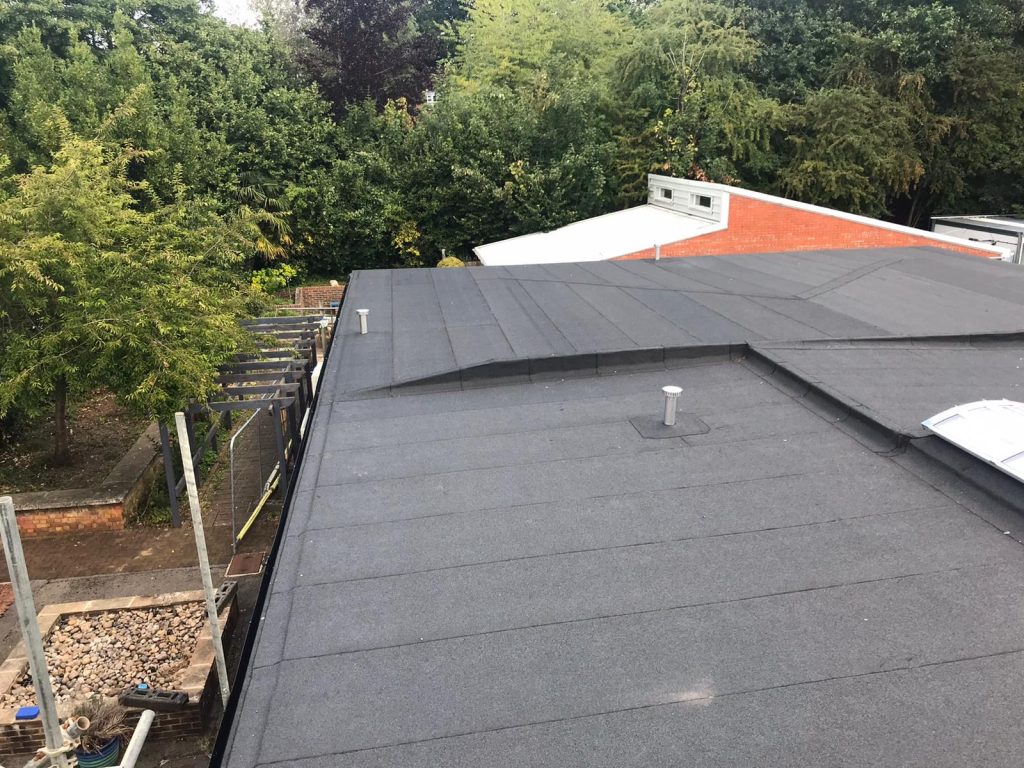
Flat roofs get a bad reputation. People assume they’re prone to leaks and drainage problems by nature. The truth is that most flat roof failures come from one thing: an insufficient or poorly designed flat roof gradient. A properly sloped flat roof can easily last 20 to 30 years with appropriate materials.
What Actually Counts as a “Flat” Roof?
No roof is truly flat. Building codes and roofing industry standards universally require at least a minimal fall even on so-called flat roofs. In the United States, the International Building Code sets the baseline at ¼:12 — meaning ¼ inch of drop for every 12 inches of horizontal distance. This applies to most low-slope roofing systems including modified bitumen, single-ply membranes, and spray polyurethane foam.
In the United Kingdom, the British Standard BS 6229:2018 recommends a minimum fall of 1:80 on the completed roof surface. This works out to roughly 0.7 degrees from horizontal — barely visible to the naked eye, but entirely sufficient to move water toward drainage outlets when everything is installed correctly.
Why the Flat Roof Gradient Gets Miscalculated
Here is where many projects go wrong. The design gradient and the achieved gradient are rarely the same thing. Construction tolerances, deck deflection under load, thermal expansion, and even the weight of roofing materials themselves can reduce the effective slope of a completed flat roof below its designed level.
The ASCE 7 standard, which governs structural design loads across the United States, specifically highlights the risk of ponding instability on low-slope roofs. When water pools, its weight deflects the deck slightly. That deflection creates a deeper pool, which deflects the deck further. This cycle — called ponding instability — can lead to catastrophic structural failure if the deck isn’t stiff enough and the roof gradient isn’t sufficient to move water off before it accumulates.
This is why engineers and roofing professionals often recommend designing to a gradient that’s higher than the code minimum. A design target of 1:60 or even 1:40 on commercial flat roofs gives enough buffer that after deflection and construction tolerances, the actual achieved gradient still meets the 1:80 minimum.
Recommended Flat Roof Gradient by Material Type
Different roofing materials have different drainage demands. Here’s a practical overview:
Modified Bitumen and Built-Up Roofing: Minimum ¼:12 under IBC. These systems rely almost entirely on slope for drainage since they have no inherent water-shedding texture.
Single-Ply Membranes (TPO and EPDM): Also minimum ¼:12, though some EPDM assemblies have maximum slope limitations as low as ½:12, so always check manufacturer specifications. PVC membranes generally allow higher slope ranges.
Spray Polyurethane Foam (SPF): Minimum ¼:12 per IBC 2018. SPF is self-sealing around penetrations, which partially compensates for low slope, but adequate drainage is still essential.
Liquid-Applied Membranes: Same ¼:12 minimum. These are typically used as topcoats and waterproofing layers and require smooth, consistent slopes to drain properly.
For areas with heavy rainfall or significant snow loads, local codes frequently exceed these national minimums. Some municipalities require up to ½ inch per foot on low-slope roofing systems. Always check with your local authority before specifying or building.
Building Code Standards and the Roof Gradient
What the International Building Code Requires
IBC Chapter 15 is the primary reference for roof assemblies in the United States. It sets out minimum slope requirements by material type and is adopted — with local amendments — in virtually every state. Here’s a summary of the key thresholds:
- Asphalt shingles: 2:12 minimum (with double underlayment below 4:12)
- Clay and concrete tile: 2½:12 minimum
- Metal shingles: 3:12 minimum
- Slate: 4:12 minimum
- Standing-seam metal panels: ¼:12 minimum
- Built-up/membrane systems: ¼:12 minimum
The National Roofing Contractors Association (NRCA) goes further than the code in its best-practice recommendations. For steep-slope materials like asphalt shingles, the NRCA recommends 4:12 or more — twice the code minimum for some materials — because performance data consistently shows better long-term results at higher slopes.
When Local Building Codes Override National Standards
The IBC sets a floor, not a ceiling. Local jurisdictions regularly amend it to reflect regional conditions. A municipality in the Pacific Northwest, where annual rainfall is measured in feet rather than inches, may require steeper slopes or more robust drainage systems than one in the arid Southwest. Similarly, cities in freeze-thaw climates add requirements for ice dam prevention that effectively push recommended slopes higher.
Before any roofing project, check with your local Authority Having Jurisdiction (AHJ). Permits are typically required for roof replacement when it involves structural modifications, and inspectors verify that the installed gradient meets approved specifications before signing off.
Consequences of Getting the Gradient Wrong
The consequences of an insufficient roof gradient range from frustrating to genuinely dangerous. On the minor end, inadequate slope causes moss growth, drain blockages, and premature membrane failure. On the serious end, ponding instability can compromise structural integrity — especially on large commercial roofs where the accumulated weight of water after a major storm can exceed design load limits.
From a financial standpoint, a gradient that falls below manufacturer minimums typically voids the roofing warranty. Insurance claims related to drainage failures may also be denied if the building is found to be out of code compliance. Getting the gradient right at the design and construction stage is far less expensive than fixing it afterward.
How to Calculate and Measure a Roof Gradient
The Rise-Over-Run Formula
The calculation itself is straightforward. Gradient = vertical rise ÷ horizontal run. From that decimal figure, you can convert to whatever format you need.
For example: a roof that rises 6 inches over a 24-inch horizontal run has a gradient of 6/24 = 0.25, which is a 25% slope, a 6:24 (simplified to 3:12) pitch, and approximately 14 degrees.
To convert to degrees, use: angle = arctan(rise/run). Most scientific calculators and smartphones handle this easily.
To express as X:12 format (US standard): multiply the decimal gradient by 12. A 0.333 gradient = 4:12.
Practical Measurement Tools
Bubble level and ruler: Place a 12-inch level on the roof surface. Raise one end until the bubble is centered, then measure the vertical gap at the raised end. That measurement in inches is your X value in X:12 format.
Digital inclinometer or pitch gauge: A faster option for professionals. Place it flat on the roof surface and read the angle directly.
Online roof gradient calculators: Enter your rise and run values and receive instant conversions to ratio, degrees, and percentage formats. Useful for double-checking manual calculations.
Design Gradient vs. Achieved Gradient
Always build in extra margin. If the code requires ¼:12 and you design to exactly ¼:12, you’re one bad day of deck deflection away from non-compliance. A design target of ½:12 on flat roofs is a sensible buffer that most membrane systems can accommodate and that gives you confidence the finished installation will perform as required.
On large commercial flat roofs, tapered insulation systems are commonly used to achieve consistent slope across the entire surface without raising structural elements. The insulation boards are manufactured at a gradual taper, and when laid correctly they create a precise, even gradient that channels water toward internal drains or perimeter scuppers.
Minecraft Gradient Roof — Why It Transforms Your Builds
If you’ve spent time in Minecraft building anything more ambitious than a dirt house, you already know that the roof makes or breaks a build. A flat, uninspired roof signals beginner work instantly. A well-constructed gradient roof — with intentional pitch, thoughtful material transitions, and careful detailing — is what separates competent builders from genuinely impressive ones.
In Minecraft, the term “gradient roof” carries two distinct but related meanings. The first is the structural gradient: the pitch or slope angle of the roof itself. The second is the color and texture gradient: the visual transition between different block types across the roof surface to create depth, realism, and interest. Both matter. Most builders who struggle with roofs are either ignoring one or handling both poorly.
Choosing the Right Pitch for Your Minecraft Roof
Minecraft’s block grid naturally produces a limited set of clean angles. The three most commonly used are:
63.4 degrees — achieved by stacking full blocks directly. This is a very steep, dramatic pitch suited to Gothic, fantasy, or fortified structures.
45 degrees — achieved using stair blocks. One block rise for one block run. This is the most versatile pitch and works for medieval, cottage, and European-style buildings.
22.5 degrees — achieved by alternating upper and lower slab blocks. This produces a shallow, elegant pitch suited to Japanese-inspired, modern, or low-rise traditional builds.
The width of your building directly affects how your chosen pitch looks. Narrow buildings with steep roofs become towering and imposing — which can work beautifully for a wizard’s tower but looks absurd on a small cottage. The Minecraft Wiki notes that when buildings are wider than about 20 blocks with a 45-degree pitch, the roof peak becomes two to two-and-a-half stories tall. At that scale, you should either add interior rooms within the roof volume or break the roof into multiple smaller sections.
For roof ridges to sit symmetrically over central features like doors or windows, odd-width buildings pair best with odd-width features. Even-width buildings work best with even-width central features.
Building a Gradient Roof in Minecraft with Block Transitions
This is where most builders either level up or stay stuck. A gradient in Minecraft is a deliberate, successive transition from one block type or color to another. It is not random splattering of different blocks across a surface. Random placement looks chaotic and unpolished. A true gradient has direction, rhythm, and logic.
The core rule: never allow two non-adjacent tones in your palette to touch. If you’re working from dark to light, each step must be one shade closer to the destination. Skipping steps in the gradient destroys the smooth transition effect.
A practical example for a warm-toned roof gradient:
Dark Oak Stairs → Stripped Spruce Blocks → Spruce Stairs → Stripped Oak Blocks → Birch Stairs → Birch Planks
This sequence moves from dark warm brown at the ridge to pale creamy tones at the eaves. Each material is close enough in tone to its neighbor that the eye reads the roof as a unified surface rather than a patchy mess.
For an earthier, natural palette common in cottagecore or fantasy builds:
Orange Terracotta → Stripped Acacia → Mud Blocks → Packed Mud → Stripped Jungle → Stripped Birch → Birch Planks
This palette transitions from warm terracotta reds down through earthy neutrals to pale wood at the eaves. It mimics the way real thatched or clay-tile roofs weather and age, with darker, older material at the top and lighter, cleaner material toward the edges.
For thatch-style roofs, moss blocks work well as intermediate steps between standard thatch-adjacent blocks. Think about where moss realistically accumulates on a real building — typically toward the top and in sheltered areas — and apply it accordingly.
Asymmetry, Overhangs, and Dormer Details
Not every gradient roof in Minecraft needs to be symmetrical. Intentional asymmetry — making one side slightly taller, or offsetting the ridge — adds character and makes builds feel more organic and hand-crafted. Cottages and rustic farmhouses especially benefit from this approach.
Overhangs are another detail that separates mediocre roofs from genuinely good ones. Extending the roof edge one or two blocks beyond the wall creates shadow lines, adds visual weight to the base of the roof, and mimics how real buildings protect their walls from rain. Slabs, trapdoors, and angled stair blocks can all be used to create overhang detail without making the structure look blocky.
Dormer windows — small vertical windows that project from a sloped roof — add enormous visual complexity with relatively little effort. A well-placed dormer breaks up a large, monotonous roof slope, adds light to interior spaces, and creates interesting silhouettes against the skyline.
Advanced Gradient Roof Techniques in Minecraft
Joining Roofs of Different Heights
One of the trickiest challenges in Minecraft building is connecting a main structure to a side extension when the two roofs meet at different heights. The temptation is to force them to match, but that usually results in awkward proportions on one or both buildings.
The cleaner solution is to bring the higher roof down to meet the lower one at the junction, using a different accent block to mark the join clearly. Contrasting blocks — white quartz against sandstone, for example — can signal the architectural join in a way that reads as intentional rather than accidental.
If the side extension is significantly taller than the main building, consider converting it into a tower with its own independent roof. This resolves the join problem entirely and adds vertical interest to the overall structure.
Stained Glass Gradient Roofs
Stained glass gradient roofs have become one of the most popular advanced techniques in the Minecraft building community, driven largely by tutorials spreading across YouTube and TikTok. The principle is the same as any block gradient — successive color transitions — but the translucency of glass adds an entirely different visual quality, especially in builds lit from within.
A warm-to-cool glass gradient works well on fantasy or ethereal builds: amber → yellow → lime → cyan → blue → purple. A monochromatic gradient — deep blue through lighter shades to near-white — suits royal or icy themed builds. The key is that each color in the sequence should be adjacent on the color wheel to its neighbor. Jumping from red to blue in one step destroys the gradient effect.
Stained glass gradients read best on larger roof sections where each color band is at least two to three blocks wide. On small roofs, individual colors become too dominant and the gradient disappears.
Non-Axis-Aligned Builds
Most Minecraft structures align to the north-south-east-west grid. Occasionally builders construct at an angle — typically 45 degrees or approximately 63 degrees — to create visual variety in a large settlement or city. For these builds, stair blocks become awkward because their orientation conflicts with the diagonal wall lines. Slabs and full blocks work far better for angled roofs because they don’t have a directional bias. Gradient techniques still apply, but keeping each color band parallel to the roof’s peak line requires extra care when the building itself isn’t axis-aligned.
Flat Roof Gradient vs. Pitched Roof: Making the Right Choice
Real-World Practical Considerations
The choice between a flat roof gradient system and a traditionally pitched roof comes down to several overlapping factors. Climate is the most important. In regions with heavy snowfall, steep pitches allow snow to slide off before it accumulates to dangerous levels. In rainy climates, steeper pitches shed water faster. In arid climates, flat roofs are entirely practical and far more common.
Building use matters too. Commercial buildings with extensive rooftop equipment — HVAC units, solar panels, cooling towers — almost always use flat roof systems because they provide a stable, accessible working platform. Residential buildings more commonly use pitched roofs, though modern architecture frequently employs low-slope designs.
Cost is a genuine factor. Flat roofs are less expensive to construct initially because they require simpler framing and fewer materials. However, they demand more rigorous waterproofing and more frequent maintenance to keep drainage systems clear. Pitched roofs cost more upfront but tend to require less ongoing maintenance when built correctly.
Aesthetic and Structural Trade-offs
Flat roof gradient systems deliver a clean, modern aesthetic that suits contemporary commercial and residential architecture. They create usable rooftop space for gardens, terraces, and equipment. Their weakness is entirely in drainage — poorly designed flat roofs are the primary source of chronic leak problems in commercial buildings.
Pitched roofs provide superior natural drainage, longer material lifespans, and the potential for usable attic space. They also offer more design variety: gable, hip, mansard, gambrel, and shed roofs all serve different architectural purposes and climatic needs.
Hybrid solutions — low-pitched roofs over tapered insulation systems — increasingly bridge the gap, offering the clean lines of a flat roof with drainage performance approaching that of a proper slope.
Conclusion
Roof gradient is one of those fundamentals that sits quietly beneath everything else in a roofing project. It doesn’t grab attention the way materials or aesthetics do, but it determines whether a roof works or fails over the long term. Too shallow and you’re fighting water damage from day one. Correctly sloped and properly drained, a roof should give you decades of trouble-free performance.
For real-world construction, the principles are clear: follow IBC minimums, aim for gradient values above the bare code floor, account for deflection and construction tolerances, and always verify with your local AHJ before building. For Minecraft builders, the same fundamental logic applies — a roof with intentional pitch and smooth block transitions reads as professional, realistic, and genuinely impressive.
Whether you’re designing a commercial flat roof, replacing asphalt shingles on a family home, or crafting an intricate fantasy castle in Minecraft, understanding how gradient affects performance and appearance puts you in a far stronger position to get the result right the first time.
Q1. What is a roof gradient? A roof gradient is the measured slope of a roof surface, expressed as a ratio of vertical rise to horizontal run. It tells you how steeply the roof falls from its highest point to its lowest drainage edge. Every roof — including flat roofs — requires some form of gradient to move rainwater toward outlets and prevent pooling.
Q2. What is the minimum gradient for a flat roof? Most roofing experts recommend a minimum slope of 1:40 during installation, as this typically settles to around 1:80 once the roof adjusts under load. Under US building codes, most flat roofing systems — including EPDM, TPO, modified bitumen, and built-up systems — require at least ¼ inch drop per foot to ensure proper water drainage.
Q3. What is the difference between roof gradient and roof pitch? Roof pitch is the specific North American term for steepness expressed as rise over a 12-inch run (e.g., 4:12). Roof gradient is the broader engineering term covering the same concept but also expressed as a percentage, ratio (e.g., 1:80), or angle in degrees. In everyday roofing conversation, they describe the same property of the roof surface — how tilted it is.
Q4. Why do flat roofs need a gradient if they look level? Although a flat roof appears to be level, it needs a slight slope of at least 1:80 to allow for the drainage of water. A truly zero-gradient roof traps rainwater after every rainfall, and no flat roofing material is code-compliant without some minimum fall. Standing water adds weight, weakens the membrane, and can block outlets with debris, leading to larger water traps and eventually structural damage.
Q5. What happens if a roof gradient is too shallow? Pooled water adds unnecessary weight to the structure, accelerates material deterioration, and creates perfect conditions for leaks to develop. Over time, shallow-gradient roofs suffer from moss and algae buildup, membrane failure, drain blockages, and in severe cases, ponding instability — where accumulated water deflects the deck, creating an even deeper pool in a self-reinforcing cycle.
Q6. What is the recommended roof gradient for different roofing materials? For metal panel roof systems, the NRCA recommends slopes of ½:12 or more for structural panel systems and 3:12 or more for architectural panel systems. For asphalt shingle, clay and concrete tile, metal shingle, slate, and wood shake and shingle roof systems, the NRCA recommends slopes of 4:12 or more. Flat membrane systems such as TPO and EPDM work down to ¼:12 under IBC requirements.
Q7. How do I calculate the roof gradient on my own roof? The calculator determines the roof gradient by dividing the vertical rise by the horizontal run. This decimal slope is then converted into more common formats: a ratio (X:12), an angle in degrees, or a percentage gradient. The quickest DIY method is to place a 12-inch bubble level on the roof surface, raise one end until the bubble centers, and measure the vertical gap — that gap in inches equals your X value in the X:12 format.
Q8. What is the legal requirement for roof gradient in the UK? BS 6229:2018 is the UK code of practice for flat and curved roof surfaces. It recommends a minimum fall of 1:80 on the completed roof. Because the guidance states “minimum,” the design trend is to specify 1:40 or 1:60 to ensure that after construction tolerances and settlement, the finished gradient still meets the 1:80 baseline. Gradients steeper than 1:60 begin to introduce structural complexity and added cost, particularly on roof gardens and podiums.
Q9. What is ponding instability and how does roof gradient prevent it? When water pools, its weight deflects the deck slightly. That deflection creates a deeper pool, which deflects the deck further — a cycle called ponding instability that can lead to catastrophic structural failure if the deck is not stiff enough and the roof gradient is not sufficient to move water off before it accumulates. A gradient at or above the code minimum — ideally ½:12 on commercial roofs — gives enough fall to prevent this cycle from starting.
Q10. Does roof gradient affect which roofing materials you can use? Yes, directly. Pitch dictates which materials can be safely installed. Asphalt shingles require at least a 2:12 pitch (with double underlayment), while flat roofs under 2:12 require specialized waterproof membranes to prevent leaks. Using any material below its manufacturer-specified minimum gradient voids the warranty and creates significant leak risk regardless of installation quality.
Q11. What is a good roof gradient for a residential house? A standard residential roof pitch is typically between 4:12 and 9:12. Roofs with a pitch of 6:12 or less are generally considered walkable for maintenance, while steeper roofs require safety equipment. The best gradient for a residential home depends on climate — steeper pitches suit heavy snow and rain regions, while lower pitches work in arid areas — and on the chosen roofing material.
Q12. Can you fix a flat roof that has the wrong gradient? Tapered insulation is the simplest fix and can be installed during re-roofing to create a new slope without altering the structure. Each board varies in thickness and directs water toward drainage points. For more severe cases where the deck itself is sagging or uneven, structural work such as adjusting joists or adding firring strips may be required before laying a new membrane.
Q13. How does roof gradient affect energy efficiency? Steep roofs often allow for better insulation and ventilation, enhancing energy efficiency. Pairing a suitable gradient with premium insulation can lead to substantial energy savings. Flat roofs depend on rigid insulation boards or spray foam applied above the deck, while low-slope and steep roofs benefit from batt insulation fitted between rafters. The gradient also affects ventilation airflow paths in attic spaces, directly influencing how well heat and moisture are managed year-round.
Q14. What is the minimum roof gradient for asphalt shingles? The International Building Code 2018 provides a 2:12 minimum roof slope for asphalt shingles. Below 4:12, a double layer of underlayment is required. The NRCA recommends 4:12 or more as the best-practice minimum for long-term shingle performance, as slower water runoff on lower slopes increases the risk of moisture wicking under the shingles.
Q15. How does roof gradient affect solar panel installation? Installation of solar panels on flat or sloped roofs may alter the roof geometry and its capacity, especially when factoring in exposure to environmental loads including snow load, ice load, wind load, water ponding, and drainage obstruction. On flat roofs, solar rack rows can interrupt natural water flow paths, creating ponding between modules. On pitched roofs, panels with gradients of 2:12 or steeper in snowy climates can shed accumulated snow in sudden avalanche-like events, creating hazards for gutters, vents, and people below.
Q16. What is the difference between roof gradient 1:40 and 1:80? These are fall ratios used primarily in UK and European flat roof specifications. A 1:40 gradient means 1 unit of vertical drop for every 40 units of horizontal distance — it is a steeper, faster-draining slope. A 1:80 gradient is shallower — 1 unit of drop for every 80 units of run. Most professionals recommend a minimum 1:40 gradient when installed. After settlement, this often becomes 1:80, which still drains effectively and reduces water pooling. Designing to 1:40 ensures the finished result won’t fall below the 1:80 code minimum.
Q17. Does roof gradient affect gutter sizing and drainage design? Yes. Roof pitch affects drainage velocity and effective drainage area calculations. A steeply pitched roof has a larger surface area but the same projected catchment area as a flat one — and it is the projected area that governs hydraulic calculations per SMACNA and ASPE standards. A steeper gradient increases the velocity at which water reaches gutters, which means gutter capacity and downspout positioning need to account for faster peak flow rates during heavy rainfall events.
Q18. What is the maximum roof gradient allowed? Although building codes do not directly prescribe maximum allowable roof slopes, fire classifications — which are required by code — often include maximum roof slope limitations. For example, some EPDM membrane assemblies have maximum roof slope limitations as low as ½:12. PVC membrane assemblies generally have higher maximum roof slope limitations; some are unlimited. Steep-slope assemblies generally do not have maximum roof slope limitations. Always check the specific manufacturer’s fire classification documentation for the assembly being installed.
Q19. Is a 1:80 roof gradient enough for a roof garden or terrace? A 1:80 fall is the BS 6229:2018 minimum for completed roof surfaces including roof gardens and podiums. However, any gradients steeper than 1:60 begin to introduce design challenges related to loadings, fixings, and structural integrity, which adds complexity and cost. A 1:60 fall is widely considered the best balance between standing water prevention and design simplicity. For standard flat roofs without a garden build-up, gradients of 1:40 are practical and cost-effective.
Q20. How does climate affect the recommended roof gradient? Climate is the single biggest external factor in gradient selection. Local building codes frequently exceed national standards, particularly in areas with heavy rainfall or snow. Some municipalities require slopes up to ½ inch per foot for certain low-slope roofing systems. These variations reflect regional climate conditions and local construction practices developed over decades of experience. Snow-heavy regions need steeper pitches to prevent dangerous accumulation. High-rainfall zones need both adequate gradient and well-designed drainage outlets. Arid climates allow the use of lower gradients with appropriate membrane systems.
Q21. What does roof gradient mean in Minecraft? In Minecraft, roof gradient refers to two related concepts: the structural pitch of the roof itself (how steep it rises) and the visual color-and-texture gradient across the roof surface (the transition between different block types from ridge to eave). In Minecraft it is easy to get a roof pitch with an angle of 63.4°, 45°, or 22.5° — just use double blocks for 63.4°, steps for 45°, and alternate upper and lower slabs for 22.5°. A well-executed Minecraft gradient roof combines both elements — the right pitch angle and a smooth block-palette transition — for a convincing, professional look.
Q22. How do you make a gradient roof in Minecraft? A gradient is simply a transition from one value or colour to another. In Minecraft this means transitioning one block to another to create a gradient effect on a surface. You can contrast gradients to splattering — where one is a specific transition effect to texture your walls, and the other is a random placement of another block to create haphazard variation. The rule is to transition block tones successively — dark to medium to light — without allowing non-adjacent shades to touch directly. Popular gradient sequences include dark oak through stripped spruce to birch planks for warm wooden roofs, or terracotta through mud blocks to birch for earthy cottage builds.
Q23. How does roof gradient affect the lifespan of roofing materials? Gradient has a direct and measurable impact on how long any roofing material lasts. A correct slope supports the membrane, protects the structure, and helps the entire roof system function well. A proper flat roof gradient directs water away from vulnerable areas, reduces long-term damage, and helps the roof dry faster, limiting issues like mould growth or freeze-thaw damage. Materials installed below their minimum gradient experience accelerated degradation from constant moisture contact, UV exposure on wet surfaces, and mechanical stress from freeze-thaw expansion — often cutting expected lifespan by 30–50%.
Q24. Do you need planning permission to change the gradient of an existing roof? In most cases, minor changes to flat roof drainage slopes — such as installing tapered insulation — do not require planning permission because they do not materially alter the roofline height or external appearance. However, significantly raising a roof to achieve a steeper pitch, converting a flat roof to a pitched one, or any works on a listed building or in a conservation area almost always require planning consent. Small adjustments to gradient rarely require planning approval since they do not significantly change the roof height, but it is always best to confirm with your local authority before proceeding.