
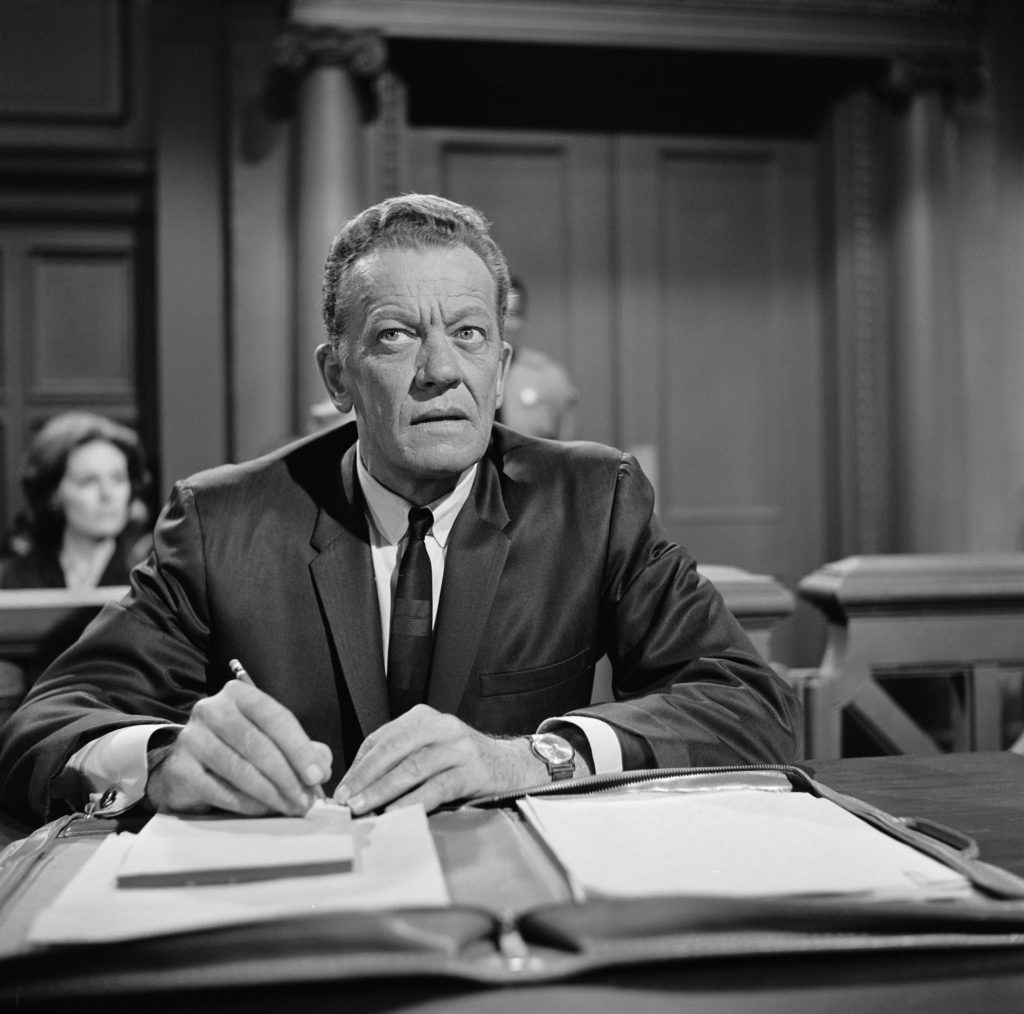
Some people spend their whole careers winning on screen. William Talman actor spent nine years losing — and became one of the most beloved figures in American television history because of it. That irony sits at the heart of his story.
He was the man audiences loved to watch fail, week after week, on Perry Mason. Yet when his real life hit its hardest chapter, he stood up in front of a camera one final time and delivered the most important performance of his career — not as a character, but as himself.
This is the full story of who he was, what he built, what he survived, and why his name still deserves to be remembered more than five decades after his death.
From Detroit to the Drama Club — Early Life of Actor William Talman
William Whitney Talman Jr. was born on February 4, 1915, in Detroit, Michigan. His father, William Talman Sr., was a vice president of an electronics company that manufactured industrial heat-measuring devices and equipment for yachts. The family was comfortable — noticeably so. His maternal grandparents, Catherine Gandy and James Wells Barber, had immigrated from England, which gave the household a kind of old-world sensibility beneath its American Midwest exterior.
Growing up wealthy in a public school neighborhood had its complications. In an April 1963 interview with TV Guide, Talman recalled that his father made enough money to send him to school by limousine each day. Public school. That meant, in his own words, he had to fight his way in and out every single day. The boy learned early that privilege doesn’t protect you from the world — it often makes the world push back harder.
That fighting spirit found a better outlet when he discovered theater. Talman founded the drama club at the Cranbrook Kingswood School in Bloomfield Hills, Michigan — a remarkable move for a teenager, and one that tells you everything about his drive. He went on to Dartmouth College and the University of Michigan, continuing to act throughout. He also attempted studying law at Dartmouth before abandoning it in favor of what he truly wanted to do.
After college, rather than taking a safe desk job, he worked across a patchwork of trades — iron foundry, paper mills, boat yards, even automobile sales. He was finding himself the hard way, which is often the only way it sticks. Eventually, family connections in the entertainment world gave him a foothold in New York’s stage scene, and he grabbed it with both hands.
A Soldier First, Then a Star — Military Service and the Move to Hollywood
Before Hollywood ever got a proper look at him, William Talman put his career on hold and served his country. He enlisted in the United States Army on February 4, 1942 — his 27th birthday — and reported to Camp Upton in Yaphank, Long Island. He went in as a private.
Thirty months of service in the Pacific Theatre later, he came out as a commissioned major. That kind of arc — from private to major in a wartime Pacific campaign — speaks to a man who performed under extreme pressure and earned the trust of those above him. It also gave him a discipline and emotional depth that would later serve him enormously as a character actor.
When he returned from the war, Talman made his way to New York’s theater circuit and began the slow, methodical climb that all serious stage actors know well. Small roles, touring companies, summer stock productions. He built his craft the right way. And he was, by all accounts, striking to look at — tall, sharp-jawed, with an intensity in his eyes that the camera absolutely loved.
William Talman Actor — Breaking Into Film Noir
By the early 1950s, Talman had made his way to Hollywood and began landing film roles. He appeared in Armored Car Robbery in 1950, a tightly wound crime thriller that showcased him as a man you wouldn’t want to cross. In 1953 he appeared in City That Never Sleeps, continuing to carve a niche as a formidable screen presence.
The Hitch-Hiker (1953) — The Performance That Put Him on the Map
Then came the role that changed everything. In 1953, director Ida Lupino cast Talman as Emmett Myers in The Hitch-Hiker — a sadistic, cold-blooded killer who terrorizes two men on a road trip, keeping them alive only because he needs their car. It was a film noir masterpiece, and Talman was terrifying in it.
The New York Times said it plainly at the time: Talman, as the ruthless murderer, made the most of one of the year’s juiciest assignments. The performance was chilling because it wasn’t theatrical. It was still. Controlled. Myers never screamed or ranted. He just watched, and that quiet menace made the audience deeply uneasy in a way that loud villainy never quite achieves.
The real-world reaction to that role produced one of the funniest and most absurd stories of his career. Shortly after the film was released, Talman was stopped at a traffic light in Los Angeles. The driver idling alongside him recognized him as the hitch-hiker. The man got out of his car, walked calmly over to Talman’s convertible, slapped him hard across the face, and walked back to his car and drove off. Talman later joked: “I never won an Academy Award, but I guess that was about as close as I ever will come to one.”
That anecdote, ridiculous as it is, reveals something important — the performance was real enough to make a stranger commit assault in broad daylight. That’s the mark of truly convincing screen work.
The Hitch-Hiker also caught the attention of someone whose decision would define the rest of Talman’s career. Gail Patrick Jackson, the executive producer of a new CBS television series being developed around the fictional defense attorney Perry Mason, saw the film and immediately knew who she wanted for her District Attorney.
Hamilton Burger and Nine Seasons of Television History
The story of how William Talman actor landed the role of Hamilton Burger is layered with irony. Raymond Burr had originally auditioned for the role of Burger. Jackson, however, encouraged Burr to lose 60 pounds and read for the lead role of Mason instead — which Burr successfully did. For Burger, Jackson had already made up her mind after watching The Hitch-Hiker. She later said she’d seen a brilliant little movie and had to have Bill Talman as Burger — and that he never disappointed her.
Talman himself had also auditioned for the role of Mason. He lost it to Burr. So in the end, both men auditioned for each other’s part, and history re-sorted them into the roles that made them famous. Television rarely produces casting stories that clean.
The Art of Playing a Perpetual Loser
Perry Mason premiered on CBS in 1957 and ran for nine seasons, producing 271 episodes. In nearly every single one of them, Hamilton Burger walked into court confident, prosecuted his case with skill and authority, and lost. Week after week. Season after season. Against the same defense attorney.
When a journalist asked Talman in 1958 how he felt about that losing streak, he called it “the longest losing streak in history” — and said it with a wry smile. That self-aware humor was part of why audiences adored him. Burger wasn’t a buffoon. He wasn’t incompetent. He was just facing Perry Mason, which meant the outcome was always the same. There’s a real craft to playing that role with dignity, week after week, without turning the character into a joke.
One episode stands out in particular. In “The Case of the Prudent Prosecutor” in 1960, Burger disqualified himself from prosecuting a long-time personal friend who had been accused of murder. It was a moment of ethical integrity for the character — and rare. At the end, after Mason cleared the friend, Burger said quietly: “You know, I think I won this case.” It was a single line, but it landed with enormous weight because it was so unexpected.
Talman brought something genuine to the role every week — a believable legal mind, a straight-backed professional pride, and just enough humanity to make the audience feel something when Burger lost. That is harder than it sounds.
He also appeared in guest roles during the same era — Wagon Train, Have Gun-Will Travel, Cimarron City, and Gunsmoke all featured him in various capacities. He was, by any measure, a working television actor at the top of his game.
The 1960 Scandal — The Party That Nearly Ended Everything
The career of actor william talman hit its most turbulent moment in March 1960, and it had nothing to do with his performance on screen.
On March 13, 1960, sheriff’s deputies raided a party at a West Hollywood apartment belonging to advertising executive Richard Reibold. They reported finding Talman and seven other guests either naked or partly clothed. All eight were arrested on charges of marijuana possession and lewd vagrancy.
CBS acted swiftly. The network invoked the morals clause in Talman’s contract and fired him without publicly explaining their reasoning. He was off Perry Mason almost immediately. The headlines were sensational, and the tabloids amplified everything.
What the tabloids didn’t amplify quite as loudly was what happened next. On June 17, municipal judge Adolph Alexander dismissed the lewd vagrancy charges against Talman and all the other defendants for lack of proof. The judge’s words were blunt: he did not approve of their conduct, but it was not his role to approve — only to enforce the statutes, and the statutes had not been violated. The marijuana possession charge was also dropped.
Talman had maintained his innocence throughout, and the court agreed there was nothing to prosecute.
The Fan Campaign That Brought Him Back
Despite his legal vindication, CBS held its position. The network remained silent on when or whether he would return. What changed their minds was not another legal decision — it was their own audience.
A flood of viewer letters poured into CBS demanding Burger’s return. Raymond Burr, who had remained Talman’s friend throughout the ordeal, personally pushed the network to reinstate him. Gail Patrick Jackson did the same. Erle Stanley Gardner, the author who created Perry Mason, also spoke up in Talman’s favor. By December of 1960, CBS brought him back after a seven-episode absence.
The damage to his wider career, however, was lasting. Outside of Perry Mason, Talman found very few doors open to him after the incident. Hollywood had an informal blacklist that operated on reputation, and his had been hit hard — even after the charges were dismissed. He worked within the show, and rarely beyond it, for the remainder of his career.
Actor William Talman Bio — Personal Life, Three Marriages, Six Children
Behind the cameras and the courtroom drama, the life of actor william talman was complicated in the way most real lives are.
His first marriage was to actress Lynne Carter, whom he wed just before shipping out for military service in 1942. The marriage lasted until September 1952 and produced one daughter, Lynda. Carter was awarded custody and 24 percent of his income following the divorce.
His second marriage was to actress Barbara Read in 1953. Together they had two children — a daughter named Barbie and a son named William Whitney Talman III. The marriage unraveled by 1960, and they divorced in August of that year. In a tragic development, Barbara Read took her own life in December 1963, leaving notes that cited ill health as the reason.
His third and final marriage was to Margaret Louise Larkin Flannigan — known as Peggy — in 1963. She had two children from a previous marriage, Steve and Debbie, both of whom Talman adopted. Together, William and Margaret had two more children: a son named Timothy and a daughter named Susan. That gave him six children in total.
Colleagues and friends remembered him as a warm, easy presence off the set. He had a dry sense of humor and a live-and-let-live attitude that made strangers feel at ease around him immediately. His friendship with Raymond Burr, whom he had technically “competed against” for a role, was genuine and loyal — not the manufactured camaraderie of co-stars doing press, but the real kind. Burr’s decision to advocate personally for Talman’s reinstatement at CBS, at professional risk to himself, is evidence enough of that.
A Final Act of Courage — The Anti-Smoking PSA That Defined His Legacy
After Perry Mason was cancelled in 1966, Talman did a six-week USO entertainment tour in Vietnam. He came home, as he always had, ready to keep working. But something was wrong. A persistent cough wouldn’t clear up.
In September 1967, doctors gave him the diagnosis: advanced, inoperable stage-four lung cancer. The disease had progressed far. It would eventually spread to his liver, bones, and brain. Treatment was attempted but did not work.
He had been a heavy smoker for most of his adult life. And now, at 52 years old, with six children and a wife who depended on him, he was dying from it.
The Decision That Made History
Talman read a newspaper article in 1968 that enraged him. It described how Hollywood actors were quietly declining to make anti-smoking public service announcements because they feared losing lucrative cigarette advertising contracts. The industry’s silence on smoking was, in his view, a failure of moral courage at the precise moment that courage was most needed.
He decided to do something about it. Talman volunteered to make a short film for the American Cancer Society. He was, at the time of filming, gaunt, visibly weakened, and reportedly under heavy sedation for the pain. He did it anyway.
The PSA opened with words that no one who heard them ever quite forgot: “Before I die, I want to do what I can to leave a world free of cancer for my six children.”
It was filmed at his home in Encino, California. At Talman’s specific request, the film was not to be aired until after his death. He made a second announcement as well — one that opened with a voice-over over a shot of his home, followed by footage of his wife and children, and then a still photograph of himself alongside Raymond Burr from the Perry Mason years. Even in his final weeks, he kept his friend close.
William Talman died on August 30, 1968, at West Valley Community Hospital in Encino, California. He was 53 years old. The cause was cardiac arrest brought on by complications from lung cancer.
The PSAs began airing in the fall of 1968 and continued into 1969. They reached millions of viewers who recognized Hamilton Burger’s face and heard a dying man speak directly to them about a choice they were still able to make differently than he had. The American Cancer Society credited the campaign with significant public impact. It was the first anti-smoking advertisement ever made by a celebrity — a fact that has been consistently overlooked in the decades since.
The Lasting Legacy of William Talman Actor
The legacy of william talman actor operates on several levels, and not all of them are equally well remembered today.
On the cultural level, he is most recognizable from Perry Mason. In 2009 — more than four decades after his death — he and Raymond Burr were honored together on a 44-cent United States commemorative postage stamp as part of the “Early TV Memories” series. Hamilton Burger and Perry Mason, permanently paired in American memory, rendered in miniature on a piece of mail. It is a modest honor, but a real one.
On the cinematic level, The Hitch-Hiker has held its place as a landmark of American film noir. The film is studied, screened, and admired. Talman’s performance in it continues to be the anchor of its power.
What often gets overlooked is that he was also a working screenwriter. He co-wrote two produced feature films — I’ve Lived Before in 1956 and Joe Dakota in 1957. He wasn’t only a performer. He was a craftsman of the written word as well, which gives his career a dimension that a simple biography of his acting roles would miss entirely.
But the deepest layer of his legacy is the PSA. He did not have to make it. He was dying, he was in pain, and no studio was counting on him, no contract demanded it. He made it because he believed it was the right thing to do. That kind of decision — voluntary, costly, and driven by a concern for people he would never meet — is rarer than most obituaries acknowledge.
His wife Peggy, despite quitting smoking briefly after his death, eventually resumed the habit. She died of lung cancer in January 2002 at age 73. The disease that claimed him claimed her too, thirty-four years later. The irony is painful and entirely human.
William Talman actor lost every case he prosecuted on television. He lost his biggest career break to a scandal he maintained was unjust. He lost his health to a habit his era normalized. But in the end, gaunt and dying, he sat in front of a camera and told the truth — and that is the performance that history will not let go.
Final Thoughts
The story of william talman actor is not a tragedy, even though it ends in early death. It is the story of a man who played a loser professionally, survived a humiliating scandal with his dignity mostly intact, raised six children across three marriages, served his country in a world war, and then — at the moment when most people would simply be trying to hold on — chose to spend his last energy warning strangers about a danger he had learned the hardest possible way.
There are actors with longer filmographies, bigger awards, and more famous faces. Very few of them have a final chapter as genuinely courageous as his.
William Talman was not Perry Mason. He was not even Hamilton Burger. He was a man from Detroit who found the stage, served in the Pacific, built a television career, survived a scandal, and died trying to save lives he would never know. That is the real record — and it is worth knowing.
FAQ 1: Who was William Talman actor?
William Whitney Talman Jr. was an American television and film actor born on February 4, 1915, in Detroit, Michigan. He is best remembered for playing District Attorney Hamilton Burger in the CBS legal drama Perry Mason, a role he held across all nine seasons from 1957 to 1966. Beyond acting, he was also a screenwriter and a pioneering public health advocate.
FAQ 2: What was William Talman actor best known for?
William Talman is best known for his role as Hamilton Burger, the district attorney who perpetually lost to Perry Mason in the long-running series Perry Mason. Despite never winning on screen, the character became one of television’s most beloved recurring figures. Talman is equally remembered today for being the first celebrity to film an anti-smoking PSA for the American Cancer Society.
FAQ 3: How many cases did Hamilton Burger win on Perry Mason?
Talman, as Burger, went on to lose all but three cases in the nine-year series, including a record two separate murder trials in the very final episode. He famously called his record “the longest losing streak in history.” Despite this, the character resonated with audiences because of his integrity and his quiet commitment to justice over winning.
FAQ 4: Why was William Talman actor fired from Perry Mason?
In 1960, sheriff’s deputies raided a party in West Hollywood and reported finding Talman and seven others variously naked and partly dressed. All were arrested for possession of marijuana and lewd vagrancy. CBS invoked the morals clause in his contract and fired him despite him maintaining his innocence. A judge later dismissed all charges for lack of proof, and Talman was reinstated after a massive viewer campaign and advocacy from his co-stars.
FAQ 5: Did the Perry Mason cast threaten to quit over William Talman’s firing?
Not only did viewers fervently demand Talman’s reinstatement, but his fellow cast members rallied around the actor. According to the Encyclopedia of Television Law Shows, the cast was willing to put their careers on the line to protect their colleague. Raymond Burr personally appealed to CBS, and Erle Stanley Gardner — the creator of Perry Mason — also spoke out publicly in Talman’s defense.
FAQ 6: What was William Talman actor’s salary on Perry Mason?
By the early 1960s, Raymond Burr commanded an annual salary of $1 million as the show’s star, while Talman earned $65,000 — much less, but still a healthy figure for a supporting television actor of that era. His income was the primary source of financial support for his family, which included six children by the time the show ended in 1966.
FAQ 7: What was William Talman’s breakout film role before Perry Mason?
In 1953, Talman played a sadistic, psychopathic killer in the film noir The Hitch-Hiker, directed by Ida Lupino. The New York Times wrote that Talman, as the ruthless murderer, made the most of one of the year’s juiciest assignments. The performance was so convincing that it directly led to executive producer Gail Patrick Jackson casting him as Hamilton Burger. It is still considered one of the finest villain performances in classic American film noir.
FAQ 8: Did William Talman actor audition for the role of Perry Mason?
Talman originally auditioned for the role of Mason, but lost out to a heavyset veteran character actor named Raymond Burr. Producers then offered him the part of District Attorney Hamilton Burger instead. In a similar irony, Burr had originally auditioned for the role of Burger — meaning both men tested for each other’s part before being swapped into the roles that defined their careers.
FAQ 9: What did William Talman actor say about Hamilton Burger never winning?
When asked how he felt about Burger losing to Mason week after week, Talman said: “Burger doesn’t lose. How can a district attorney lose when he fails to convict an innocent person? Unlike a fist or gun fight, in court you can have a winner without having a loser. Like any real-life district attorney, justice is Burger’s main interest.” This perspective gave the character far more dignity than a simple reading of his win-loss record would suggest.
FAQ 10: What was the anti-smoking PSA made by William Talman actor?
Talman volunteered to make a short film for the American Cancer Society, which was shown in late 1968 and 1969 as a television anti-smoking commercial. He was the first actor to ever make such a commercial. When the message was being filmed, Talman knew he was dying, was in great pain, and was in fact under heavy sedation. He requested it not be aired until after his death. The PSA opened: “Before I die, I want to do what I can to leave a world free of cancer for my six children.”
FAQ 11: What were the exact words William Talman actor spoke in his anti-smoking PSA?
In the PSA, Talman said: “You know, I didn’t really mind losing those courtroom battles, but I’m in a battle now I don’t want to lose at all. Because if I lose it, it means losing my wife and those kids you just met. I’ve got lung cancer. So take some advice about smoking and losing from someone who’s been doing both for years. If you don’t smoke, don’t start. If you do smoke, quit. Don’t be a loser.” The script was entirely improvised — the writer later confirmed he hadn’t written a single word of it.
FAQ 12: How many cigarettes did William Talman actor smoke per day?
The dying actor had unwittingly prepared for what would become the role of a lifetime by smoking up to three packs of unfiltered Camels a day for more than 40 years — somewhere between 750,000 and 1 million cigarettes over his lifetime. His decades of heavy smoking directly caused the stage-four lung cancer that claimed his life at age 53. His wife Peggy resumed smoking after his death and also died of lung cancer in 2002.
FAQ 13: When and how did William Talman actor die?
William Talman died of cardiac arrest due to complications from lung cancer at West Valley Community Hospital in Encino, California, on August 30, 1968, at the age of 53. He had been diagnosed with advanced, inoperable stage-four lung cancer in September 1967. The cancer spread to his liver, bones, and brain before his death. He filmed his landmark anti-smoking PSA just six weeks before he passed.
FAQ 14: Where is William Talman actor buried?
William Talman is interred at Forest Lawn Hollywood Hills in Los Angeles, California — Plot: Court of Liberty, Lot 833. His third wife, Margaret “Peggy” Talman, who died of lung cancer in January 2002, was later laid to rest alongside him. The grave has become a point of quiet remembrance for Perry Mason fans and admirers of his public health advocacy.
FAQ 15: How many children did William Talman actor have?
Talman was married three times. With his first wife Lynne Carter, he had one daughter, Lynda. With his second wife Barbara Read, he had a daughter, Barbie, and a son, William Whitney Talman III. With his third wife Margaret Flannigan, he had a son, Timothy, and a daughter, Susan, and he adopted her two children from a previous marriage, Steve and Debbie. That gave him a total of six biological and adopted children — the very six he mentioned by name in his anti-smoking PSA.
FAQ 16: Did William Talman actor’s son follow him into acting?
Tim Talman knew almost immediately that he would follow his father’s footsteps and become an actor. He has succeeded in this task, having extensively toured in shows such as Cats and Peter Pan. Tim once showed his father’s anti-smoking PSA to his eighth-grade biology class as part of a project on cancerous lungs — when the lights came up, his teacher and several classmates were in tears. Tim has said his father is his hero.
FAQ 17: Was William Talman actor ever a screenwriter?
His best-known role was as escaped killer and kidnapper Emmett Myers in the classic film noir The Hitch-Hiker (1953), directed by Ida Lupino. He also co-wrote two feature films, I’ve Lived Before (1956) and Joe Dakota (1957). His writing credits are often overlooked in summaries of his career, but they demonstrate a creative range that went beyond performing. He was, by any fair measure, both a working actor and a working screenwriter.
FAQ 18: What Broadway shows did William Talman actor appear in?
Talman began his acting career on the stage. He was the leading man in the summer stock company at Ivoryton, Connecticut, and he played the male lead in Dear Ruth during part of the play’s New York run. He appeared on Broadway in Beverly Hills, Spring Again, and A Young Man’s Fancy, and toured with the road companies of Yokel Boy and Of Mice and Men. His stage foundation gave him the technical discipline that made him such a reliable supporting presence on television.
FAQ 19: What was William Talman actor’s military rank?
The young actor was appearing in the comedy Spring Again at Henry Miller’s Theatre when he was drafted into the U.S. Signal Corps. He went in as a private and came out three years later as a major, having spent his time in the Pacific arranging shows and training service teams that won championships in baseball and boxing. He entered service on his 27th birthday, February 4, 1942, and served for 30 months in the Pacific Theatre of World War II.
FAQ 20: Did William Talman actor appear on a U.S. postage stamp?
He appears as District Attorney Hamilton Burger, alongside Raymond Burr as lawyer Perry Mason, on a 44-cent USA commemorative postage stamp in the “Early TV Memories” issue honoring Perry Mason, issued August 11, 2009. The recognition came more than four decades after his death and stands as a lasting acknowledgment that Hamilton Burger — the man who always lost — was just as central to the show’s cultural legacy as Perry Mason himself.
FAQ 21: What inspired William Talman actor to make the anti-smoking PSA?
A heavy smoker for most of his life, he was angered by a newspaper article he read about actors being afraid to make anti-smoking messages for fear of losing opportunities to make lucrative cigarette commercials. He decided to do something about it. At the time, major celebrities including John Wayne, Gary Cooper, and Steve McQueen were actively appearing in cigarette advertisements. Talman’s decision to speak out publicly while dying of the disease was considered an act of extraordinary courage for a Hollywood figure of that era.
FAQ 22: Did William Talman actor’s PSA influence other celebrity anti-smoking campaigns?
Talman’s groundbreaking advocacy encouraged other celebrities to take up the cause. Soon Brooke Shields was posing with cigarettes stuffed in her ears, and John Wayne was warning of the perils of tobacco. In 1985, Yul Brynner, a five-pack-a-day smoker dying of lung cancer, echoed Talman’s performance by recording a commercial for posthumous release. Talman is widely regarded as the pioneer who proved that a dying celebrity could change public behavior through direct, personal testimony on screen.
FAQ 23: What was William Talman actor’s relationship like with Raymond Burr off-screen?
Although they played rivals on Perry Mason, Talman and Burr were friends off the set. Talman is remembered as an affable man with a wry sense of humor and a live-and-let-live attitude that instantly put strangers at ease. Their friendship was genuine enough that Burr personally lobbied CBS to reinstate Talman after his firing, putting his own professional standing at risk to advocate for his co-star. Talman also featured Burr in his second anti-smoking PSA as “a friend of mine you might recognize.”
FAQ 24: What is William Talman actor’s lasting legacy in television history?
Tim Talman said of his father: “My father is my hero. It’s not surprising that he went to such lengths to make an anti-smoking spot.” Beyond his nine seasons on Perry Mason and his landmark film noir work in The Hitch-Hiker, William Talman actor’s most enduring contribution to American culture is the PSA he filmed while dying — the first of its kind by any celebrity. His final role saved at least one documented life, and the eternal loser went out with a winning performance. He set a standard for celebrity courage in public health advocacy that is still referenced and studied today.

