The year 1878 changed American money forever. After five years without a silver dollar in production, Congress stepped in and forced the U.S. Mint to start striking them again. That single decision gave birth to one of the most collected coins in the entire hobby — the Morgan Silver Dollar. If you have ever held a heavy, gleaming silver piece from this era, you already know why collectors lose sleep over these things. The 1878 dollar coin sits at the very beginning of that story, and understanding it means understanding one of the most fascinating chapters in United States coinage history.
But silver was not the only metal leaving the presses that year. The Mint was also producing gold denominations, including the Liberty Head Quarter Eagle and the Liberty Head Eagle. Together, these coins paint a complete picture of what American money looked like during a period of deep political tension over currency standards. Whether you are sitting on a family heirloom, browsing a coin shop, or building a serious collection, this guide covers everything you need to know — from the historical backstory and design details to the varieties, mint marks, grading advice, and current market values that drive this coin’s enduring appeal.
Why the 1878 Dollar Coin Exists — The Story Behind the Silver
You cannot appreciate this coin without knowing why Congress was so desperate to bring silver dollars back. The whole saga starts with a law that made a lot of people very angry.
The “Crime of 1873” and the End of Silver Coinage. In 1873, President Ulysses S. Grant signed the Fourth Coinage Act into law. Buried inside the fine print was a provision that dropped the standard silver dollar from the list of authorized coins. At the time, most people did not notice. But within a few years, silver prices collapsed, and western miners suddenly realized they had lost their biggest buyer — the U.S. Treasury. Farmers and debtors were furious too. They believed that removing silver from the monetary system shrank the money supply, drove prices down, and made it harder to pay off loans. The backlash was immediate and loud. Critics started calling the legislation the “Crime of 1873,” and the “free silver” movement gained serious political traction across the South and West.
The Bland-Allison Act and the Birth of the Morgan Dollar. By 1878, Congress had heard enough. Representative Richard Bland of Missouri and Senator William Allison of Iowa pushed through the Bland-Allison Act on February 28, 1878. President Rutherford B. Hayes vetoed the bill, fearing it would harm public credit. Congress overrode his veto the same day — a rare feat that only about four percent of vetoed bills ever achieve. The new law required the Treasury to purchase between two million and four million dollars’ worth of silver bullion every month and coin it into legal-tender silver dollars. With all that silver flooding in, the Mint needed a fresh design. Assistant Engraver George T. Morgan got the job, and the result became one of the most beloved coins in American history. That is how the 1878 dollar coin came to be — not from quiet bureaucratic planning, but from a full-blown political showdown over the future of money itself.
Design and Inscriptions on the One Dollar Coin 1878 E Pluribus Unum
Part of what makes this coin so collectible is the sheer beauty of its design. Morgan spent months refining the artwork, and the final product holds up remarkably well nearly 150 years later.
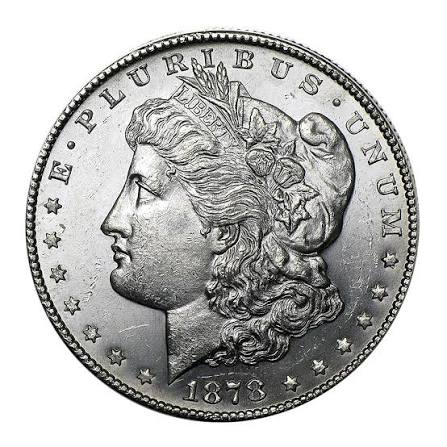
The Obverse — Lady Liberty and Her Symbols. The front of the coin features a left-facing portrait of Lady Liberty wearing a Phrygian cap — the type of cap worn by freed slaves in ancient Rome, making it a powerful symbol of American liberty. The cap is decorated with sprigs of cotton and wheat, representing the agricultural backbone of the nation’s economy. Thirteen stars circle the portrait, one for each of the original colonies. Above Liberty’s head sits the national motto “E PLURIBUS UNUM,” and the date “1878” appears at the bottom. The model for the portrait was Anna Willess Williams, a Philadelphia schoolteacher whose profile Morgan considered ideal. Collectors searching for the one dollar coin 1878 e pluribus unum should note that this motto placement is one of the easiest ways to confirm you are looking at a genuine Morgan Dollar rather than a later reproduction or a different coin type entirely.
The Reverse — The Eagle, the Arrows, and “ONE DOLLAR.” The back of the coin shows an American bald eagle with wings spread wide, clutching an olive branch in one talon and three arrows in the other — a traditional symbol of a nation that desires peace but stands ready for war. Between the eagle’s wings appears the inscription “IN GOD WE TRUST.” The words “UNITED STATES OF AMERICA” arc across the top, while “ONE DOLLAR” sits at the bottom within a wreath. Morgan left his personal mark on the coin as well: a small letter “M” engraved on the ribbon loop of the wreath on the reverse. Mint marks indicating where the coin was struck appear just below the wreath — no mark for Philadelphia, “CC” for Carson City, and “S” for San Francisco.
Key Varieties of the 1878 One Dollar Coin
First-year Morgan Dollars are famous for their variety of reverse designs. The Mint made several changes to the eagle within the first few weeks of production, and those changes created distinct sub-types that collectors chase to this day.
8 Tail Feathers — The Original Reverse. The very first Morgan Dollars struck in 1878 featured an eagle with eight tail feathers. Production of this version lasted roughly two weeks before Mint officials realized the design was ornithologically incorrect — real bald eagles only have seven tail feathers. Estimates suggest between 750,000 and one million coins were struck with the eight-feather reverse before the change was made. Because it represents the true “Day One” of the entire Morgan series, the 8 tail feathers variety holds a special place in the hobby. Circulated examples typically trade in the $44 to $105 range, but proof strikes in top grades have sold for over $56,000 at auction. If you are looking at a 1878 dollar coin and count eight feathers, you are holding something genuinely scarce.
7 Over 8 Tail Feathers — The Transitional Error. Rather than discard the original eight-feather dies, Mint workers tried to modify them. They re-hubbed the dies to display seven tail feathers, but traces of the original eighth feather remained visible underneath. This created the famous 7/8 tail feathers variety — a transitional piece that shows elements of both designs on the same coin. Within this category, collectors distinguish between “Strong” and “Weak” variants based on how visible the underlying eighth feather is. The strong type tends to command higher premiums because the doubling is more dramatic and easier to appreciate under magnification.
7 Tail Feathers — Reverse of 1878 vs. Reverse of 1879. Once the Mint moved fully to a seven-feather design, they produced two distinct reverse styles. The earlier version, called the “Reverse of 1878,” shows a flat or slightly concave eagle breast and a top arrow feather that runs parallel to the others. The later version, known as the “Reverse of 1879,” features a rounder, more natural-looking breast and a noticeably slanted top arrow feather. The Reverse of 1879 in MS64 condition holds the record sale for first-year Morgans at over $155,000, making it the most valuable standard variety among 1878 issues. Serious collectors also track VAM (Van Allen–Mallis) die varieties within these groups, including the popular VAM-38, which displays strong doubling on the obverse lettering and a distinctive tear-drop-shaped die scratch near Liberty’s eye.
Mint Marks and Mintage — Where Each 1878 Dollar Coin Was Struck
Knowing where your coin was made is just as important as knowing which tail-feather variety it belongs to. The mint of origin directly affects both rarity and value.
Philadelphia (No Mint Mark). The Philadelphia Mint served as the primary production facility in 1878 and is the only mint that produced all four major tail-feather varieties. With the highest overall mintage, Philadelphia issues are generally the most accessible for new collectors. However, do not mistake “common” for “uninteresting.” Gem-quality Philadelphia coins with deep mirror prooflike surfaces are exceptionally difficult to find and bring serious money at auction.
Carson City (CC). The Carson City Mint in Nevada struck a much smaller quantity of 1878 Morgan Dollars, and that lower mintage makes the 1878-CC the most valuable standard-issue coin among its peers. Prices for circulated examples start around $140 and climb past $435 even in moderately worn condition. Collectors should exercise caution here, because counterfeits of the 1878-CC are widespread. Always verify the weight — a genuine coin should weigh exactly 26.73 grams — and strongly consider buying only pieces that have been certified by a reputable third-party grading service.
San Francisco (S). The San Francisco Mint produced a moderate number of 1878 Morgan Dollars, and surviving examples are commonly found in well-circulated grades. With prices starting around $41, the 1878-S represents the most affordable entry point for collectors who want a genuine first-year Morgan without breaking the bank. Look for the small “S” mint mark positioned just below the wreath on the reverse.
Beyond Silver — The 1878 2.5 Dollar Gold Coin and the 1878 10 Dollar Gold Coin
Silver gets most of the attention when people talk about 1878 coinage, but gold denominations from the same year deserve a closer look.
The 1878 Liberty Head Quarter Eagle (1878 2.5 Dollar Gold Coin). This coin belongs to the long-running Liberty Head series designed by former Chief Engraver Christian Gobrecht, which ran from 1840 through 1907. The 1878 2.5 dollar gold coin was struck at both the Philadelphia and San Francisco mints in a composition of 90 percent gold and 10 percent copper, containing 0.12094 troy ounces of pure gold. Despite relatively healthy mintage numbers, far fewer survive today than the original production figures suggest. Many were melted during the 20th century, and a significant number were lost to FDR’s 1933 Gold Recall Order. Numismatic expert David Akers has described the 1878 as “one of the most common of all Liberty Head quarter eagles,” yet market prices still reflect the inherent scarcity of any pre-1933 gold coin that has managed to survive. Collectors who already own 1878 Morgan Dollars often pursue the quarter eagle as a natural companion piece from the same historic year.
The 1878 Liberty Head Eagle (1878 10 Dollar Gold Coin). Also designed by Gobrecht, the 1878 10 dollar gold coin contains 0.4806 troy ounces of gold and was struck at Philadelphia and San Francisco. The San Francisco issue is notably scarce, with a mintage of only about 26,100 pieces. Values for the Philadelphia coin start around $2,500 in average circulated condition and can exceed $6,800 in uncirculated grades. Proof examples are exceptionally rare and have sold for more than $35,000. For collectors who appreciate breadth, owning silver and gold pieces from the same year offers a richer understanding of 1878 as a pivotal moment in American monetary history.
How to Grade and Authenticate Your 1878 Dollar Coin
Condition is everything in numismatics. Two coins that look identical to the untrained eye can differ in value by thousands of dollars once a professional grades them.
Understanding the Sheldon Scale (G-1 through MS-70). The coin grading system used in the United States runs from Good (G-4) through Mint State (MS-70). For Morgan Dollars, the grades most commonly encountered are Good (G), Very Good (VG), Fine (F), Extremely Fine (EF), About Uncirculated (AU), and Mint State (MS-60 through MS-70). When examining any 1878 dollar coin, focus on the high points where wear shows first: the hair above Liberty’s ear and across her cheek on the obverse, and the eagle’s breast feathers and wing tips on the reverse. If those areas still display sharp, undisturbed detail, the coin likely grades in the upper tiers.
Third-Party Grading and Why It Matters. Services like PCGS (Professional Coin Grading Service) and NGC (Numismatic Guaranty Company) authenticate and grade coins, then seal them in tamper-evident holders called “slabs.” For 1878 Morgan Dollars — especially Carson City issues — third-party certification is not just recommended, it is practically essential. The market is full of counterfeits, cleaned coins, and pieces with artificial toning designed to trick inexperienced buyers. A certified coin also carries special designations like Prooflike (PL) and Deep Mirror Prooflike (DMPL), which can add a significant premium to the value.
Common Errors and Die Varieties Worth Money. Beyond the tail-feather varieties, collectors should watch for Doubled Die Obverse (DDO) errors — particularly doubling on the letters in “PLURIBUS,” which is a recognized Top 100 Morgan variety. The 1878-S “Clashed E” variety, where the letter E from “UNITED” appears transferred below the eagle’s tail feathers, commands premiums ranging from around $80 in About Uncirculated condition to over $1,100 in MS65. An MS65 example of the “Doubled E in Pluribus” variety sold for $2,550 at a 2019 auction, proving that careful inspection of even seemingly common coins can uncover hidden value.
Current Market Values and Collecting Tips for the 1878 Dollar Coin
The market for first-year Morgans has remained strong for decades, driven by both collector demand and the intrinsic value of the silver itself.
What Your Coin Is Worth Today. Every 1878 Morgan Silver Dollar contains 0.77344 troy ounces of pure silver. At recent silver spot prices near $30 per ounce, that gives even the most worn example a melt value floor of roughly $23. However, numismatic premiums push actual selling prices well above melt in nearly all cases. Circulated Philadelphia 7-tail-feather coins generally trade between $41 and $105. The 8-tail-feather variety commands a modest premium above that. Carson City issues start around $140 and rise steeply with grade. At the top of the market, gem-quality coins with rare variety designations have fetched six figures at major auctions.
Smart Buying Advice for New and Experienced Collectors. If you are just starting out, the 7-tail-feather Philadelphia coin is the smartest first purchase. It is affordable, historically significant as the inaugural year of the series, and readily available from reputable dealers. For any coin valued above a few hundred dollars, always buy certified. Be wary of pieces that appear too bright or have an unnatural sheen — these are often cleaned coins that will grade significantly lower than they appear. Building a complete 1878 set across all mint marks and major tail-feather varieties is a rewarding collecting goal that remains achievable for most budgets, and each piece you add deepens your connection to one of the most consequential years in American coinage.
Frequently Asked Questions
1. How much is a 1878 dollar coin worth today? The value of a 1878 dollar coin ranges from about $40 for a heavily circulated Philadelphia issue to well over $155,000 for rare gem-quality varieties. The most common 7-tail-feather coins in average circulated condition typically sell between $41 and $105, while Carson City mint marks and high-grade examples command significantly higher prices.
2. How do I know if my 1878 dollar coin is real or fake? Start by weighing the coin on a precision scale — a genuine 1878 Morgan Dollar weighs exactly 26.73 grams. Fakes are usually lighter and show soft, mushy details under 10x magnification, particularly around the lettering and stars. For Carson City (CC) coins, always verify through a reputable third-party grading service like PCGS or NGC, since counterfeits of the 1878-CC are extremely common.
3. What is the silver content of an 1878 dollar coin? Every 1878 Morgan Silver Dollar is composed of 90% silver and 10% copper, with a total weight of 26.73 grams. This gives each coin exactly 0.77344 troy ounces of pure silver. At current silver spot prices, the melt value alone provides a price floor of roughly $23 or more for even the most worn examples.
4. Why does my 1878 dollar coin have 8 tail feathers instead of 7? Your coin is the original first-strike version of the Morgan Dollar. The Mint initially designed the eagle with 8 tail feathers, but real bald eagles only have 7. The error was corrected within roughly two weeks, making the 8-tail-feather variety scarcer than later issues. Only an estimated 750,000 to 1 million coins were struck with this reverse before the change was made.
5. What does the “CC” mint mark mean on a 1878 dollar coin? The “CC” stands for the Carson City Mint, located in Nevada near the famous Comstock Lode silver deposits. The 1878-CC Morgan Dollar had a mintage of about 2,212,000 coins, which is significantly lower than Philadelphia or San Francisco. This lower production combined with strong collector demand makes the CC mint mark the most valuable among standard 1878 issues.
6. Is the 1878 dollar coin rare? It depends on the specific variety and mint mark. The 8-tail-feather version from Philadelphia is genuinely scarce, with fewer than a million coins produced. The 7-tail-feather Philadelphia coins are the most common, while the Carson City issue is considered rare due to its lower mintage. Across all varieties, gem-quality uncirculated examples are difficult to find regardless of mint mark.
7. What is the difference between 7 tail feathers and 8 tail feathers on a 1878 dollar coin? The 8-tail-feather version was the very first Morgan Dollar design, produced for approximately two weeks before the Mint corrected the eagle to reflect the anatomically accurate 7 feathers of a real bald eagle. Some transitional coins known as the 7/8 variety show traces of the original 8th feather beneath the 7-feather redesign, creating a third distinct collectible sub-type.
8. Where is the mint mark located on a 1878 dollar coin? The mint mark appears on the reverse (back) of the coin, centered just below the wreath and above the letters “DO” in “DOLLAR.” Philadelphia coins carry no mint mark at all. San Francisco coins display a small “S,” and Carson City coins show “CC” in the same position.
9. Should I clean my 1878 dollar coin? No — never clean a 1878 dollar coin under any circumstances. Cleaning removes the coin’s natural patina and surface texture, which professional grading services consider irreversible damage. A cleaned Morgan Dollar can lose 30% to 50% of its market value, and it will receive a “Details — Cleaned” designation instead of a numeric grade from PCGS or NGC.
10. What does “E Pluribus Unum” mean on the 1878 dollar coin? “E Pluribus Unum” is a Latin phrase meaning “Out of Many, One,” referring to the formation of a single nation from many states. On the 1878 Morgan Dollar, this motto appears above Lady Liberty’s head on the obverse side of the coin. It has been a standard inscription on United States coinage since the late 18th century.
11. How many 1878 dollar coins were minted in total? Approximately 22.5 million Morgan Silver Dollars were struck across all mints and varieties in 1878. The Philadelphia Mint produced the most at roughly 10.5 million, followed by San Francisco at about 9.77 million and Carson City at around 2.21 million. However, far fewer coins survive today due to large-scale government melts, particularly under the 1918 Pittman Act.
12. What is a 1878 dollar coin with no mint mark worth? A 1878 dollar coin with no mint mark was struck at the Philadelphia Mint. In average circulated condition, values range from about $41 to $105 depending on the tail-feather variety. Uncirculated examples in MS-65 condition can sell for $625 or more, and rare proof versions have been known to exceed $50,000 at auction.
13. Is the 1878 dollar coin a good investment? For experienced collectors who understand grading and variety identification, select 1878 Morgan Dollars can hold and appreciate in value over time. However, common-date circulated examples carry premiums above melt value that may not grow quickly. The best investment potential lies in certified high-grade coins, rare varieties like the 8-tail-feather issue, and Carson City mint marks, which have shown consistent long-term demand.
14. What is the most valuable 1878 dollar coin ever sold? The highest recorded sale for a 1878 Morgan Dollar is over $155,000, achieved by a 7-tail-feather Reverse of 1879 variety graded MS-64. Proof strikes have also reached exceptional prices, with an 1878 7-tail-feather proof in PR-67 condition selling for $84,000 and an 8-tail-feather proof in PR-66 fetching $56,400 at major auctions.
15. What is the difference between the Reverse of 1878 and the Reverse of 1879? The Reverse of 1878 features a flat or slightly concave eagle breast with a top arrow feather that runs parallel to the other arrow feathers. The Reverse of 1879 shows a rounder, more naturally shaped convex breast and a distinctly slanted top arrow feather. The easiest way to identify which version you have is by examining the angle of that top arrow feather under magnification.
16. Can I spend a 1878 dollar coin as regular money? Technically, the 1878 Morgan Dollar has a legal tender face value of one U.S. dollar and could be used in a transaction. However, doing so would be an enormous financial loss, since even the most worn example is worth at least $40 in collector value and contains over $23 in silver alone. No knowledgeable owner would spend one at face value.
17. How do I get my 1878 dollar coin professionally graded? Submit your coin to either PCGS (Professional Coin Grading Service) or NGC (Numismatic Guaranty Company) through their websites or through an authorized dealer. Both services authenticate the coin, assign a grade on the Sheldon Scale, and seal it in a tamper-evident holder called a “slab.” Fees start around $20 to $40 per coin depending on the service tier and declared value.
18. What is a DMPL 1878 dollar coin? DMPL stands for Deep Mirror Prooflike, a special designation given by grading services to Morgan Dollars whose fields display deep, mirror-like reflective surfaces similar to a proof coin. A 1878 dollar coin with a DMPL designation is significantly more valuable than a standard mint-state example of the same grade, often commanding premiums of two to five times higher.
19. Were any gold coins also made in 1878? Yes. The U.S. Mint produced several gold denominations in 1878, including the $2.50 Liberty Head Quarter Eagle, the $5 Liberty Head Half Eagle, the $10 Liberty Head Eagle, and the $20 Liberty Head Double Eagle. The $2.50 and $10 gold coins from 1878 are particularly popular with collectors who want gold and silver pieces from the same historic year.
20. What errors should I look for on a 1878 dollar coin? The most valuable errors include Doubled Die Obverse (DDO) varieties with visible doubling on the letters in “PLURIBUS,” which is a recognized Top 100 Morgan Dollar variety. The “Clashed E” error on 1878-S coins, where the letter E from “UNITED” transferred below the eagle’s tail feathers, commands premiums up to $1,100 or more in higher grades. Die cracks and repunched mint marks can also add collector value.
21. What is the weight and size of a 1878 dollar coin? The 1878 Morgan Silver Dollar has a total weight of 26.73 grams, a diameter of 38.1 mm (1.5 inches), and a thickness of 2.4 mm. Its edge is reeded, meaning it has small, evenly spaced grooves around the circumference. These specifications remained consistent throughout the entire Morgan Dollar series from 1878 to 1921.
22. Why is the 1878 dollar coin called a “Morgan Dollar”? The coin is named after its designer, George T. Morgan, who served as Assistant Engraver at the United States Mint. Morgan was a British-born engraver recruited specifically to create new coin designs for the Mint. Although the coin’s official name is the Liberty Head Silver Dollar, the numismatic community universally refers to it as the Morgan Dollar in his honor.
23. How should I store my 1878 dollar coin to preserve its value? Store your coin in an airtight holder such as a coin capsule, a non-PVC plastic flip, or a certified grading slab. Keep it in a cool, dry environment away from humidity and direct sunlight. Never store coins in paper envelopes, cardboard folders with PVC sleeves, or loose in a drawer, as exposure to sulfur compounds in the air causes tarnishing and long-term surface damage.
24. What is the difference between an 1878 Morgan Dollar and an 1878 Trade Dollar? Both are silver dollar coins struck in 1878, but they are entirely different series. The Morgan Dollar was designed for domestic circulation under the Bland-Allison Act, while the Trade Dollar was created in 1873 specifically for international commerce with Asia. The Trade Dollar is slightly heavier at 27.22 grams and features a different seated Liberty design. By 1878, Trade Dollar production was being phased out as the Morgan Dollar took over.