If you grew up anywhere near a television set during the seventies, your Saturday mornings had a rhythm. You rolled out of bed before your parents woke up, poured yourself a bowl of something sugary, planted yourself on the carpet about two feet too close to the screen, and waited for the magic to start. CBS, ABC, NBC — it did not matter which channel you picked. Every single one of them was running animated shows back to back, from sunrise until noon. That weekly ritual was not just a childhood habit. It was a shared cultural experience that connected millions of kids across the country, and the shows they watched during those hours shaped the way an entire generation thought about storytelling, humor, and visual art.
1970 cartoons were more than simple entertainment for children. They were a turning point in the history of animation itself. The decade sat right between two very different worlds. Behind it was the Golden Age of theatrical shorts — the era of Bugs Bunny outsmarting Elmer Fudd in beautifully drawn seven-minute films made for movie theaters. Ahead of it was the franchise-driven, merchandise-heavy model of the 1980s and 1990s, where toy companies often designed the characters before writers ever touched a script. The seventies sat in the middle, and that awkward, experimental, wonderfully strange position is exactly what made its animated output so memorable. From mystery-solving teenagers and talking race cars to educational musical shorts and sophisticated magazine illustrations, the world of 1970’s cartoons was far richer and more influential than most people give it credit for today. This article covers the full picture — the television shows, the car-themed animation craze, the adult cartooning scene, and the lasting cultural footprint that still shows up in modern entertainment.
Why 1970 Cartoons Became Saturday Morning Legends
The Rise of the Saturday Morning Block
Before cable television existed, American families had access to three major broadcast networks. Those networks discovered something valuable in the late 1960s: if you filled Saturday mornings with animated programming, you could capture an enormous audience of children whose parents were still asleep. Advertisers — especially cereal companies, toy manufacturers, and candy brands — were willing to pay handsomely for access to that audience. By the start of the new decade, the Saturday morning cartoon block had become a genuine institution.
No studio benefited from this shift more than Hanna-Barbera Productions. Founded by William Hanna and Joseph Barbera after the closure of MGM’s animation department, the company had spent the late 1950s and 1960s perfecting a method of producing cartoons cheaply enough to survive on television budgets. Their approach was called “limited animation.” Instead of drawing every frame from scratch the way Disney or Warner Bros. did for theatrical shorts, Hanna-Barbera simplified lip movements, kept body motion to a minimum, reused background paintings across multiple episodes, and focused their budgets on voice acting and clever writing. It was not pretty by film standards, but it worked beautifully on a small television screen. By 1970, Hanna-Barbera controlled roughly eighty percent of all children’s television programming and had secured the top three Saturday morning ratings slots. The CBS program 60 Minutes once referred to them as “the General Motors of animation,” and that comparison was not an exaggeration. In one particularly prolific year, the studio produced nearly two-thirds of every Saturday morning cartoon on American television.
External pressure also shaped what these shows looked like. A group called Action for Children’s Television, founded in 1968 by Boston mother Peggy Charren, lobbied the Federal Communications Commission to reduce violence in children’s programming and to require networks to include educational content. Their efforts had real teeth. Earlier Hanna-Barbera action shows like Jonny Quest and Space Ghost had featured gunfire, explosions, and physical combat. By the early seventies, those elements were largely gone. The 1970 cartoons that replaced them leaned on mystery-solving plots, slapstick humor, and moral lessons wrapped inside catchy stories.
What Made These Shows Different from Earlier Decades
The animated shows of the seventies looked and felt fundamentally different from what had come before. The theatrical shorts of the 1940s and 1950s — your Tom and Jerry, your Looney Tunes, your Tex Avery cartoons — were built around pure physical comedy. A cat chased a mouse. A rabbit outsmarted a hunter. The humor was visual, violent in a rubbery cartoon way, and almost entirely wordless.
The new generation of 1970 cartoon shows replaced that model with something more narrative. Characters had names, backstories, and recurring relationships. Episodes followed a structure — a setup, a mystery or problem, a series of comedic misadventures, and a resolution. The clearest example of this shift was the “meddling kids” formula that Scooby-Doo made famous: a small group of teenagers, a loveable but cowardly animal sidekick, and a spooky mystery that always turned out to have a mundane explanation. That template proved so profitable that Hanna-Barbera recycled it across more than a dozen different series throughout the decade.
At the same time, the seventies also saw the rise of educational animated content designed to sit alongside the entertainment shows. Schoolhouse Rock!, which premiered in 1973, aired short musical segments between cartoon blocks on ABC. Each segment used catchy songs and colorful animation to teach grammar, multiplication, American history, civics, and science. The results were staggeringly effective. Ask almost any American who grew up during that era how a bill becomes a law, and there is a strong chance they will start humming a tune before they finish answering.
The Most Iconic 1970’s Cartoons That Defined the Era
Scooby-Doo and the Mystery-Solving Blueprint
No single show had a bigger influence on the animated landscape of the seventies than Scooby-Doo, Where Are You! The series technically premiered in September 1969, but it became a full-blown cultural phenomenon during the following decade. Every Saturday morning, millions of children watched Scooby and his four teenage companions — Fred, Daphne, Velma, and Shaggy — drive their van into some new haunted location, encounter what appeared to be a ghost or monster, and then unmask a perfectly ordinary criminal at the end of every episode.
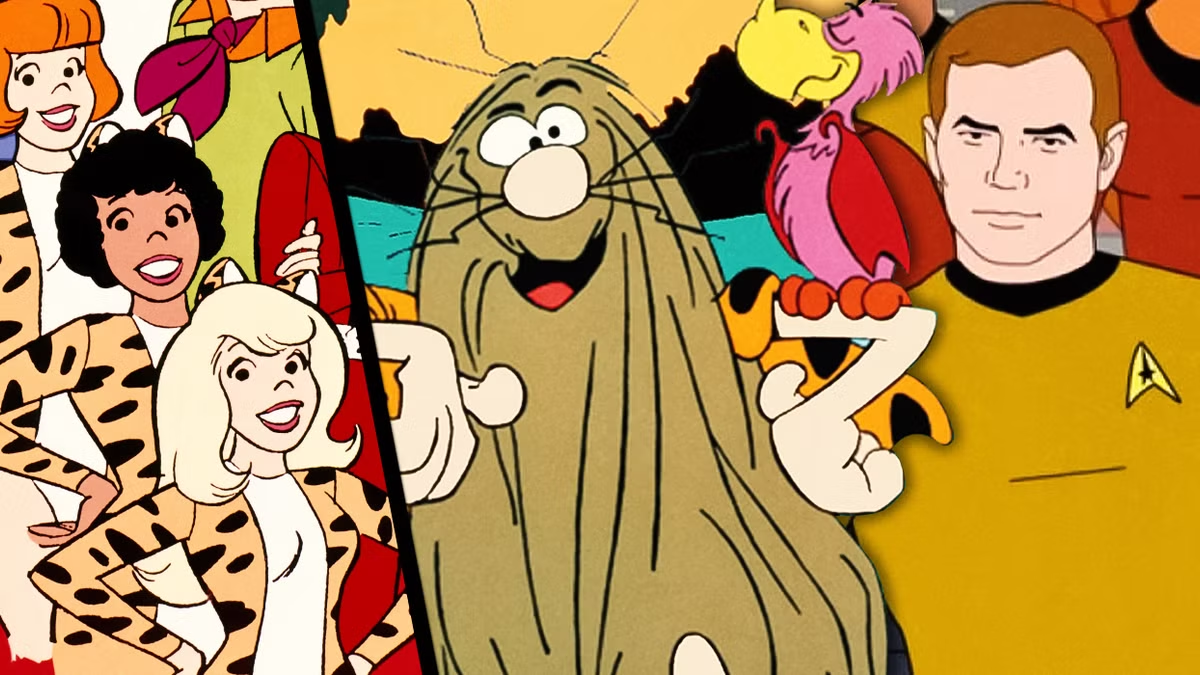
The formula sounds repetitive on paper, and it was. But repetition was the secret ingredient. Kids loved knowing what to expect. The stakes were never too high. The scares were always undercut by Scooby and Shaggy’s cowardly humor. And the message at the end — that the monster was always just a person in a costume — was oddly reassuring. Hanna-Barbera recognized the formula’s commercial power and duplicated it relentlessly. Josie and the Pussycats added a rock band twist. The Funky Phantom introduced a Revolutionary War ghost as the sidekick. Captain Caveman and the Teen Angels swapped the dog for a prehistoric superhero. Jabberjaw replaced the van with a submarine and the dog with a fifteen-foot talking shark. Each variation was a slightly different coat of paint on the same reliable engine, and audiences kept tuning in. The sheer volume of these mystery-solving programs is one reason why 1970 cartoons remain so closely associated with the genre to this day.
Super Friends, Schoolhouse Rock!, and the Educational Turn
The early seventies also brought DC Comics superheroes to Saturday morning screens for the first time. Super Friends debuted on ABC in 1973 and featured Superman, Batman, Wonder Woman, Aquaman, and a rotating roster of other Justice League members fighting villains, alien invaders, and natural disasters. The show introduced millions of children to characters they had only seen in comic books, planting seeds that would eventually grow into the billion-dollar superhero film industry decades later. The series ran in various forms from 1973 through 1986, making it one of the longest-running animated franchises of its era.
Schoolhouse Rock! occupied a very different space, but its cultural impact was just as large. The series was born when advertising executive David McCall noticed that his son struggled with multiplication tables but could memorize every lyric to the Rolling Stones songs he heard on the radio. McCall reasoned that if you set educational content to catchy music, children would absorb it almost without trying. He was right. Songs like “Conjunction Junction,” “I’m Just a Bill,” and “Three Is a Magic Number” became permanent fixtures in American pop culture. Teachers still use them in classrooms today. Multiple surveys over the years have found that adults remember learning grammar and civics from Schoolhouse Rock! more clearly than from any lesson they received in school.
Reruns That Felt Brand New
Several animated shows that originally debuted in the 1960s found massive new audiences during the seventies through reruns, syndication deals, and spin-off series. The Flintstones, which had ended its prime-time run in 1966, remained one of the most-watched animated programs throughout the decade thanks to constant reruns and the launch of new spin-offs like The Pebbles and Bamm-Bamm Show in 1971. The Jetsons experienced a similar second life. And Tom and Jerry, despite being a product of the 1940s MGM studio, continued to entertain children through The Tom and Jerry Comedy Show and syndicated reruns of the original theatrical shorts. The staying power of these older properties proved something important about the best 1970 cartoons: strong characters and smart humor never really expire. They just find new audiences.
1970 Muscle Car Cartoons and the Automobile Craze in Animation
Speed Buggy, Wacky Races, and the Rise of Talking Vehicles
America in the early seventies was obsessed with cars. Detroit’s muscle car era was at its peak. Mustangs, Camaros, Challengers, and Barracudas roared down suburban streets and across drag strips. That fascination with speed, power, and automotive design spilled directly into Saturday morning animation, producing a wave of car-themed 1970 cartoons unlike anything the medium had seen before.
Speed Buggy, which debuted on CBS in 1973, was the most successful of the bunch. The show followed an anthropomorphic orange dune buggy — voiced by the legendary Mel Blanc — who could talk, race, and express emotion through his headlights and front grille. Alongside his teenage companions Tinker, Mark, and Debbie, Speed Buggy traveled from race to race, stumbling into spy capers and criminal plots along the way. The show borrowed heavily from both Scooby-Doo and the 1968 Disney film The Love Bug, but it carved out its own identity through Blanc’s vocal performance and the racing sequences that gave each episode a sense of momentum. Speed Buggy was so popular that it eventually aired on all three major broadcast networks — a rare achievement for any Saturday morning program.
Wacky Races, though it originally premiered in 1968, remained a fixture of seventies syndication. Eleven wildly designed vehicles — from the Compact Pussycat to the Mean Machine — competed in cross-country races packed with sabotage, dirty tricks, and slapstick disaster. Dick Dastardly’s inability to win a single race despite elaborate cheating schemes became one of animation’s most beloved running gags. The show spawned two spin-offs, Dastardly and Muttley in Their Flying Machines and The Perils of Penelope Pitstop, both of which ran heavily in reruns throughout the decade. Wheelie and the Chopper Bunch arrived in 1974, adding yet another talking car to the Hanna-Barbera roster with a heroic Volkswagen Beetle-like character who battled a gang of motorcycle bullies.
How Car Culture Shaped the Decade’s Animated Art
The crossover between 1970 muscle car cartoons and American car culture extended well beyond television. Throughout the decade, a distinctive style of cartoon car illustration exploded in popularity. These drawings featured exaggerated proportions — oversized rear tires, impossibly low stances, shaker hood scoops the size of small buildings, and clouds of tire smoke billowing behind the vehicle. They appeared on T-shirts, van murals, drag racing posters, magazine advertisements, and gas station promotional materials. Artists like Jeff Hobrath and others built entire careers around this style, creating bold, colorful illustrations of classic seventies muscle cars — Chevelles, Plymouth Barracudas, Ford Mustangs, and Pontiac Firebirds — rendered in a cartoonish, larger-than-life fashion that perfectly captured the era’s love affair with horsepower.
What makes this artistic tradition remarkable is its staying power. Today, stock illustration platforms carry thousands of muscle car cartoon images directly inspired by the seventies aesthetic. Car show posters, automotive merchandise, and collector prints still rely on the same visual language. The connection between animated storytelling and automobile culture that the decade forged has never really broken.
Playboy Cartoons in the 1970’s — A Different Side of the Decade’s Animation
The Magazine’s Golden Age of Illustration
While Saturday morning television aimed squarely at children, a completely separate tradition of cartoon art flourished on newsstands and coffee tables across the country. Playboy magazine, founded by Hugh Hefner in 1953, had featured full-page color cartoons from its very first issue. By the early seventies, with the magazine’s circulation peaking at 7.2 million readers in 1972, those cartoons had become one of the publication’s most respected and distinctive features.
Hefner was a former cartoonist himself, and he cared deeply about the visual quality of the artwork his magazine published. The roster of artists who contributed playboy cartoons 1970’s readers would have encountered included some of the finest illustrators of the twentieth century. Erich Sokol brought a sophisticated European sensibility and a remarkable command of light and composition. Eldon Dedini painted lush, watercolor-rich scenes that looked more like gallery pieces than magazine gags. Gahan Wilson specialized in darkly humorous, grotesque imagery that blurred the line between comedy and horror. Doug Sneyd became the magazine’s most prolific cartoonist, contributing work for decades. Shel Silverstein — better known today as a beloved children’s book author — was a regular contributor of both cartoons and poetry. Jules Feiffer brought sharp social and political commentary through his multi-panel strips. And Harvey Kurtzman, the creative genius behind Mad magazine, collaborated with artist Will Elder on “Little Annie Fanny,” a lavishly painted comic strip that ran in the magazine from 1962 through 1988.
Overseeing much of this output was cartoon editor Michelle Urry, a Canadian-born former dress designer who held the position for a significant portion of the magazine’s history. Urry was known for her high standards and her genuine affection for the cartoonists she worked with. Jules Feiffer once described her as “mother superior to cartoonists,” and her Christmas parties and poker nights for contributors became legendary within the illustration community.
Cultural Influence and the End of an Era
The significance of Playboy’s cartoon program went beyond entertainment. The magazine’s commitment to fully painted, high-quality color artwork arguably did more to elevate the status of magazine cartooning as a legitimate art form than any other American publication during the twentieth century. While most magazines treated cartoons as filler content, Playboy treated them as features worthy of the same care and investment as its fiction and journalism.
That tradition came to an end in 2016, when the magazine underwent a major redesign that eliminated both the cartoons and the jump-copy format that had given them physical space on the page. Hefner reportedly resisted dropping the cartoons more than he resisted dropping the nudity, but he ultimately went along with the change. The decision marked the symbolic close of a chapter in American illustration history that had lasted over sixty years. Today, the legacy of those 1970 cartoons from Playboy’s pages lives on through collector markets, retrospective exhibitions, and the archives maintained by organizations dedicated to preserving the history of cartoon art.
The Lasting Impact of 1970 Cartoons on Modern Animation and Pop Culture
Characters and Formulas That Survived the Decade
The storytelling templates established during the seventies did not disappear when the decade ended. They evolved, mutated, and reappeared in forms their original creators probably never anticipated. The influence of 1970 cartoons on modern entertainment runs deeper than most people realize. The “mystery-solving team” formula that Scooby-Doo perfected became the structural backbone for dozens of later shows, from Teenage Mutant Ninja Turtles to Buffy the Vampire Slayer to Stranger Things. Whenever you see a group of young friends investigating strange events with a mix of humor and suspense, you are looking at DNA that traces directly back to those Saturday morning cartoons of the early seventies.
Scooby-Doo himself has become one of the most enduring characters in animation history. The franchise has produced dozens of television series, more than forty direct-to-video films, multiple theatrical releases, live-action adaptations, comic books, video games, and an almost endless stream of merchandise. Scooby-Doo’s commercial staying power is a testament to how well the original show’s formula was constructed.
The anthropomorphic vehicle concept that Speed Buggy and Wheelie and the Chopper Bunch pioneered also left a lasting mark. The idea of giving cars human personalities, emotions, and voices was considered a novelty in the seventies. Decades later, Pixar turned that same concept into the Cars franchise, one of the most commercially successful animated film series of the twenty-first century.
Nostalgia, Reboots, and Streaming Revivals
Warner Bros., which absorbed Hanna-Barbera in 2001 following the deaths of both founders, continues to mine the seventies catalog for new projects. New iterations of Wacky Races have been produced. The HBO Max series Jellystone! brought dozens of classic Hanna-Barbera characters together in a modern comedy format. Scooby-Doo content continues to be developed for both television and film. And classic animated shows from the era are now available on streaming platforms and specialty channels like MeTV Toons and Boomerang, introducing them to children and nostalgic adults who never experienced them during their original broadcast runs.
The cultural footprint of these programs extends far beyond the screen. Flintstones vitamins have been a staple of American childhoods for decades. Scooby-Doo merchandise generates hundreds of millions of dollars in annual revenue. Vintage cartoon T-shirts featuring characters from the seventies have become fashion staples. Even the animation style itself — the slightly rough, hand-painted look of limited animation — has become an aesthetic that modern designers consciously reference when they want to evoke warmth, nostalgia, and a certain kind of unpretentious charm. Few decades in animation history have left a fingerprint as visible as the one left by 1970 cartoons.
Conclusion
When you step back and look at the full picture, the breadth of what 1970 cartoons contributed to American culture is staggering. Saturday morning television gave us mystery-solving dogs, crime-fighting superheroes, and musical grammar lessons that stuck in our heads for life. The muscle car craze produced talking race cars and a cartoon illustration style that still sells merchandise at car shows today. And the magazine world delivered some of the finest single-panel cartoon art the country has ever seen. Every corner of American visual culture felt the influence.
This was not just a decade of nostalgia. It was a decade of genuine creative problem-solving. Studios figured out how to produce animation on tight budgets without sacrificing the charm that made audiences care. Writers discovered storytelling formulas so durable they are still being used half a century later. And artists — working in television studios, magazine offices, and freelance illustration — pushed the medium forward in ways that continue to echo through modern entertainment. As streaming platforms keep revisiting this era and new generations discover what made it special, the animated legacy of the seventies shows absolutely no sign of fading. If anything, the characters and stories born during those years keep finding new ways to matter.
Frequently Asked Questions
FAQ 1: What were the most popular 1970 cartoons on television?
The most popular 1970 cartoons included Scooby-Doo Where Are You!, Super Friends, The Pink Panther Show, Schoolhouse Rock!, Hong Kong Phooey, Josie and the Pussycats, and The Bugs Bunny Show. Hanna-Barbera produced the majority of these programs and dominated the Saturday morning schedule across CBS, ABC, and NBC throughout the entire decade.
FAQ 2: What time did Saturday morning cartoons air in the 1970s?
Saturday morning cartoons in the 1970s typically aired between 8:00 a.m. and 1:00 p.m. Eastern Time across all three major broadcast networks. Kids would wake up before their parents and watch back-to-back animated programming for up to five hours straight, making it the most concentrated block of children’s content in American television history.
FAQ 3: Why were 1970 cartoons so different from cartoons in the 1960s?
A pressure group called Action for Children’s Television (ACT) lobbied the FCC to reduce violence in children’s programming during the late 1960s. This forced studios like Hanna-Barbera to abandon action-heavy shows and shift toward mystery-solving formats, educational content, and humor-driven stories with lower stakes, fundamentally changing what 1970 cartoons looked and felt like compared to the previous decade.
FAQ 4: Who created most of the cartoons in the 1970s?
Hanna-Barbera Productions created the vast majority of animated shows during the 1970s. At the studio’s peak, it produced nearly two-thirds of all Saturday morning cartoons in a single year and controlled roughly eighty percent of children’s television programming. Other studios like Filmation and DePatie-Freleng also contributed shows, but Hanna-Barbera’s dominance was unmatched.
FAQ 5: What was the Scooby-Doo formula and why was it copied so many times?
The Scooby-Doo formula featured a group of teenagers and a comedic animal sidekick who traveled together solving mysteries each week. Hanna-Barbera replicated this template across more than a dozen spin-off shows — including Josie and the Pussycats, Jabberjaw, Captain Caveman and the Teen Angels, Clue Club, and The Funky Phantom — because the format was cheap to produce, safe for broadcast standards, and consistently attracted high ratings.
FAQ 6: What was Schoolhouse Rock and why is it still remembered today?
Schoolhouse Rock! was an educational animated series that aired short musical segments between Saturday morning cartoons on ABC starting in 1973. Each segment used catchy songs to teach grammar, math, civics, and science. Songs like “Conjunction Junction” and “I’m Just a Bill” became so deeply embedded in American culture that many adults still recall learning more from these shorts than from their classroom instruction.
FAQ 7: Were there any car-themed 1970 cartoons?
Yes, several popular 1970 cartoons featured cars as central characters. Speed Buggy (1973) starred a talking orange dune buggy voiced by Mel Blanc who solved mysteries with a group of teenagers. Wacky Races, though it debuted in 1968, ran heavily in syndication throughout the seventies with eleven outlandish racing vehicles. Wheelie and the Chopper Bunch (1974) featured another anthropomorphic car character from Hanna-Barbera.
FAQ 8: What is the connection between 1970 muscle car cartoons and American car culture?
The early 1970s coincided with the peak of America’s muscle car era, and that automotive obsession spilled into both animation and illustration art. Cartoon-style muscle car drawings — featuring exaggerated stances, smoking tires, and cars popping wheelies — became staples of poster art, T-shirt graphics, and magazine advertisements. This visual style remains hugely popular on merchandise and stock illustration platforms today.
FAQ 9: What were playboy cartoons in the 1970’s?
Playboy magazine featured full-page color cartoon illustrations throughout the 1970s, created by artists like Erich Sokol, Eldon Dedini, Gahan Wilson, Doug Sneyd, Shel Silverstein, and Jules Feiffer. The magazine’s circulation peaked at 7.2 million readers in 1972, and its cartoon program was considered some of the finest single-panel illustration art produced in America during the twentieth century.
FAQ 10: What was Super Friends and when did it first air?
Super Friends was a Hanna-Barbera animated series based on DC Comics’ Justice League of America that first aired on ABC in 1973. It featured Superman, Batman, Wonder Woman, Aquaman, and other heroes fighting villains and alien threats. The show ran in various formats through 1986 and introduced millions of children to superhero storytelling years before modern blockbuster films existed.
FAQ 11: Can you still watch classic 1970 cartoons today?
Yes, many classic 1970 cartoons are available today through streaming platforms, DVD collections, and specialty television channels. MeTV Toons, which launched in 2024, broadcasts classic animation from the 1930s through the 2010s. Boomerang and various Warner Bros. streaming services also carry Hanna-Barbera titles. Warner Archive has released complete series DVD sets for shows like Speed Buggy, Scooby-Doo, and Super Friends.
FAQ 12: What was limited animation and why did studios use it in the 1970s?
Limited animation was a cost-saving production technique that Hanna-Barbera pioneered for television. Instead of drawing every frame from scratch like theatrical studios did, limited animation simplified lip movements, minimized body motion, and reused background paintings across multiple episodes. This approach made it affordable to produce animated content at the scale television demanded, even though the visual quality was lower than theatrical film animation.
FAQ 13: What is the difference between 1970 cartoons and 1980s cartoons?
The biggest difference was commercial intent. Most 1970 cartoons were original creative properties built around storytelling formulas like mystery-solving and adventure comedy. In the 1980s, many cartoons — including Transformers, G.I. Joe, He-Man, and My Little Pony — were designed primarily to sell toy lines, with toy companies often creating the characters before writers developed any scripts. Government deregulation under the Reagan administration allowed this shift to happen.
FAQ 14: Why did Hanna-Barbera dominate Saturday morning television in the 1970s?
Hanna-Barbera dominated because it mastered the economics of television animation before any competitor could. Its limited animation technique kept production costs low while maintaining strong character writing and memorable voice acting. The studio also benefited from an early relationship with all three major networks and was willing to produce content at a volume no other animation house could match — at one point controlling eighty percent of children’s programming.
FAQ 15: What was Fat Albert and the Cosby Kids about?
Fat Albert and the Cosby Kids was an animated series that premiered on CBS in 1972. It followed the adventures of a group of friends in a Philadelphia neighborhood and stood out from other 1970s cartoons by tackling real-life issues like bullying, honesty, and the importance of education. The show used humor and relatable characters to deliver moral lessons, and its iconic theme song and catchphrase made it one of the decade’s most distinctive animated programs.
FAQ 16: What role did voice actors play in 1970 cartoons?
Voice actors were essential to the success of 1970 cartoons because limited animation relied heavily on vocal performances to convey personality and emotion. Mel Blanc (Speed Buggy, Captain Caveman), Daws Butler (Yogi Bear, Huckleberry Hound), Don Messick (Scooby-Doo), and Casey Kasem (Shaggy) became legendary figures in animation. Many voice actors worked across dozens of shows simultaneously, and their union membership gave them significant leverage in the industry.
FAQ 17: Were there any anime or Japanese cartoons shown in America during the 1970s?
Yes, several Japanese animated series were adapted for American audiences during the 1970s. Battle of the Planets (an adaptation of Science Ninja Team Gatchaman) premiered in 1978 and became a hit. Mazinger Z, known as Tranzor Z in the United States, was one of the most influential mecha anime of the era. Speed Racer, though it debuted in the late 1960s, remained popular in syndication throughout the seventies.
FAQ 18: What happened to Saturday morning cartoons after the 1970s?
After the 1970s, Saturday morning cartoons began a gradual decline. The 1980s brought toy-driven shows that drew criticism from parents’ groups. The Children’s Television Act of 1990 required networks to air educational programming, and cable channels like Nickelodeon and Cartoon Network began offering cartoons around the clock, removing the need for a dedicated Saturday block. The last network Saturday morning cartoon block ended in 2014 when The CW canceled The Vortexx.
FAQ 19: Which 1970 cartoons have been rebooted or revived for modern audiences?
Several 1970 cartoons have been rebooted in recent years. Scooby-Doo has been continuously revived across television series, theatrical films, and direct-to-video movies. Wacky Races received a modern animated reboot. The HBO Max series Jellystone! combined dozens of classic Hanna-Barbera characters in a new comedy format. Warner Bros., which absorbed Hanna-Barbera in 2001, continues to develop new projects based on the studio’s 1970s catalog.
FAQ 20: What was the educational impact of 1970 cartoons on children?
Schoolhouse Rock! was the most educationally impactful animated program of the decade, using music and animation to teach grammar, math, science, and civics between Saturday morning cartoon blocks. Beyond Schoolhouse Rock!, many 1970 cartoons embedded moral lessons — about teamwork, honesty, and problem-solving — into their storylines, partly in response to FCC pressure and the influence of advocacy groups like Action for Children’s Television.
FAQ 21: How many cartoons did Hanna-Barbera produce during the 1970s?
Hanna-Barbera produced an extraordinary volume of animated content during the 1970s, contributing to over 249 individual cartoon series across its full history — totaling more than 1,200 hours of original episodes. During the seventies specifically, the studio launched dozens of new shows including Josie and the Pussycats, Super Friends, Speed Buggy, Jabberjaw, Captain Caveman, Hong Kong Phooey, and The Great Grape Ape Show, among many others.
FAQ 22: Were there any adult-oriented cartoons in the 1970s besides Playboy cartoons?
Yes. Wait Till Your Father Gets Home (1972–1974) was a Hanna-Barbera prime-time animated series aimed at adult audiences, often compared to All in the Family for its topical humor about generational conflict. Fritz the Cat (1972) became the first animated feature film to receive an X rating. Underground comix and counterculture publications also featured adult cartoon art throughout the decade, though Playboy remained the most mainstream platform for sophisticated cartoon illustration.
FAQ 23: What made The Pink Panther Show popular during the 1970s?
The Pink Panther Show ran on NBC from 1969 to 1978 and stood out because it relied almost entirely on visual comedy with minimal dialogue. The stylish, jazz-scored cartoon featured the cool, laid-back pink feline navigating slapstick situations with a quiet confidence that set it apart from the louder, more verbal cartoons of the era. The show also included The Inspector and Ant and the Aardvark segments, giving each episode variety and a distinctly European comedic sensibility.
FAQ 24: Why are 1970 cartoons considered the golden age of Saturday morning television?
Many animation historians consider the 1970s the golden age of Saturday morning cartoons because the decade combined peak creative output, massive viewership, and cultural influence in a way no other era matched. Networks competed fiercely for the top-rated shows, Hanna-Barbera was producing content at an industrial scale, ratings regularly topped twenty million viewers, and the characters created during this period — Scooby-Doo, the Super Friends, Schoolhouse Rock! — remain commercially and culturally relevant more than fifty years later.